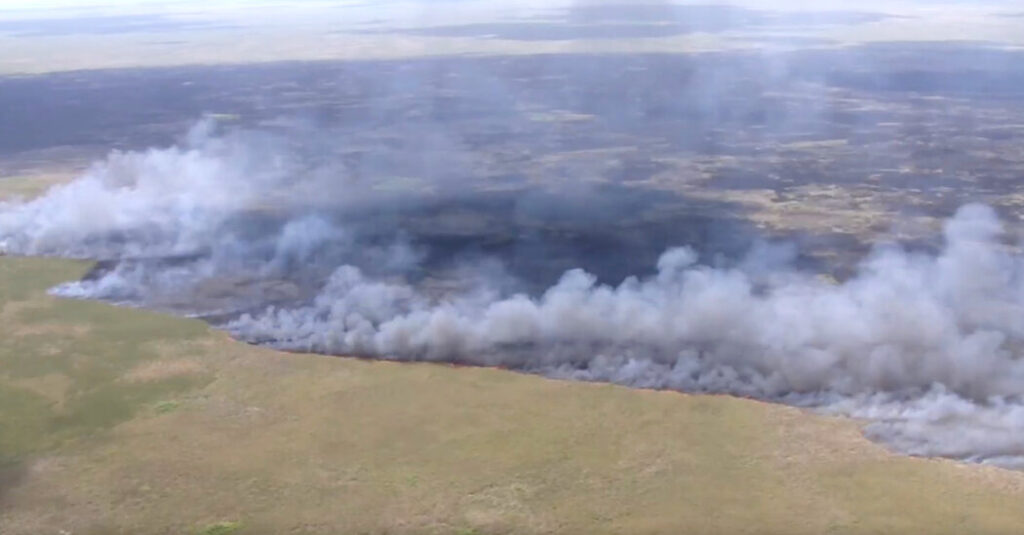
Wildfires raging across the Southeastern United States have destroyed dozens of homes and prompted some communities to evacuate, officials said.
In southern Georgia, more than 27,000 acres of wildfires were blazing and evacuations were underway in several communities, according to the Georgia Forestry Association on Wednesday. Much of the state was under a burn ban.
“This is a serious and evolving situation,” said Tim Lowrimore, the forestry association’s president and chief executive.
Smoke spread across the Southeast and led to poor air quality from Atlanta to Jacksonville, Fla., and Columbia, S.C.
The National Weather Service office serving Atlanta reported that the air quality would be unhealthy for some people into at least Thursday and advised that children and people who are sensitive to ozone avoid prolonged outdoor exercise.
Gov. Brian Kemp of Georgia declared a state of emergency on Wednesday.
“With much of Georgia remaining in extreme drought conditions, wildfires have already surpassed the state’s five-year average and continue to spread,” he said.
In a social media post, the governor urged residents “to do your part in preventing the spread of wildfires as response teams work around the clock to contain those currently blazing.”
Joey Cason, the manager of Brantley County in the state’s southeast corner, said wildfires had destroyed nearly 50 homes, according to WJAX-TV.
A drought in the Southeast United States has left the landscape parched and highly flammable. A single spark in the dry vegetation can turn into a rapidly spreading fire, especially with the light winds and low humidity that were prevalent on Wednesday.
“The ground is so dry,” said Tony Cruz, a meteorologist with the National Weather Service office in Jacksonville, Fla. “That’s the biggest factor right now.”
The U.S. Drought Monitor map tracks the intensity of drought by county across the country, and the highest levels used on the map, extreme to exceptional drought, were spread across north Florida and southern Georgia.
In Florida, the drought is the worst since the map was introduced in 2000, according to David Zierden, the Florida state climatologist at Florida State University. The state also had severe drought in 1998, when devastating wildfires broke out. The drought situation in Georgia is also severe.
North Florida and southern Georgia recorded below normal rainfall this winter, and since Oct. 1, the two regions have been experiencing rainfall deficits of 12 to 16 inches, Mr. Zierden said.
Amy Graff is a Times reporter covering weather, wildfires and earthquakes.
The post Wildfires in Georgia Destroy Homes and Set Off Evacuations appeared first on New York Times.