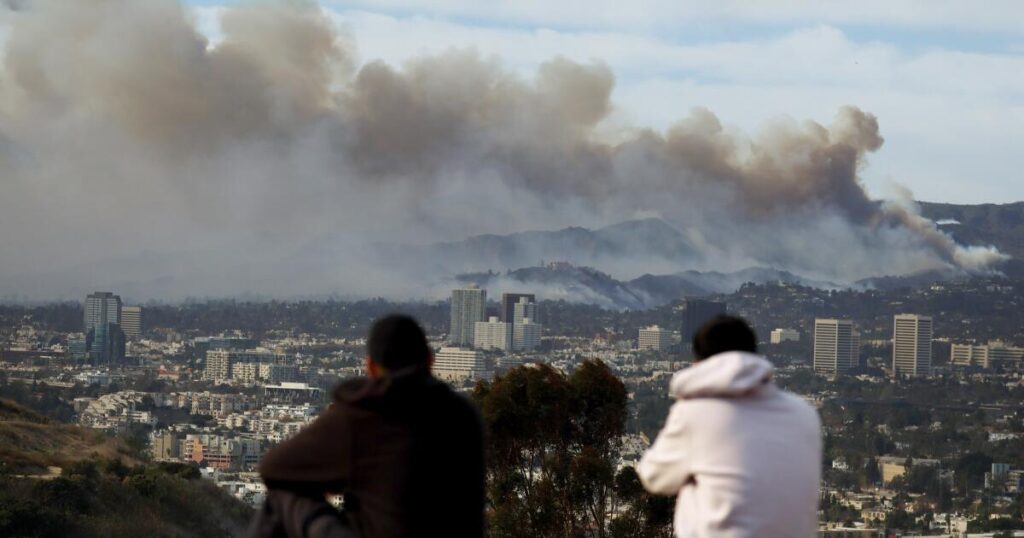
Greater Los Angeles remained the most ozone-polluted metro area in the nation, according to the American Lung Assn.’s 2026 State of the Air report, which found that Southern California continues to face some of the country’s dirtiest air.
The report, released on Wednesday, ranked Los Angeles-Long Beach as the worst U.S. metro area for ozone pollution, with an average of 159.2 unhealthy ozone days a year. The region also ranked seventh worst nationally for annual particle pollution and seventh worst for short-term particle pollution.
The American Lung Assn., or ALA, assigns grades based on the number of unhealthy air days and the severity of pollution levels, using federal air quality standards. Los Angeles County received failing grades across all three categories measured in the report: ozone, short-term particle pollution and annual particle pollution.
Riverside and San Bernardino counties also failed all three measures.
Orange County received an F for ozone, a failing grade for annual particle pollution and a C for short-term particle pollution.
Ground-level ozone, often called “smog,” is a corrosive gas that forms when pollution from vehicles and other sources reacts in heat and sunlight. It can irritate the lungs and trigger serious breathing problems.
Short-term and annual particle pollution refer to fine particulate matter, known as PM2.5. These microscopic particles come from sources such as vehicle exhaust, industrial emissions and wildfires. Because they are small enough to enter the bloodstream, they are linked to asthma attacks, heart disease, strokes and lung cancer, according to Will Barrett, assistant vice president for Nationwide Clean Air Policy at the ALA.
The report did find some signs of progress. Los Angeles posted its lowest annual particle pollution level in the history of the report, even though the region still ranked among the nation’s worst overall.
On the other hand, ozone pollution in Los Angeles worsened from last year’s report, keeping the metro area in the top spot nationally for smog. The report says Los Angeles has ranked worst for ozone in 26 of the 27 years the ALA has issued the study.
Speaking to the press Tuesday, Barrett said the region’s pollution comes largely from transportation sources “primarily burning gasoline and diesel,” along with refineries and other local emissions sources. He said those pressures are compounded by climate and coastal conditions that push pollution inland, especially into the Inland Empire, where unhealthy ozone days are even more severe.
Nationally, the report found that in the U.S., 152.3 million people, or 44% of the population, live in places that received a failing grade for at least one measure of ozone or particle pollution. That includes 33.5 million children, or 46% of people under 18. In California, the ALA said 82% of residents live in counties affected by unhealthy air.
Of the 15 U.S. counties with the most bad smog days last year, eight were in California.
When it came to bad PM2.5 pollution days, California had seven of the 15 worst counties.
And of the 15 counties with the worst year-round PM2.5 pollution, nine were in California.
In the report, the ALA said recent federal actions could undermine California’s efforts to improve air quality. Those include missed deadlines for stronger particle pollution standards, rollbacks of clean-vehicle and fuel-economy rules, exemptions from toxic air pollution regulations, and a Congressional Review Act challenge targeting three of California’s clean-vehicle standards.
“This [Environmental Protection Agency] is making significant rollbacks to life-saving clean air rules,” Diana Van Vleet, the report’s lead author and the ALA’s director of nationwide clean air advocacy, said during Tuesday’s press call. “Federal actions have weakened, delayed and repealed many pollution limits.”
She referenced the EPA’s February revocation of a longstanding scientific conclusion that man-made climate change threatens the health of Americans.
“The recent actions by the federal government to interfere with California’s state rights to protect residents’ health are a major challenge to the ongoing success of our local air districts and state Air Board,” said Barrett. He added that state estimates show federal actions weakening California’s clean-air authority could lead to more than 14,000 deaths, thousands of emergency room visits and hospitalizations, and $145 billion in cumulative health impacts through 2050.
Children are especially vulnerable to polluted air because their lungs are still developing, they breathe more air relative to their body size, and they often spend more time outdoors, the report said.
“In my daily work life, I treat children with asthma that is often made worse because of the heavy doses of pollution they breathe,” said Afif El-Hasan, physician-in-charge at Kaiser Permanente San Juan Capistrano Medical Offices.
El-Hasan added that air pollution “also inhibits lung development in children, which can lead to reduced lung capacity as adults. This is not reversible. Once it happens, it’s done.”
Southern California’s air pollution burden has long been shaped by a mix of traffic, freight movement, industry, geography and climate.
The county rankings show the concentration of that burden. San Bernardino County ranked as the most ozone-polluted county in the nation, with 159.2 weighted average unhealthy ozone days, followed by Riverside County at 126.7 and Los Angeles County at 119.0.
The report also highlighted cleaner-air successes elsewhere in California. Sacramento recorded its lowest annual particle pollution levels and fewest unhealthy ozone days in the report’s history.
Four California cities also ranked among the nation’s cleanest in at least one category: Salinas and Chico for having zero high-ozone days, and Santa Barbara and San Luis Obispo for recording zero days of unhealthy particle pollution.
The ALA urged state lawmakers to keep funding programs aimed at cutting emissions from the biggest sources. “The Lung Association is calling for the California Legislature to invest in zero-emission truck programs,” Barrett said, as well as for funding for cleaner agricultural equipment and consumer cars.
The health and environmental arguments for these political positions have been argued to death, but Barrett says that the economic consequences of dirty air are often overlooked. “What is often missing is this impact of the cost of air pollution on family budgets, on kids missing school, their parents staying home from work, on and on and on,” he said. “Air pollution is a costly societal problem that needs to be addressed.”
The post 44% of Americans breathe dangerously polluted air. In California, it’s 82% appeared first on Los Angeles Times.