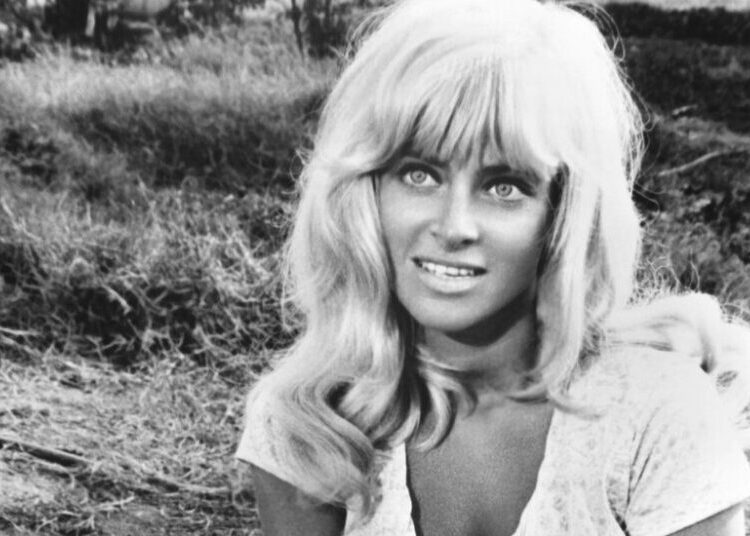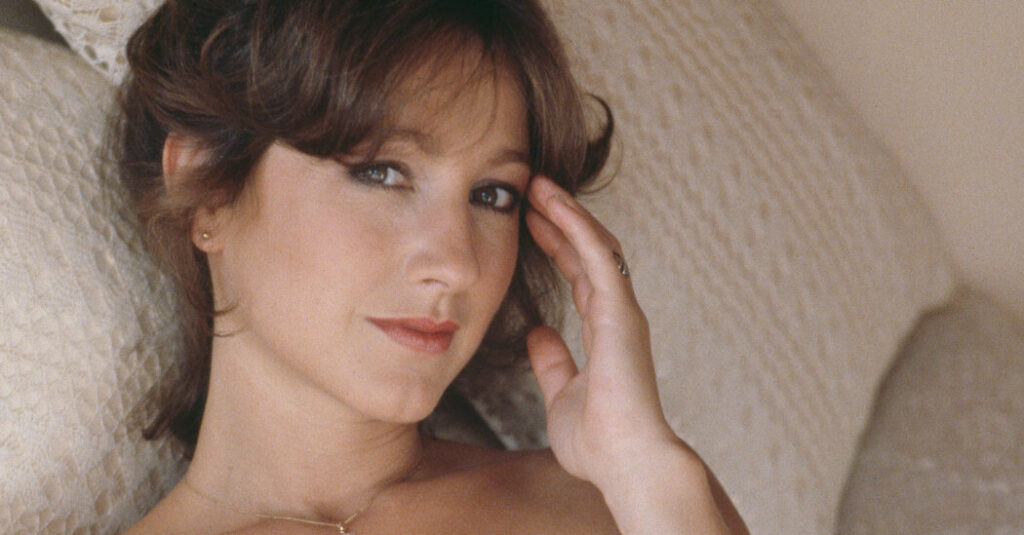
Nathalie Baye, an actress who was admired for her naturalness and versatility and who became one of the most familiar faces in French cinema over four decades, died on Friday at her home in Paris. She was 77.
Her death, from Lewy body dementia, was announced by President Emmanuel Macron of France, who saluted the “singular path she took in our French cinema — by the side of great directors, never abandoning a popular touch.”
In about 100 films and television shows, Ms. Baye (pronounced BUY-eh) explored a wide range of characters, often to critical acclaim and box-office success in France. Year after year, sometimes several times in the same year, she established a near-omnipresence in French movie theaters.
She proved adept at portraying bourgeois or working-class characters who were sensual or cold, reflective or excitable. She played a streetwise and sarcastic prostitute in the police thriller “La Balance” (1982), an implacable, unflappable 16th-century peasant opposite Gérard Depardieu in the drama “The Return of Martin Guerre” (1982), and a disillusioned beauty salon attendant in the romantic comedy “Venus Beauty Institute” (1999).
Her ease on the set made Ms. Baye a favorite of the best-known French directors of her generation and the one before, including François Truffaut, who cast her as a bespectacled, serious-minded script girl in her breakthrough film, “Day for Night” (1973); Jean-Luc Godard, in whose 1980 film “Every Man for Himself” she won her first César, the French equivalent of an Academy Award; and Claude Chabrol, for whom she played a bourgeois Bordeaux politician in the psychological thriller “The Flower of Evil” (2003).
Ms. Baye trained as a ballet dancer, and directors admired her lithe, natural movement in front of the camera.
“It’s a pleasure to film her, walking in an apartment, burrowing into an armchair, stretching out on a bed,” Bertrand Tavernier, who directed her in “A Week’s Vacation” (1980), once said of Ms. Baye. “You get the impression that she choreographs her movements according to her state of mind.”
She won four Césars, including two for best supporting actress: in the 1980 Godard film, where she played the estranged girlfriend of a neurotic filmmaker, and in Pierre Granier-Deferre’s “Strange Affair” (1981), where she was the sharp-eyed wife of a department store executive.
She also won for best actress in “La Balance” (“Miss Baye seems to be enjoying herself immensely,” Janet Maslin wrote in The New York Times) and in Xavier Beauvois’s “The Young Lieutenant” (2005). In that film, she portrayed the hard-luck head of a Paris police detective squad, her characteristic rapid-fire delivery and understatement guiding the action.
“Nathalie Baye has established a way of existing on the screen which owes more to her ‘nature’ than to her technical skills,” the critic Jean-Michel Frodon wrote in a 1999 appraisal in Le Monde, headlined “The Seductions of an Anti-Star.”
Ms. Baye, he added, had always been, “with her charm and energy, a young woman close to us, who could have been the neighbor next door.”
Her nuanced approach is on display in “Strange Affair.” In a dinner party scene with her husband’s overly attentive new boss, a department store manager played by Michel Piccoli, the camera catches her glance, a gesture with her hands, a slight smile — all of them enough, the viewer soon realizes, to keep the boss at bay.
Like Mr. Depardieu and Alain Delon, with whom she partnered in “Our Story” (1984) under the direction of Bertrand Blier, Ms. Baye was the rare French star to catch the attention of Hollywood. She had a supporting role in Steven Spielberg’s “Catch Me if You Can” (2002) as the French mother of the con man Frank Abagnale Jr. (played by Leonardo DiCaprio).
In America, critics saluted Ms. Baye’s subtlety, even if they sometimes found her trapped in films that didn’t deserve her.
“Ms. Baye is a sensitive actress, and it is impossible not to be drawn to any character she plays,” A.O. Scott wrote in The Times in 2000, reviewing “Venus Beauty Institute.” But the film “takes unfair advantage of her gift for generating sympathy,” Mr. Scott continued, finding her relationship to the principal male character in the film not “especially believable.”
Nathalie Marie Andrée Baye was born on July 6, 1948, in Mainneville, in Normandy, one of two children of Claude Baye and Denise Coustet.
Her parents were unsuccessful painters who lived the life of bohemians — her father managed a camp ground, among other odd jobs, to make ends meet — and there was never enough money in the household, Ms. Baye told interviewers. “They were humorous, but they were in pain,” she once said, noting that in subsequent years they were chary of paying her compliments.
Ms. Baye grew up in Montparnasse, the Left Bank neighborhood of Paris; briefly attended the prestigious École Alsacienne; left Paris, and school, at 14 for dance lessons in Monaco; worked as an au pair in New York at 17; and studied dance on the side.
On returning to Paris, she attended the famous Cours Simon drama school before enrolling in the Conservatoire National Supérieur d’Art Dramatique, the French national drama school from which she graduated in 1972 with the second prize for acting.
The following year, Mr. Truffaut found her in an audition and cast her in “Day for Night.” “I discovered this line of work a little bit by chance,” Ms. Baye told a television interviewer in 2021.
In the 1980s, she was a staple in French gossip and celebrity magazines, particularly after she and the pop singer Johnny Halliday began living together. They co-starred in the 1985 film “Detective,” directed by Mr. Godard, before breaking up the next year.
She is survived by their daughter, the actress Laura Smet; a brother, Louis; and a grandson.
Ms. Baye told interviewers that directors could count on her not to complain during film shoots, and she often commented on what she considered her good fortune to have a calling to which she felt devoted.
“It’s the profession that came to me,” she said in the 2021 television interview. “What a great piece of chance it is, to do work that one loves. So many don’t.”
Adam Nossiter has been bureau chief in Kabul, Paris, West Africa and New Orleans and is now a writer on the Obituaries desk.
The post Nathalie Baye, Versatile and Admired French Actress, Dies at 77 appeared first on New York Times.