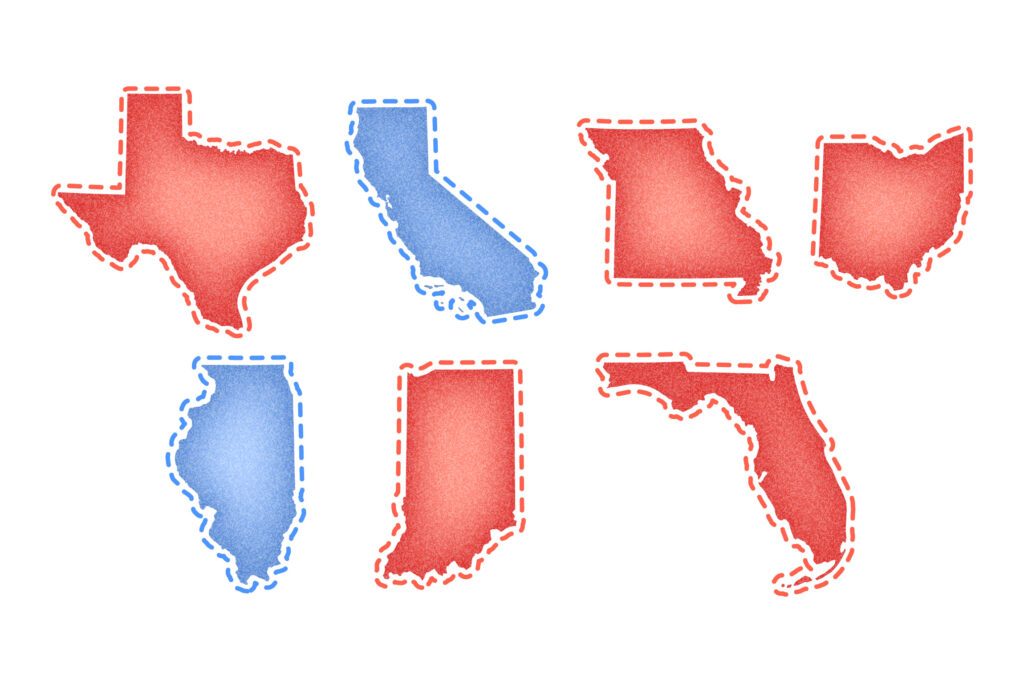
The redistricting arms race sparked by President Donald Trump’s push to draw new congressional lines in Texas has both parties scrambling to rethink the political map.
Republicans in four states — Missouri, North Carolina, Ohio and Texas — have adopted maps more favorable to their party since last summer. Democrats have responded by drawing a friendlier map for themselves in California and Virginia.
In Indiana, GOP state senators rejected Trump’s push to redraw the state’s congressional map after months of pressure. Republicans in Florida are considering adopting new districts.
A judge approved a new map for Utah that is likely to give Democrats a seat there, and courts are considering challenges elsewhere. In January, a panel of federal judges allowed California’s new map to stand, giving Democrats a victory.
The Supreme Court weighed in on one of the biggest prizes — Texas — in December, clearing the way for the map to take effect after a three-judge panel previously ruled against it. The high court ruling was a victory for Trump and his party.
Implementing new maps is easier said than done. Many states are bound by laws that dictate when and how redistricting can happen. States typically draw new district lines once a decade, after each census, or if a map is struck down in court. There is also a tight timeline to get changes into place before the midterm elections this fall.
Republicans hold a 217-213 House majority, with four vacancies and one independent, and any change to the congressional map could determine which party controls the chamber next term.
Here’s a look at some of the targets and the steps involved to change political boundaries in these states — and whether the districts leaned toward Trump or Democratic nominee Kamala Harris in the 2024 presidential election.
Texas
The redistricting battle began with Texas, where Trump pressed Gov. Greg Abbott (R) to draw congressional boundaries with more safely red seats. Republicans complied and approved a map that could give them up to five more seats. Voting rights groups sued, and a three-judge panel struck down the new map as a racial gerrymander. The Supreme Court ruling ensured the new map will take effect.
Republicans control 25 of Texas’s 38 House seats. The new map is more partisan and includes 30 districts that recorded double-digit vote margins for Trump in the 2024 presidential election. Two Democratic House members from Texas — Rep. Henry Cuellar in the 28th District and Rep. Vicente Gonzalez in the 34th — represent districts that split the ticket and favored Trump in 2024. Both districts have been redrawn to shift further to the right.
California
California was the second state to jump into the redistricting battle. In response to the potential Republican pickups in Texas, Gov. Gavin Newsom (D) and state Democrats proposed a new map that would potentially turn five House seats blue, evening the score with the actions in Texas.
Approving new federal and state district maps wasn’t as easy as in Texas. California normally uses an independent commission to draw congressional and state legislative districts, which was put in place to make map-drawing less political. Lawmakers sought permission to sidestep the commission to adopt a new map, and voters signed off on the idea in November.
The map California used in the 2024 elections was already deeply blue, with Democrats holding all but nine of the state’s 52 House seats. But many of the districts were considered competitive. In 2024, the presidential vote margin in 15 congressional districts was 10 points or less. The new map shifted most of the state’s competitive districts toward the left.
North Carolina
Republican state lawmakers in October approved a new map that will probably give them another district. Already, Republicans hold 10 of the state’s 14 districts.
Republicans control both houses of the legislature, and they quickly approved the new map. North Carolina’s constitution does not give the governor the power to veto redistricting plans, so Gov. Josh Stein (D) was unable to block the map.
A group of voters sued, but, in a November decision, a panel of three federal judges allowed the new map to be used.
Missouri
Missouri Gov. Mike Kehoe (R) called a September special legislative session to push through a mid-decade congressional redistricting plan, dubbed the “Missouri First Map.”
The plan cleared both chambers and was signed by Kehoe. The new map would squeeze an additional red seat by carving up the 5th District, held by Rep. Emanuel Cleaver II (D). This solid-blue district, which includes Kansas City, heavily favored Harris in 2024.
Dividing Kansas City for a new GOP seat leaves only one solid-blue district in Missouri — the 1st District around St. Louis. That is a majority-minority district and protected by the Voting Rights Act.
Utah
A judge in November ordered a new map for Utah that will probably give Democrats one of the state’s four congressional districts. Her ruling came after an earlier decision found the state’s map violated the Utah Constitution by improperly splitting Salt Lake County.
Ohio
Ohio’s bipartisan redistricting commission approved a new map in October, giving Republicans better odds of winning two more House seats.
With bipartisan approval in the commission, the map does not need approval from the Republican-held state legislature. The state was required to create a new congressional map ahead of the 2026 midterms after the state Supreme Court struck down the map drawn after the 2020 Census. In 2022, the Ohio Redistricting Commission adopted a map that could be used only until 2026.
Republicans control 10 of the 15 seats in Ohio and will have better odds in two districts under the new compromise map. The 1st District, represented by Rep. Greg Landsman (D), will slightly favor Republicans. The 9th District, represented by Rep. Marcy Kaptur (D), will have a larger Republican advantage than it already does. The 13th District, represented by Rep. Emilia Strong Sykes (D), will lean slightly Democratic.
Indiana
Republicans in Indiana’s state House in December approved a new map, but their GOP counterparts in the state Senate rejected it a week later. It marked the biggest rebuke yet from members of Trump’s own party to his redistricting effort.
The map Republicans proposed would have allowed them to win all nine of the state’s congressional districts. Currently, they hold seven of them.
The now-rejected map was aimed at wiping out the electoral prospects of Rep. Frank J. Mrvan (D), whose district includes the edges of suburban Chicago, and Rep. André Carson (D), who represents Indianapolis and is the only Black member of the state’s congressional delegation.
Maryland
Maryland Gov. Wes Moore (D) and some Democratic state lawmakers pushed for a new map that would be likely to give them all of the state’s congressional districts. Democrats already hold seven of the state’s eight seats, and a new map would give them a shot at laying claim to the one held by Rep. Andy Harris (R), the chairman of the House Freedom Caucus.
An advisory commission recommended a new map in January, but its proposal split Democrats who control the state legislature. Maryland state Senate President Bill Ferguson (D), long an opponent of redistricting in the middle of the decade, halted action on the map.
New York
In January, a New York judge invalidated the district held by Rep. Nicole Malliotakis (R), finding that its makeup violates a provision of the state constitution that protects the voting rights of racial minorities. The Supreme Court in March blocked the decision, which probably would have given Democrats a good chance of winning the seat. The district includes Staten Island and parts of Brooklyn.
Illinois
Illinois jumped into the redistricting story when Gov. JB Pritzker (D) invited Texas Democratic lawmakers in August to stay in suburban Chicago when they fled their state to stall the Republican redistricting efforts.
Pritzker has been vocal about the redistricting battle nationally, and Democrats who dominate the state legislature have full control of the map-drawing process.
But lawmakers have not taken significant steps to draw new districts, and the impact of any map changes would be limited. Democrats hold 14 out of the state’s 17 House seats, and the map is already carved largely in their favor.
Florida
Florida’s congressional map has shifted in favor of Republicans in recent years. The GOP picked up four seats after Gov. Ron DeSantis (R) pushed state lawmakers to redraw the map in 2022.
DeSantis has called a special session for April 28 to consider new districts.
The state constitution has a “Fair Districts” amendment that says districts cannot be drawn to favor any one political party, and any changes to the map could be challenged in court. Five congressional districts had 2024 presidential vote margins within 10 points, and all of those seats are held by Democrats.
Virginia
Democrats who control the state legislature asked voters in January for permission to redraw the state’s congressional map in their favor. Voters in April signed off on a map that could give Democrats as many as 10 of the state’s 11 districts. Currently, they have six.
Maeve Reston, Molly Hennessy-Fiske, Yvonne Wingett Sanchez and Erin Cox contributed to this report. Data analysis by Lenny Bronner and Clara Ence Morse. Presidential results for the proposed new districts are from a Washington Post analysis of 2024 precinct election results and data from Redistricting Partners.
correctionAn earlier version of this article misspelled the last name of the U.S. representative for Texas’s 28th Congressional District. It is Henry Cuellar, not Cueller.
The post Mapping where the redistricting fight stands and where it’s headed appeared first on Washington Post.