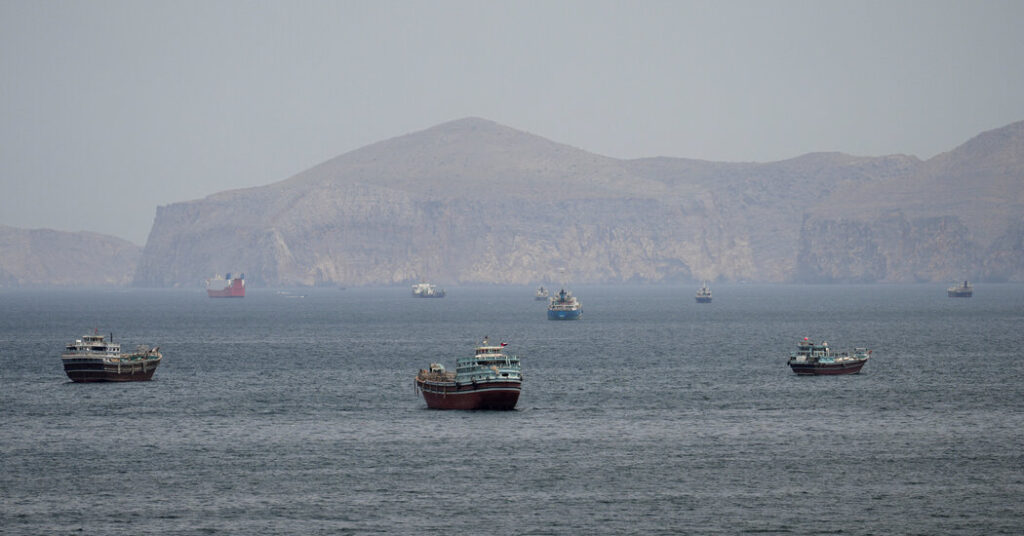
Iran’s Islamic Revolutionary Guards Corps said that its naval forces had seized two cargo ships near the Strait of Hormuz on Wednesday, the Iranian news media reported, as Tehran sought to exert control over the strategic waterway.
Hours after President Trump extended a cease-fire with Iran, the Revolutionary Guards’ Navy said that two vessels, the MSC Francesca and the Epaminondas, had tried to navigate through the contested strait “without the necessary permits,” according to a statement shared by the semiofficial Tasnim news agency. The statement said that the ships were being directed toward Iran’s coast, adding: “Disrupting the order and security of the Strait of Hormuz is our red line.”
Earlier on Wednesday, United Kingdom Maritime Trade Operations, a British Navy agency, said that two cargo vessels had come under attack in the area of the strait. One of them, a container ship sailing off the coast of Oman, was said to have been struck by a gunboat belonging to the Guards. The ship’s captain said that the gunboat gave no radio warning before firing on it, according to the agency, which said that no crew members were hurt but that the ship’s bridge had been heavily damaged.
The British agency said that a second unnamed outbound cargo ship had come under fire eight nautical miles off the coast of Iran. The captain of that vessel said the crew were unharmed, according to the agency, which did not name either vessel.
MSC, the global shipping company that owns the Francesca, did not immediately respond to requests for comment. The vessel was flying a Panamanian flag and bound for Sri Lanka.
The seizures showed how the Strait of Hormuz remains heavily contested by both the United States and Iran even after Mr. Trump renewed a cease-fire just before it had been set to expire.
In announcing the extension of the truce, Mr. Trump said that a U.S. naval blockade on Iranian ports would remain in place, which Iranian officials have described as a violation of the truce. The U.S. Navy has turned back more than two dozen ships trying to enter or leave Iranian ports since it began the blockade more than a week ago, according to the U.S. military’s Central Command.
The Strait of Hormuz, normally a conduit for one-fifth of global oil and a significant share of gas supplies, remains a high-risk area, maritime security officials said, while the future of U.S.-Iran negotiations remains unclear. Since March 1, the day after the U.S.-Israeli strikes on Iran began, the British Navy’s maritime trade agency has recorded 34 security incidents in the strait and the surrounding waters of the Persian Gulf and the Gulf of Oman.
Multiple ships have been struck by unknown projectiles, causing hull damage or fires on board. Iran’s Revolutionary Guards have also threatened vessels, the agency said.
“The operating environment remains high-risk,” the agency said in a report on Tuesday. “The cease-fire remains fragile, and blockade-related enforcement activity continues.”
European leaders were meeting on Wednesday in London to discuss how to reopen the critical shipping route. Britain and France were set to host military planners from more than 30 countries to “advance military plans to reopen the strait, as soon as conditions permit, following a sustainable cease-fire agreement,” according to a statement from Britain’s defense minister.
The meeting builds on an earlier gathering of officials from more than 50 countries to condemn the closure of the strait, and to call for a diplomatic solution.
Leo Sands contributed reporting.
Lynsey Chutel is a Times reporter based in London who covers breaking news in Africa, the Middle East and Europe.
The post Danger Escalates in Strait of Hormuz as Iran Says It Seized 2 Cargo Ships appeared first on New York Times.