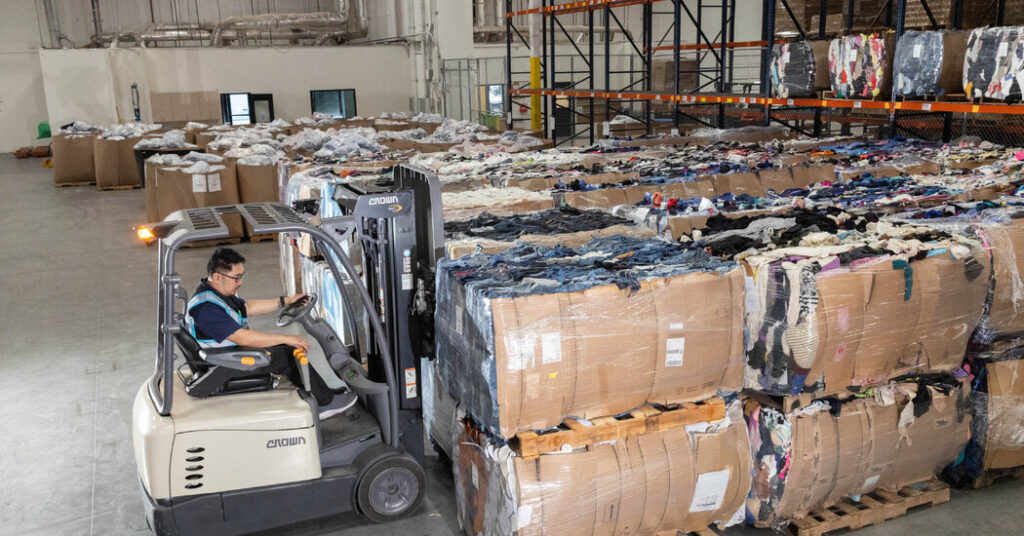
It’s springtime and a lot of us are refreshing our wardrobes, retiring old clothes and picking up new ones for the warmer weather. But can we get rid of the used stuff responsibly?
While it’s possible, it’s not as easy as a growing number of companies would have you believe. Just drop the used clothes into a collection bin or a prepaid mailer, they say, and they’ll recycle your textiles, keeping them out of landfills.
It’s an admirable goal, but those companies talk more about collecting clothes than about where they end up. Often, that’s because they have little or no idea. And that raises major concerns. Chief among them: When a company doesn’t track the full journey of a garment, it has no way to know where the item really ends up.
“Don’t just tell me you diverted tons of clothing from a landfill,” Susan Keefe, director for Southern California of the nonprofit advocacy group Beyond Plastics, said. “Tell me: Where did it go?”
Here’s what to know about the clothing collection business.
Recycling usually isn’t true recycling
The first thing to keep in mind is that most garments sent for recycling don’t become new clothing. They’re downcycled into things like insulation or mattress filling.
Truly recycling old clothes into new ones is technologically possible, but the fashion industry has been slow to build the systems necessary to do it.
Until that changes, the best that collection companies can do is downcycle clothes that are in poor shape and channel those in good shape to thrift shops or international markets. Those are good options, but they shouldn’t be the only options.
That’s because the world already has too much clothing. Exporting things to secondhand markets overseas may sound better than sending them to a U.S. landfill, but sometimes they just end up in someone else’s landfill overseas. Or worse, polluting beaches and deserts.
There’s a tracking problem
One of the most-recognized collection companies, Trashie, says it directs old garments to their “highest and best use.” The for-profit company invites people to pay $20 for a bag to fill with clothes. When they return the bag by mail, customers earn TrashieCash that can be used for purchases with the company’s partners.
Trashie assesses every item for “rewearability,” according to its founder and chief executive, Kristy Caylor. Last year, she said, products were sorted into 613 grades for reuse or recycling.
However, sorting clothing into different streams doesn’t necessarily mean it has somewhere to go.
Most of what Trashie processes is sent for resale abroad, but the company doesn’t track what happens to it all. It can’t, nor can any other company exporting used clothes.
“No system offers individual-garment level traceability once the garments enter the downstream retail market,” Ms. Caylor said. “This would require garment-level tagging and some type of tracking device, which is unrealistic.”
Two other for-profit collection companies, Retold and Ridwell, say they prioritize keeping clothes in the United States. But that, too, is hard to ensure.
They use thrift store networks when clothes are in good condition, and recycling partners for the rest. Until the middle of last year, Ridwell sent its clothing to charities, including Goodwill, but wanted more visibility into where lower-quality options ended up. That turned out to be a difficult task, Gerrine Pan, the company’s vice president of partnerships, said. “Clothing is, above and beyond, the hardest hard-to-recycle thing we work with,” she said.
One of Ridwell’s new partners, Phoenix Fibers, processes old clothes into shredded fibers for use in insulation for cars and appliances. That’s a great way to repurpose old clothes, but it underscores the reality that true recycling is not an option.
In the Northeast, a company called Helpsy says its mission is to keep clothing out of the trash. In 2024, it reported more than 32 million pounds of items gathered via collection bins, including in partnership with the New York City Department of Sanitation.
It’s a Certified B Corporation, which means it’s required to meet certain social, environmental and governance standards. The company that oversees the B Corp system so far hasn’t examined what ultimately happens to Helpsy’s clothes, however, and much of what Helpsy collects is sent for resale in lower-income countries. While that increases the number of times that many garments are worn, it also involves the same risk that others companies face: that the textiles ultimately become someone else’s problem to dispose of.
That’s not Helpsy’s focus, said Dan Green, a co-founder and chief executive of the company.
“Helpsy is less concerned with where clothes become waste than we are in how much value can be created before they become waste and how we can prevent more clothes from being created in the first place,” Mr. Green said in an email.
There’s a long list of other companies that operate pickup services or drop-off bins in semipublic spaces like schools and church parking lots and that make various claims about how donating clothes will help the environment or people in need. They generally don’t share much detail about where they send clothes and their business models tend to rely on exporting used clothing to markets overseas.
What can you do?
The problem with these models, said Liz Ricketts, co-founder of the Or Foundation, a nonprofit group based in Ghana, is how much they try to simplify the problem of clothing waste and how they can inadvertently make people feel OK about buying more than they need.
“It’s trying to make it frictionless to ‘recycle’ your clothes. That simplicity doesn’t match with reality at all,” Ms. Ricketts said, adding, “It gives license to thoughtlessly overconsume.”
The argument in favor of these companies is that they can, theoretically, build a business model that places value on textile waste. And that could eventually support the development of other systems needed for proper clothing waste management, like repair and true recycling.
A start-up called Supercircle is trying to make that case.
The company accepts used clothing from customers of brands like J. Crew and Reformation and currently does a lot of downcycling. But it’s also stockpiling large quantities of textiles that Chloe Songer, one of the company’s founders, said will enable Supercircle to provide textile recyclers with feedstock to run their equipment when recyclers are ready for it.
For now, though, customers have to make decisions based on reality today. Ms. Keefe of Beyond Plastics suggested identifying specific needs locally. For example, find shelters that can use the specific things, whether baby clothes or winter hats, that you’re trying to get rid of. Or, identify arts and crafts programs that can use materials like fabric scraps.
“There’s all kinds of ways you can donate your used clothing instead of paying someone else to truck it around for you,” she said.
The key is to do some research. Yes, it takes more time and effort. That’s why collection services have such strong appeal, she said. They make it easy to feel like you’re doing the right thing.
“The thing that bugs me the most is, it appeals to people who are environmentally conscious, like myself,” Ms. Keefe said. “But it doesn’t solve the problem.”
The most important thing, experts and environmental activists say, is to buy less in the first place. It’s easier to deal with clothes responsibly if there are fewer of them to begin with.
The post You Paid to Have Old Clothes Recycled. Here’s What That Really Means. appeared first on New York Times.