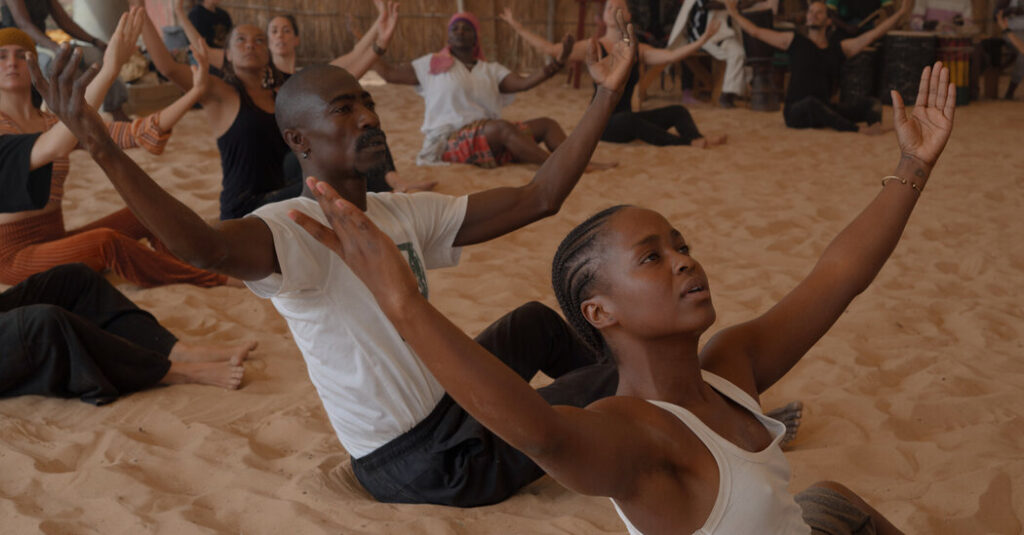
The main studio of the École des Sables, a school near Dakar, Senegal, defies every convention of what a professional dance space should be. It has no sprung floor, no mirrored walls. Actually, there are no walls at all.
The dancers work outdoors, under a large, tented canopy, which provides shade from the sun without enclosing the space. The surrounding trees, housing very vocal birds, are close enough to touch.
And the floor is unusually treacherous: It’s sand. Recalling her first time at the École des Sables, Florette Gateka, a dancer from Burundi, said that finding her footing on the uneven, shifting surface was “such a struggle — oh my god.”
Yet the singular atmosphere soon won her over, Gateka said. She was one of two dozen dancers training for a teaching certification at the École des Sables in early March. The sand studio was part of the nature-oriented vision of Germaine Acogny, 81, the school’s commanding founder. One morning, the group joined her in front of the studio to “channel the energy” from the landscape. Perched on rocks, they took deep breaths.
“Here, everything is alive,” Gateka said.
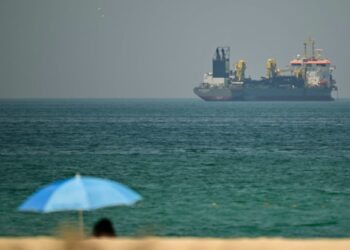
Yet in the background was a less than idyllic hum. Not far along the Atlantic coastline, trucks zoomed back and forth on a construction site — the future home of a deepwater commercial port, overseen by Dubai Port World, which threatens the cultural ecosystem around the school.
Acogny, often called the mother of African contemporary dance, founded the École des Sables in 1998 in the fishing village of Toubab Dialao, about an hour’s drive from Dakar. Over the years, it has established itself as the highest-profile dance training hub in Africa. While it has no permanently enrolled students, it holds regular intensive courses. In addition to learning Acogny’s contemporary technique, which incorporates elements from a range of Western African dances, dancers can study traditional styles or Black modern dance, like the Katherine Dunham and Umfundalai techniques.
In recent years, the school’s achievements have reached the international stage, notably with the first African production of Pina Bausch’s “The Rite of Spring” (1975), which toured globally from 2021 to 2025 (including a stop at the Park Avenue Armory in New York). The school is also a vital platform for choreographers across the region: Later this month, it will host the African Dance Biennial, bringing 25 companies to Toubab Dialao.
At first, the goal of the school was to fill a gap, Acogny said in an interview at her home, a short walk from the sand studio. While African dance artists have become increasingly visible in contemporary dance internationally, there are very few high-level training programs or facilities on the continent, forcing many to travel to Europe or North America to hone their professional skills.
“We wanted to show that dance training in Africa can also reach excellence,” Acogny said. “And I think we’ve managed that.”
Yet the École des Sables has long struggled for stability. In the absence of steady state funding, money is a persistent concern. And the construction of the port has brought new challenges. The school is set to lose surrounding land to expropriation, land that it had acquired to protect its natural ecosystem. Together with other at-risk local arts institutions, it has tried to fight back.
After the dancers took in their peaceful surroundings that March morning, Acogny directed them to turn toward the construction site, and putting her palms forward, told them: “Send your energy to stop the port.”
BEFORE THE ÉCOLE DES SABLES, Acogny had long sought a dance space to call home. After spending her early years between France and Senegal, where her father was a high-ranking civil servant, she opened her first studio in Dakar at just 24. Then, in 1977, Léopold Sedar Senghor, the first president of Senegal, picked her to lead a pioneering program: Mudra Afrique, a satellite of Mudra, the then-popular Brussels school of the ballet choreographer Maurice Béjart.
As a young woman at the helm, Acogny didn’t have an easy time. “I was also divorced and a mother of two, and dance wasn’t seen as a proper job,” she said. Mudra Afrique was conceived as a Pan-African project, with a number of countries expected to contribute financial support. “But only one, the Republic of Congo, ever did,” Acogny said. The school folded in 1982, when Senghor’s successor withdrew state support.
Acogny’s life partner, Helmut Vogt, met her shortly before Mudra’s end. “She had everything, and then all of a sudden, she had nothing,” Vogt said.
An amateur dancer from Germany, Vogt had had a peripatetic career path before opening a dance studio in Frankfurt with a friend. For Acogny, he started to act as an agent of sorts, booking her gigs around Europe, then helping her to found the École des Sables, where he was managing director until 2020.
“Early on, I asked myself: ‘Am I ready to dedicate myself to serving Germaine and her mission?,’” he said. “My answer to myself was yes.”
Success came slowly. In the late 1980s and early ’90s, the couple invested in several short-lived ventures, including dance intensives in a remote village in southern Senegal, where Acogny had connected with a healer. (“We had to bring 50 mattresses over from Dakar,” Vogt said.) But political unrest in the region made it impossible to continue.
Toubab Dialao came to the rescue. This small fishing village was already an unlikely haven for artists: In the 1970s, the Haitian artist Gérard Chenet, a political exile, had settled in the area and built a hybrid art center, Sobo Badè, which boasts a theater and space for artist residencies, as well as a hotel and restaurant.
“Step by step, my father brought a lot of international artists,” Ibrahima Jacques Chenet, Chenet’s son, said at Sobo Badè. Some stayed and opened other art spaces, earning Toubab Dialao a reputation as a cultural village, Chenet said.
After holding some intensives at Sobo Badè, Acogny and Vogt looked for a space of their own. Acogny sold a small apartment she owned in Paris and Vogt added his savings to secure the grounds of the École des Sables and build the sand studio. Yet developing the school further, and making it financially viable, proved daunting.
“We would hold workshops with dancers from 25 African countries,” Vogt said, “but we had to find ways to cover the costs, because African dancers often don’t have the money to pay for training.”
In the absence of funding from Senegal’s ministry of culture, help has mostly come from European and American foundations, as well as the European Union; the luxury brand Chanel has been a partner for the past two years. Over the years, the school was able to build bungalows to house students and artists on site, as well as a second studio. But the lack of resources directed to culture on the African continent is an issue for artists, Acogny said. (Earlier this week, the budget for the African Dance Biennial, set to open on April 29, was still around $47,000 short, according to Vogt.)
“You have to be strong to avoid a situation where Europeans impose what they want,” she said.
The school has also been forced to hold its ground against the new port in Ndayane, just south of Toubab Dialao, a $1.2 billion project designed to relieve congestion at the port of Dakar. Nearly 450 acres have been designated for expropriation, affecting a number of local arts institutions.
They have set up an association to defend themselves and warn of the environmental threat. There has been no consultation with locals, Chenet said, or attempts to preserve the artistic ecosystem. (In an email statement, a spokesman for Dubai Port World said that “a public consultation process” had been conducted by the Senegalese government, and that affected community members have access to a grievance mechanism and compensation.)
“I don’t feel like we’re being heard,” said Acogny, who used to walk to the laguna every morning. Yet she refuses to let the port “take any energy” out of her, she added. “I believe everyone has their place in life. And mine was here.”
While Acogny still choreographs — most recently, a tribute to Josephine Baker, “Joséphine” — her work as a dancer and teacher has often overshadowed her stage creations. The success of the École des Sables, especially, has brought her international recognition late in life, with distinctions including the Golden Lion at the 2021 Venice Dance Biennale.
“I stayed calm and carried on,” she said. “I’d rather be recognized in the fall of my life than at the beginning, because perhaps I would have been forgotten by now.”
At the École des Sables, she no longer leads as many training sessions as she used to, but the next generation is ready to take over. In a class in March, Kodro Evry Aoussou-Dettmann, a dancer and choreographer from the Ivory Coast, taught the Acogny technique as its founder sat ramrod straight behind her, occasionally getting up to correct steps or reaffirm their intention.
Aoussou-Dettmann said Maman Germaine, as many call her, had a profound effect on her life when she first came to the École des Sables, in 2010. “As an African woman, there is still a lot of pressure from your family to marry,” she said. “I didn’t feel like I always had a voice. The École des Sables gave me confidence to find a way.”
She described the Acogny technique and its connection to nature as “a religion.” Many of its steps bear the names of animals or plants. The plexus is the sun; the spine, the “tree of life.” (“When I was a little girl,” Acogny said, “people thought I was crazy because I imagined the trees dancing.”)
All classes are conducted to the invigorating sound of live sabar drums, and pleasure, too, is important. “Listen to your body, don’t frustrate it,” Aoussou-Dettmann told a sweating group of dancers. They attempted a modified version of a balletic grand plié, undulating their spines while balancing close to the ground. “Do you feel that slight wind on your skin?”
At the end of class, Aoussou-Dettmann gestured respectfully to Acogny: “Thank you to Maman.”
“I hope you’re happy,” Acogny told the group. “Either way, I call the shots.” As they laughed and clapped, she added, her voice turning softer: “But I think you’re happy.”
The post In Senegal, a Dance School Where ‘Everything Is Alive’ appeared first on New York Times.