Say you’re a big museum with globalist ambitions in a large-spending, star-obsessed town. Also say that, after approaching a half-century mark and achieving significant strengths, you still have an off-balance collection, one with significant gaps. What do you do?
On the principle that design is destiny, you focus on packaging. You commission a drop-dead new building, purpose-built to draw attention away from competitive “masterpiece”-waving.
And you make the building magnetic enough to attract not only more news spots and foot traffic, but also the eyes of a new generation of patron-collectors eager to have their art, names and cash attached to a suddenly sexy institution.
This is what the Los Angeles County Museum of Art here may be betting on with its just-opened David Geffen Galleries, a new permanent-collection building designed by the Pritzker Prize-winning Swiss architect Peter Zumthor, and advertised by the museum as a stand-alone work of art in itself, a 110,000-square-foot piece of habitable sculpture.
As an architectural — OK, sculptural — experience, it really is pretty stunning. As a space to show art, at least as used in this debut display, it has problems, potentially remediable. As a symbol of a major cultural institution trying to be equally global and local, and hoping to erase any qualitative difference between the two, it’s a developing model to watch.
Conceived as a long horizontal biomorph of glass and concrete raised on piers above street level, the building de-emphasizes structural hierarchies. At one story tall, it has no high or low; all undulating curves, it has no front or back. But it does have layers, one of them transparent.
The whole form is bounded by an interior wraparound corridor, walled with floor-to-ceiling windows offering views of the LACMA campus, the city and the hills beyond. It is filled with light that changes as you circumambulate the route and as day passes into night. Wonderful. (A visitor from New York may be reminded of the panoramic pleasures of Manhattan’s High Line.)
The corridor holds a continuous series of exhibitions, large and small. And at various points it gives access to the building’s inner core, which is tightly packed with dozens of dark, boxy galleries, some quite small, installed with thematic exhibitions drawn from the almost 3,000 works selected — from the museum’s collection of more than 150,000 — for this inaugural display.
What’s really new about the new LACMA, along with the sheer spectacle of the Zumthor design, is this way of representing, in a single labyrinthine sweep, the breadth of the permanent collection — holdings uneven in scope and depth.
Officially established only in 1965, LACMA is a relative newcomer among the largest art museums, and much of what’s on the view in the new building has arrived in the past 20 years.
There are notable, cherishable strengths, particularly in Asian, Islamic and South American art, old and new. It’s spotty in Western European painting, and thin in African and Oceanic material.
It doesn’t come anywhere close to the breadth or depth of the Met, a genuinely encyclopedic museum that gives you, in its introductory Great Hall, acres of Ancient Egypt over here, acres of Ancient Greek and Roman over there, and a continent’s worth of European painting, chronologically sorted out, at the top of the Grand Staircase. (Next month, the Met will also inaugurate fashion in the new Condé M. Nast Galleries for the Costume Institute.)
With its new building LACMA appears to have strategically tweaked its identity from “encyclopedic museum,” defined as a collection of objects from all over the world, identified by chronology, place and culture of origin, to a more elastic “global museum,” with a view of art as a mingling of objects and influences ever on the move.
To visualize this phenomenon, LACMA has mapped out its permanent collection display not by continents, but by oceans — Atlantic, Pacific, Indian Ocean, Mediterranean Sea — which flow and feed into each other.
This idea of flow — embodied in Zumthor’s fluid design — extends to the view of art history it houses. It is succinctly put forth in the wall text at two public entrances that urges visitors not to look for directional signage as they begin their tour but to forge their own routes. (“Let your curiosity be your compass,” the text reads. “Wander” is the title of the guidebook produced for the occasion.)
When London’s Tate Gallery experimented with a nonchronological, multicultural approach to its collection decades ago, people got seriously huffy. Undoubtedly some will here too, though they may find solace in a few old-style, culture-and-era-specific highlights that emerge from the maze.
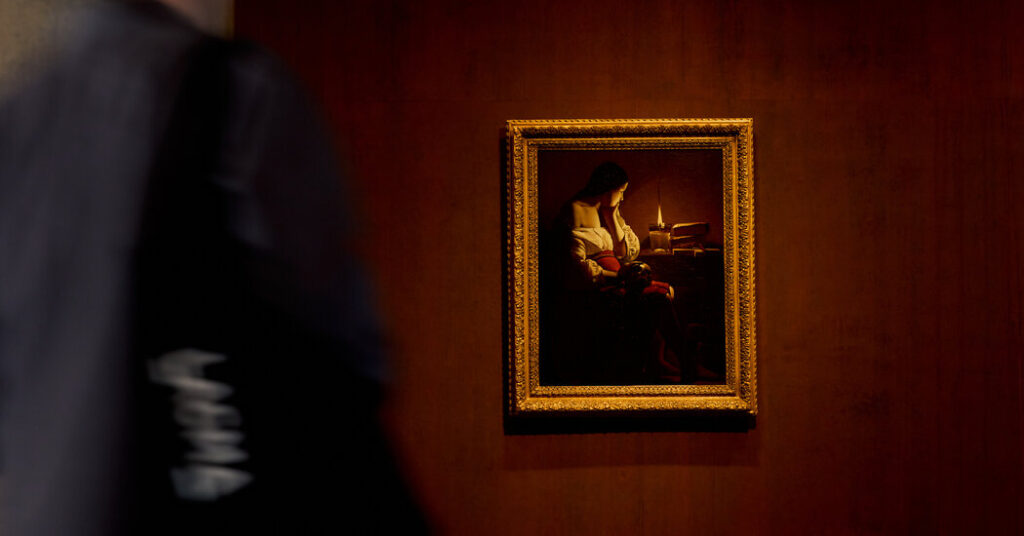
Among them is one called “Shaping Dutch Identity: The Mr. and Mrs. Edward Carter Collection,” in which Rembrandt’s “Portrait of Marten Looten” is joined by a vivid Clara Peeters still life of cheeses, cherries and Chinese porcelain. In an ensemble titled “Model Lives in Baroque Italy,” Gian Lorenzo Bernini’s bust-length marble “Portrait of a Gentleman” hosts a gathering of Classical gods and Vatican cardinals. And in “Drawn to Devotion: Piety in Practice,” Georges de La Tour’s dusky “Magdalen With the Smoking Flame” is the focus of a visual essay on 17th-century spirituality.
In general, displays built around single charismatic images like the La Tour are winners. The collection’s famed Ardabil carpet, center stage in a gallery lined with Persian manuscript paintings, looks as monumentally brilliant as the day it came off 16th-century Iranian looms. And a gold-embroidered 18th-century Qing dynasty robe, set alone in a darkened space, seems to be emerging, animate and shining, from a just-opened tomb.
There are also some sly exercises in curatorial wit, among them a Los Angeles-centric grouping called “The Stuff of Alchemy: Plastic in Art,” which includes an abstract wall relief by Craig Kauffman (1932-2010), its colors based on his childhood memories of Jell-O; a cast-resin piece by the mystically minded Helen Pashgian; and a photo by Robert Mapplethorpe of a model sporting a molded plastic bustier.
Not all the installations are equally alluring. Several devoted primarily to decorative arts feel dryly didactic, as much about label-reading as looking. And some are undercut by their architectural setting. In a show devoted to South Asian religious art, a group of sandstone Buddhist carvings read, from a distance, like rust stains on Zumthor’s Brutalist gray concrete walls.
But there are also major revelations, and the one delivered in a generous sampling of LACMA’s permanent collection of Spanish-Colonial art is worth traveling to see. Much of this work appears in two installations of Spanish American art that together yield one formally riveting and emotionally potent image after another.
In its introductory wall text, the museum pointedly identifies as a Los Angeles-specific institution that reflects, through its collection, the multicultural host city with a vital Latino overlay that has produced it and continues to shape it. And for me, this acknowledgment is what gives LACMA its defining edge as an institution.
You see it at work in Spanish-American galleries and just steps away from the introductory text in a section titled “Pacific Connections in the Ancient Americas.” Here you’re greeted by the ancient earthenware sculpture — it may date as far back as 200 B.C. — of a vivacious little spirit-dog from West Mexico, who stands as guardian and guide to a trove of Mesoamerican objects lining the exteriorgallery.
Look in another direction and you’ll see Diego Rivera’s 1925 “Flower Day,” a painting inspired by Indigenous Mesoamerican and European Modernist sources. It was the first by this artist to enter an American museum collection.
Just beyond the Rivera is a small gallery lined with work mostly by Chicano artists. Here, in a large 1978 poster designed by the San Francisco activist Yolanda M. López (1942-2021), a scowling Aztec warrior points a finger at us, Uncle Sam style, and demands “Who’s the illegal alien, PILGRIM?”
Finally, look behind you and you’ll see a big free-standing 2023 sculpture by the contemporary Los Angeles artist Liz Glynn that doesn’t fit in to any category. Inspired by the Parthenon friezes in Athens, it’s an image of two powerfully muscled horses meeting in head-on, mutually destroying collision. It’s titled “The Futility of Conquest.”
This out-of-the-gate lineup is of a kind I can’t imagine any other American museum of LACMA’s size, type and stature delivering. I applaud it. And, happily, you don’t have to wander far to see it.
Which is a relief. Wandering without a compass can be fun, but it gets wearying. And in the Zumthor building, as you ricochet, without discernible purpose, from one dimly lighted, concept-heavy interior display to another, a visit can feel less like a trip through a treasury than through a catacomb.
This environment can’t be structurally altered. Its walls aren’t movable. Its dimensions aren’t adjustable. But its contents and presentational style can be rethought, and LACMA has said that periodic rethinking will be part of its curatorial plan. On a not-yet-announced timetable, objects will be rotated in and out and gallery themes will change, a dynamic that has had very positive results at MoMA in New York.
Bottom line, as LACMA’s collection changes and grows — and I take the Zumthor project as having been calculated as the primary engine in a campaign to grow it — my hope is that the museum will not let itself be crippled by the design’s eccentricities, but will work with and around them.
I hope it will go with the “flow” idea, but articulate it more clearly, maybe in a single starter gallery that will set up, like a hiker’s AllTrails app, several suggested exhibition routes. And I hope that it will continue to tell intricate, knotty, scholarly stories and alternate such telling with some “masterpiece”-touting. The collection has some sensational things; new ones will arrive. Bring them out for their close-ups. In short, be the institution you clearly want to be: a “glocal” beacon of glam-with-brains.
The David Geffen Galleries at LACMA
Member previews through May 3. Opens May 4, 5905 Wilshire Boulevard, Los Angeles; lacma.org.
Holland Cotter is chief art critic and a senior writer for the Culture section of The Times, where he has been on staff since 1998.
The post Inside LACMA’s Eye-Popping New Home, How Do You Find the Art? appeared first on New York Times.