Olafur Eliasson shook up the contemporary art scene in 2003 when he installed a glowing replica of the sun inside London’s Tate Modern and watched visitors flock to it as if to the nearest beach.
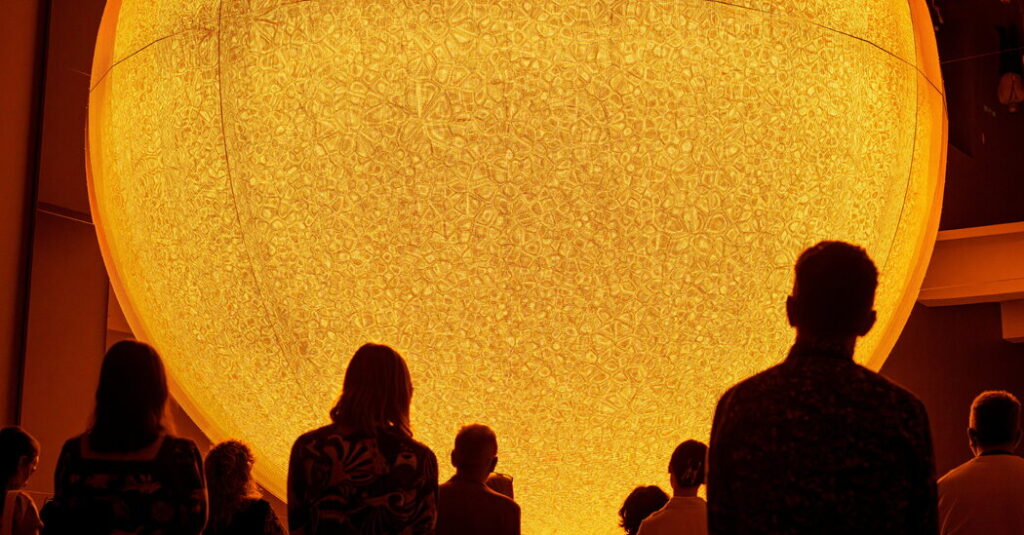
Recently, another of Eliasson’s outsized spheres drew large crowds, this time in Salt Lake City, Utah: a towering, globe-shaped screen which, night after night, beamed sounds and images illustrating the ecological threats faced by the Great Salt Lake and its ecosystem.
To make the installation (titled “A symphony of disappearing sounds for the Great Salt Lake”), the Danish Icelandic artist teamed up with the music producer Koreless to create a soundtrack using sounds (collected by archivists) made by more than 150 local animal species — including bison, coyotes, frogs, pelicans and rattlesnakes — which he has paired with abstract images inspired by crystalline shapes and motifs in nature. The Great Salt Lake is in peril: Nearly two-thirds of the lake bed is currently exposed, and the rest could soon follow, wiping out dozens of species that rely on it for survival.
For Eliasson, nature is not just the subject of his art: it’s the material that he makes it with. An early work, “Beauty” (1993), was a spotlight installed above a cascade of fine water droplets that produced a rainbow. Eliasson has also exhibited beds of real-life lichen, man-made waterfalls, and blocks of ice from melting glaciers, which he displayed for contemplation at outdoor locations in Paris and London.
In a recent video interview, Eliasson — back in his Berlin studio, with a glowing-sun painting hanging on the rear wall — discussed his latest project and the thinking behind his art. The conversation has been edited and condensed.
What was your Great Salt Lake project all about?
The state of Utah is very beautiful. Where in the world do you have this barren landscape, with no trees — this void? Not in many places. Utah is one of those places. Iceland is another.
When I was younger, I had a very strong tie to Iceland. So when I heard about the Great Salt Lake in Utah, I kind of felt at home.
In Iceland, there is a sensation of seeing the invisible. There’s a void. There’s the absence of presence. You have a distinct sense of looking at something that has been, or something that is about to disappear. The most extreme version is that you look at the glaciers and literally see them recede. They recede 30 centimeters a day.
My father lived on the south coast of Iceland, where all the glacial rivers are. He was a cook on a fishing boat and also a painter. As a boy, I would go with him into the canyons and the valleys. He would have his little easel and stand there painting. I would run up the mountainside and see if I could roll a rock down and hit his easel. I was lucky to be bored and to just do nothing.
If you go to the Alps these days, there are trees, there are cows, there’s a train going through a tunnel, there are cars, there are people everywhere. The hiking routes on Mont Blanc are made of asphalt.
Talk about the Utah project in more detail.
My proposal was to create a kind of symphony of all the sounds that have either disappeared, or will soon disappear — frogs, pelicans, rattlesnakes, all kinds of insects and bees and flies. It was an attempt to create awareness of a void, a negative space.
I created an audiovisual sculpture, like a spherical billboard. I took all the colors of the lake, all the narrative material from the lake — the frogs, the weather, the shade, the heat, the cloud, the dust, and salt crystals and mineral crystals that can only be seen under polarized microscopes — and made a compilation of everything.
We worked with three sound recorders, people who made archives of sounds from nature. The lake is diminishing at such a fast rate now that a number of species are about to be extinct. These are typically insects, but because of that, the whole ecosystem is collapsing. This is one of the big areas for migration birds. But now they’re migrating by another route because of severe drought and low water levels. So it’s quite a complex ecosystem.
What is the point you are making with this installation?
It’s a little bit like the climate crisis. Everybody knows about it, but it is much harder than we think to actually go from knowing about it to being active about it. We are not really changing our livelihoods completely. What is the human tipping point into doing something? When are we going to get mobilized?
This is not intended as a doom-and-gloom project, because I think the threat-based or fear-based narrative might provoke some change — some people might be jolted into action — but it’s short-term action. For a long-term commitment, we need a positive bias, a narrative that carries this idea of believing in something. You’re not threatened into doing something, but have a sense of courage, feel a mandate.
How did nature become your vocabulary?
There were key moments. One of them was when I moved to Cologne, Germany, in the early 1990s and met some of the young German artists. They were so radical, so talented — and I realized: I’m going to get nowhere if I try to be an artist like them, because they’re so good. They have proper arguments about art theory. How could I do that?
I realized that if I want to be an artist, I should be super honest. And honest means to look inward. Where do I come from? Who am I? What do I have to say? That’s when I made my first rainbow piece, because I came from Iceland, and there are rainbows everywhere.
I showed that work in Cologne in 1994 in a garage next to a cinema. So when the film was over, everybody came to my opening, and said: “You made a rainbow? How did you do that?” That was the first time that it clicked a bit.
How are you feeling now about the state of the planet and of humanity?
I’m upset with the big corporations, the companies, the politicians, the big decisions. I see a lot of people on the ground actually doing stuff, small companies, little things, buying the right products. People are moving somewhat. But the populism and the strange ways that politics has somehow found a way to manifest itself, with the oil lobby and the money and capitalism, is absolutely counterproductive to any progress. This scares me.
I’ve become quite interested in rest as resistance. Everything is about championship, winning, competition, capitalism, and more, more, more consumption. And instead of building more, owning more, being more, sometimes maybe it’s good to be soft and to be slow.
I learned from nature that if you slow down, you see more. When you stand on a pile of moss, the moss actually starts talking to you. It’s quite a mind-bend not to think: What can I use this moss for? How much money could I make with it? You have to say: Where do you come from? It’s the idea of being present, to listen.
The post Olafur Eliasson Uses Art and Sound to Raise Climate Awareness in Utah appeared first on New York Times.