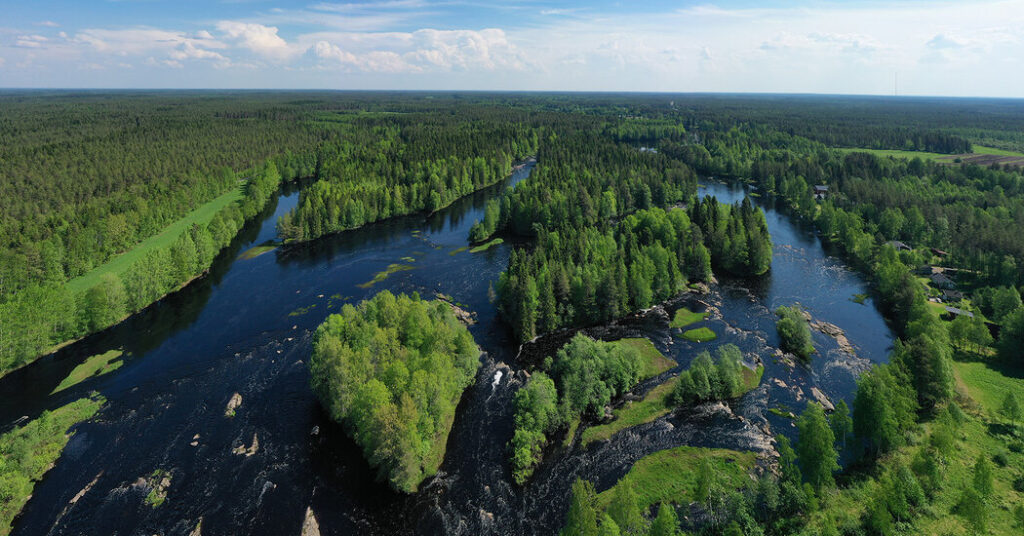
For the artist Antti Laitinen, his childhood playground among the trees and streams of central Finland has become an experiment in how the world can survive. He only has to look at the lichen sprinkled around the region’s landscape.
Yes, that colorful symbiotic mishmash of fungus and algae may offer hope for our future. It is almost like a gauge for all that surrounds Laitinen in the region of Oulu, Finland, where his most recent works are part of “Climate Clock,” a sprawling installation by 10 artists, opening June 13 as part of Oulu’s programming as the European Capital of Culture 2026.
This installation, stretching from the city center of Oulu to its outlying forests, will address the urgency of climate change. As the winter snows are melting, “Climate Clock” is taking center stage, lichen and all.
“I collect different kinds of lichen from across Finland and combine them into what I think of as a lichen cocktail, and they’re attached to two spheres I’ve made from branches,” Laitinen, 50, said in a recent video interview. “Some species will thrive while others may not. The outcome is determined not by me, but by the environment.”
That immersive experience is key, he said, to understanding how our environment is changing, and how our perceptions are changing at the same time. The existence of lichen is viewed as a signal of the state of the environment.
“Most lichens are highly sensitive to pollution, especially sulfur dioxide, making them natural indicators of environmental conditions,” Laitinen explained. “When I was younger, beard lichen, or usnea, was absent from Oulu due to pollution from factories in the area. But because of stricter emissions legislation and lowered sulfur dioxide levels, the lichen gradually returned, and now, about 40 years later, it is once again common in the area.”
The two spheres he created, measuring about 120 centimeters, or about four feet, in circumference, are made from bended tree branches and covered in lichen. Laitinen will hang them in different parts of the forests as bellwethers, and their positions, he hopes, will reflect the environment in real time.
“These two spheres will exist in distinct microclimates, one in an open, windy, well-lit area and the other in a more sheltered, shaded setting,” he explained, adding, “These differences will influence how the lichens grow, and only time will reveal how the work evolves.”
In addition to the two spheres rich with lichen, his other artwork for “Climate Clock” is similar to his “Broken Landscape” series, in which he alters trees in the Koiteli forest of his youth to create open circles. This work, combined with the spheres, is titled “Olet Tässä” (Finnish for “You Are Here”).
“The openings in the trees are created by bending branches, forming windowlike frames within the landscape, and the work invites people to see the landscape differently, noticing details they might otherwise overlook,” Laitinen explained. “I am interested in how removing something can become an act of addition, and how a small intervention can transform an entire visual experience.”
And visual experiences are what is ultimately behind “Climate Clock,” in addition to a sense of urgency of all that we see in nature.
“One of the thoughts that I’ve been framing around the whole project is this idea that the climate clock is ticking, the snow is melting and we are learning anew what our forebears knew: that time is not ours to command, that nature keeps its own time,” said Alice Sharp, the curator of “Climate Clock,” in a recent video interview. “The central focus of this project is looking at how we connect to the environment, where the seasons and the people’s rhythms with it have become out of step because of climate change.”
Sharp, the artistic director and founder of Invisible Dust, a British arts and environmental group, brought together several artists for “Climate Clock,” including the Bangladeshi British artist Rana Begum, who will transform a local town square with five stone sculptures that rise from beneath the pavement, referencing glaciers and their geometric forms. The Nigerian artist Ranti Bam will use clay vessels about 2.5 meters, or around eight feet, high scattered throughout a nearby forest to depict the presence of humans in nature. The Danish cooperative Superflex will present a pink marble cube structure inside which visitors can sit and hear one word per hour from a Finnish translation of Homer’s “Odyssey,” spoken by a local fisherwoman.
In addition, the couple Tellervo Kalleinen and Oliver Kochta-Kalleinen will present “The Most Valuable Clock in the World,” a mechanical electronic artwork that will travel around the region, displaying valuable moments donated by local residents through moving images. The piece by the Mexican Belgian artist Gabriel Kuri will stretch across both sides of the main road from Oulu city to the airport as a metaphor for how we navigate the enormous uncertainties of climate change. And on a nearby beach, the Japanese artist Takahiro Iwasaki’s installation of a 10-foot-tall wooden barrel invites visitors to peer through small openings to discover hundreds of delicate symmetrical snowflakes, linking the fragility of snow and light with Oulu’s natural setting.
The diversity of these artistic approaches has inspired these creators in ways they did not expect, and the project has already created a sense of community and hope for the future.
“I genuinely believe that culture does have that power to break down barriers,” said Claudia Woolger, the creative producer of “Climate Clock,” in a recent video interview. “It made me realize even more so than diplomacy the important role that culture can play to promote peace, and, boy, do we need that in this day and age.”
The post An Installation in Nature has Climate Lessons for Humans appeared first on New York Times.