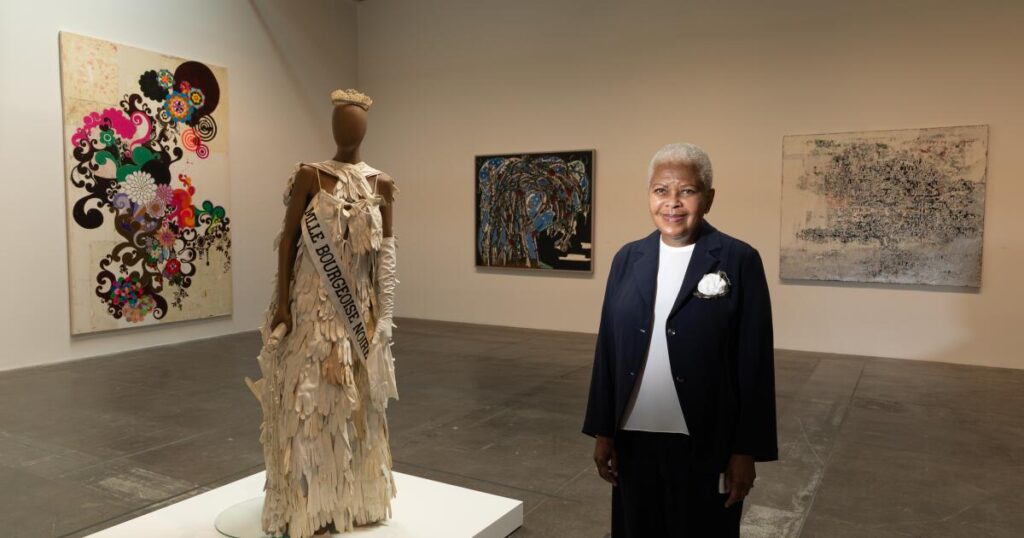
Few people have done more to shape Los Angeles’ art scene than Eileen Harris Norton.
The third-generation Californian, born and raised near Watts Towers in South Los Angeles, bought her first artwork at the Baldwin Hills Crenshaw Plaza, co-founded Art + Practice in Leimert Park, and has spent 50 years collecting artists who were, in many cases, her friends and neighbors. She also became a major force behind a generation of museum curators who have systematically changed who and how institutions across the country collect.
The city now has an opportunity to engage with her legacy through an exhibition, “Destiny Is a Rose: The Eileen Harris Norton Collection,” at Hauser & Wirth in downtown L.A. through August.
Featuring more than 80 works — many of which hung in her home until recently — the show offers rare insight into a renowned collector whose acquisitions are marked by sustained support for women artists, artists of color and Southern California-based artists, and a belief in art as an engine for education and social change.
During a recent interview that began in the leafy courtyard of the gallery, Harris Norton shared the story of her collection, revealing the personal depth of her connection to the art and artists in the process. It’s a material history of a culture: one Harris Norton didn’t just witness or document, but actively built.
The notoriously private collector is lively and disarmingly funny. She noted that her kids call the celebrated abstract painter Mark Bradford “Uncle Bradford,” and that when she first met him, he was “living in this hole and creating these beautiful pieces.”
When she addresses the discrimination she encountered in the art world, she doesn’t name the racial overtones. She pitches her voice higher, widens her eyes, and lets the imitation convey her meaning. “Now everyone says, ‘Oh, Eileen, I wish I had a Mark Bradford,’” she says. “And let me tell you, they had their chance to buy a Mark Bradford 20 years ago, and they were like, ‘Meh, I don’t know.’”
Several visitors stop by to congratulate Harris Norton on the show. A curator from the Brooklyn Museum tells her that a Kara Walker pop-up artist’s book, one of many works Harris Norton has gifted to the institution, will appear in an upcoming show.
For decades, the dominant account of L.A. art centered on Ed Ruscha’s deadpan photographs, David Hockney’s shimmering pools and the perceptual experiments of the Light and Space artists. What Harris Norton’s collection makes clear is how much that story left out. It is Womanhouse and Judy Chicago. It is the Watts rebellion and Noah Purifoy. It is the Chicano printmakers in East Los Angeles and the Black artists of Leimert Park. Not separate movements, but a continuous conversation between artists responding to similar environmental and social conditions that the institutions tasked with paying attention largely failed to take into account.
“Everybody was going to New York and buying whoever was popular,” Harris Norton recalled. “Then they’d come to our house and go, who is that?”
There was no dearth of viewing material in Harris Norton’s house. A photograph by Uta Barth, “Deep Blue Day” (2012), which usually hangs in Harris Norton’s bedroom, is on the far wall of the first gallery. A portrait of Harris Norton by Don Bachardy hangs nearby, as does a photograph of Harris Norton’s son Michael beneath an arbor by Kwaku Alston, a kaleidoscopic print by her neighbor Miriam Wosk, and Kerry James Marshall’s plates emblazoned with protest slogans including “We Shall Overcome.”
Curator Ingrid Schaffner calls the miniature sculptures by Betye Saar and Takashi Murakami installed on discrete shelves “the house gods” — works that, like the others, “anchor Eileen’s day.”
When Harris Norton was growing up, her mother took her to museums and performances, and taught her that beauty was a right. Leaving the neighborhood for cultural events eventually led to leaving for school at Alexander Hamilton High School on the Westside. “I was always an outsider,” Harris Norton recalled.
Before marrying Norton Utilities founder Peter Norton in 1983, Harris Norton taught bilingual education in public schools. The first piece of art she bought in 1976 was a linocut from the artist and activist Ruth Waddy at a printmaking demonstration. This marked the beginning of Harris Norton’s preference for studio visits to gallery rounds, and personal relationships to market value. Harris Norton and her husband collected together throughout their marriage; after their divorce in 2000, she continued on her own.
“I’d go so far as to say that the Nortons were the glue that sustained the young artists of the time,” said conceptual artist Charles Gaines. “They first introduced and supported many of the artists who, as their reputations grew, expanded the significance and reputation of the city globally.”
Gaines said his work was still under the radar during his first L.A. show at Leo Castelli Gallery, and only two pieces sold. One went to Harris Norton.
“It was inspirational,” Gaines said of his canvases that surfaced stereotypical, racially inflected words from documents with no explicit racial content. “It demonstrated that I could get support for difficult work.”
“Destiny is a Rose” is organized in five chapters: “Home,” “Essence,” “Near,” “Far” and “Deep,” and proceeds in mostly chronological order. “Near” gathers work from the 1980s and ‘90s, primarily by L.A.-based artists Harris Norton met during studio visits around her Venice neighborhood.
“A woman named Nancy Cutler used to lead tours,” Harris Norton explained. “She’d rent a bus, give us boxed lunches, and we’d visit maybe 10 studios.” Harris Norton stood out. “I was, well, different, and had a different point of view.” That difference led her to acquire works including Alison Saar’s “Bye Bye Blackbird” (1992), featuring an angelic pair of wings assembled from worn-out shoe soles, and May Sun’s lightbox sculpture “Reconfiguring the Urban Landscape” (1992), which uses iron bars on sand to pair an illuminated image of destruction from the L.A. riots with a hexagram from the “I Ching.”
“She really made a conscious effort to support artists who weren’t being embraced by the art world at the time,” Sun explained. “Like artists of color, experimental artists, artists thinking beyond the mainstream.”
After first meeting Harris Norton at the Santa Monica Museum of Art — where Sun was one of six inaugural artists — Sun developed a relationship with the collector, who eventually commissioned her to make one of the family’s annual Christmas gifts. Each year, the Nortons collaborated with an artist to produce an editioned work, sending it to friends along with a wide network of curators and museum directors.
“It had a subversive side to it,” Schaffner said of the annual gift. “It came with great generosity, but it was also a way of putting artists they might never have heard of before in the hands of the establishment.”
Sun’s contribution, for example, a set of printed silk napkins, ended up in the Brooklyn Museum’s permanent collection.
At a time when few museums had contemporary art departments — “you couldn’t write a dissertation on a living artist,” Schaffner notes — Harris Norton funded the scaffolding that would sustain the artists she collected. She underwrote curatorial travel, including a 1997 trip to the Johannesburg Biennial, where a cohort of American curators, among them Nancy Spector and Thelma Golden, encountered a genuinely global art world. She seeded what became the Contemporary Curators Conference, an annual gathering that gave a nascent generation a place to convene.
Schaffner points out several striking black-and-white photographs by Catherine Opie and Lorna Simpson that document those years, identifying younger versions of seminal art world figures.
“Far” traces expansion in two directions: geographic, as Norton’s eye moved beyond California to Japan, Cuba, England; and social, into work breaking new ground on questions of gender, sexuality and post-colonial histories. When Japanese artists arrived on the West Coast, and MOCA hosted the formative “Superflat” exhibition, titled for the artists’ anime-inflected aesthetics, Norton added Murakami and Yoshitomo Nara to her collection, understanding, before most, the cultural importance of the event.
Among the most affecting displays in the exhibition is a grouping by Jerome Caja, a queer performance artist from the Bay Area who died of complications from AIDS in 1995. His miniature fingernail polish paintings of everyday objects — a purse, a lipstick tube, a stiletto — are equal parts playful and macabre.
“Deep,” the exhibition’s final movement, features David Hammons’ “Traveling” (2001-2), a large-scale drawing created by bouncing a basketball first in dirt and then on a piece of paper lifted off the wall by a battered suitcase, a reference to the distance between “street” culture and the gallery’s white walls. On the opposing wall, Lorna Simpson’s four-panel photo work “You’re Fine” (1988) depicts a reclining woman, her back turned to the camera between the phrases “you’re fine” and “you’re hired,” and a list of physical exam tests. Here, the Black female body, transformed first into a suite of medical data and then into an employee, is recalled as the historical site of institutional surveillance and social scrutiny.
Many major museums, Schaffner says, “would give eyeteeth for these works today.”
Because Harris Norton collected these acclaimed artists while they were still relatively unknown, she is often described as prescient. But the term suggests a capacity to anticipate what the art market will value. Those familiar with her legacy, however, say Norton wasn’t predicting the future; she was building it. At that time, accumulating works by women and artists of color working with nontraditional materials that defied formal categories, wasn’t only uncommon — it wasn’t done.
Here, Patrick Martinez’s blue and red neon sign, “Promised Land” (2022), hangs beside a video of Bradford playing basketball in a voluminous antebellum hoop skirt in “Practice” (2003). John Outterbridge’s miniature shopping cart, packed with scraps of colored fabric and sewn sacks, is mounted on the wall facing Hammons’ “African American Flag” (1989), suspended from the ceiling.
And Betye Saar’s “Souvenir of Friendship” (1977), a mixed-media collage featuring an antique photo of the artist’s aunt overlaid with lace, shares space with Lorraine O’Grady’s “Mlle Bourgeoise Noire” (1980-83), a gown made from 180 pairs of white dinner gloves — worn during performances critiquing the exclusion of Black artists from the mainstream art world unless they made work that conformed to white expectations, or what she called “art with white gloves on.”
“This is the culture I want to be in,” Schaffner said, looking around. “We’re allowed to be in this world because of what she built, her dedication, her vision.”
In the corner of the final gallery is an Alma Thomas painting that usually hangs in Harris Norton’s kitchen. “Untitled” (ca. 1968) is a wheel of concentric circles — chestnut at the center, then saffron, vermilion, peony pink, cerulean — each ring composed from individual daubs of paint that are both distinct and part of a larger whole. It’s easy, standing before it, to think of Harris Norton’s influence moving in the same way: outward, in ever-widening circles, from a single point of sustained attention.
The post This influential L.A. collector bought the artists no one else would. The art world is finally catching up appeared first on Los Angeles Times.