Two American officials killed in a car crash early Sunday in northern Mexico while returning from a countercartel operation were officers of the Central Intelligence Agency, according to people familiar with the episode, raising questions about the agency’s role in Mexico’s war against drug cartels.
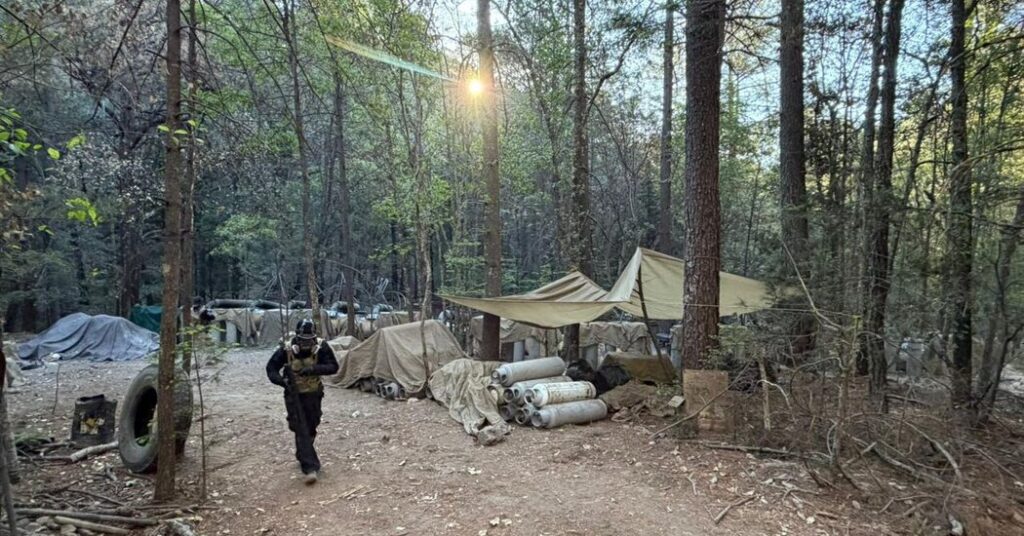
The two C.I.A. officers, along with two Mexican officials, were killed when their vehicle crashed while returning from an operation led by Mexico’s armed forces to dismantle clandestine methamphetamine labs in the mountains, said the authorities in the state of Chihuahua, where the accident occurred.
The people confirming the Americans’ identity spoke on condition of anonymity to discuss sensitive details of the episode.
The C.I.A. declined to comment.
President Claudia Sheinbaum of Mexico said on Monday that her cabinet had no prior knowledge of the activities involving the Americans in Chihuahua and would investigate whether their involvement in the operation violated Mexico’s national security laws.
“What has been agreed upon with the U.S. government — and has been very clear — is that information is shared and there is extensive joint intelligence work that allows federal forces to operate within our country’s territory and U.S. forces within theirs,” Ms. Sheinbaum said on Tuesday morning at her daily news conference.
“There is a great deal of collaboration and coordination, but there are no joint operations as such on the ground,” she said. “If this investigation confirms that there was a joint operation, then the corresponding sanctions would have to be reviewed.”
Mexico’s national security law forbids foreign agents, including U.S. military and law enforcement officials, from operating in the country without authorization from the government. American officials working directly with state-level authorities without federal approval would be a breach of the Constitution.
The Mexican government has consistently rejected pressure from the White House to deploy U.S. forces to Mexico to fight drug groups in an active role, saying that American boots on the ground would violate the country’s sovereignty. Instead, Ms. Sheinbaum has insisted that Mexican troops lead the fight on the ground, with U.S. forces limited to support, sharing intelligence in joint operations centers or in a training capacity.
Still, the C.I.A., along with the Pentagon, have taken on an expanded role in the war against drugs and trafficking groups since President Trump took office early last year. The campaign against the cartels has historically been led by the Justice Department and its law enforcement arm, the Drug Enforcement Administration.
But after the Trump administration designated some two dozen drug organizations as terrorist groups last year, it tapped into the military and the C.I.A.’s more sophisticated, high-tech and lethal resources in the battle against the cartels.
The C.I.A. expanded a secret drone program in Mexico, deploying surveillance drones more powerful than those used by the Justice Department to the fight. At the same time, the Pentagon has used lethal military equipment to target drug traffickers in the Caribbean and the Pacific Ocean, killing at least 174 people since those operations started late last year.
In February, the C.I.A. also provided crucial intelligence on the location of Nemesio Oseguera Cervantes, the longtime leader of the Jalisco New Generation Cartel who was known as El Mencho. He was killed in an operation by Mexican forces.
The attorney general for Chihuahua insisted on Monday that U.S. personnel were not involved in the antidrug operation and that it was led by Mexican forces.
Instead, American “instructors” went to the scene of the operation only after it unfolded for training purposes, “such as teaching the handling of drones,” the state attorney general’s office said in a statement. It did not identify the Americans as C.I.A. officers, which is standard because of the sensitive nature of the agency’s work.
But the statement released late Monday seemed to contradict comments made by Eloy García, a spokesman for the state attorney general’s office, and the office’s previous press releases.
Earlier Monday, the office said the American victims had been killed while returning “from an operation to dismantle clandestine laboratories.” Mr. García later told The New York Times that they were part of an authorized training program to teach their Mexican counterparts how to handle dangerous synthetic drugs.
Traditionally, D.E.A. agents have been invited to the scene of antidrug operations after they were conducted by Mexican forces to train them on how to handle evidence for a future trial or for use in other cases, analysts say.
Sunday’s incident suggests a more active role for the C.I.A. in Mexico, though the presence of American officers on the scene of a drug operation for training purposes was essential and not out of the ordinary, according to former U.S. officials.
“There is a misconception about what training and support means,” said John Feeley, who served as the deputy chief of mission for the U.S. Embassy in Mexico City from 2009 to 2012. “It’s not just classroom study. And it can’t all be learned in an office setting.”
“What is different now from similar Merida Initiative joint operations is the level of transparency about them,” Mr. Feeley added, referring to the U.S.-Mexico security partnership. “This is what should be occurring, with Mexicans in charge of the operation and Americans providing the skills Mexico needs so both governments can more professionally and legally attack illegal drug production.”
Emiliano Rodríguez Mega contributed reporting.
Maria Abi-Habib is an investigative correspondent reporting on Latin America and is based in Mexico City.
The post 2 Americans Killed in Mexico Crash Were C.I.A. Officers appeared first on New York Times.