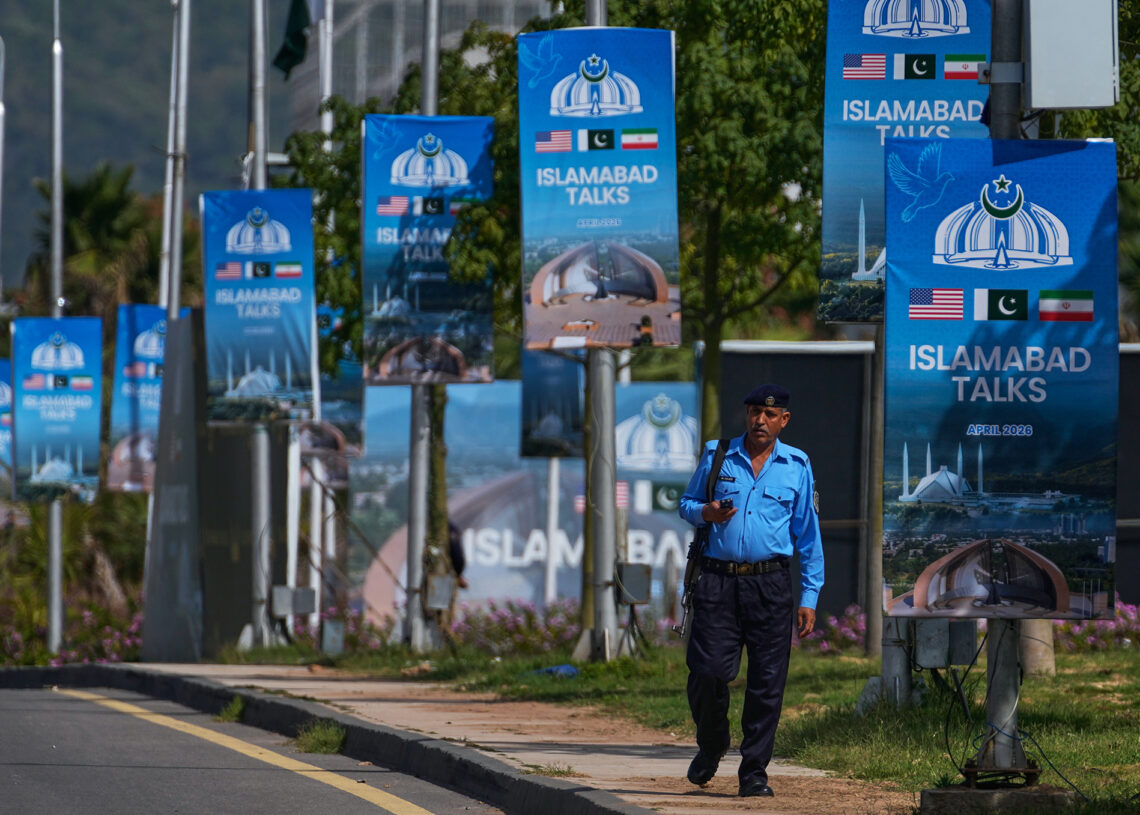
A U.S. delegation was expected to depart Tuesday for a second round of face-to-face peace talks with Iran in the Pakistani capital but was delayed for “additional policy meetings” involving Vice President JD Vance, a White House official said Tuesday.
The fate of the two-week ceasefire in the war remains unclear. Iran has yet to confirm its attendance at the Islamabad talks, instead warning that it is prepared “to unveil new cards on the battlefield.” The ceasefire is set to expire Wednesday.
President Donald Trump accused Iran of violating the ceasefire “numerous times” in a post on Truth Social early Tuesday. In a separate interview with CNBC, he said the United States is “going to end up with a great deal” from the negotiations. “I think they have no choice. We’ve taken out their navy, we’ve taken out their air force, we’ve taken out their leaders,” Trump said.
When asked whether the U.S. would resume bombing if a deal is not reached by Wednesday, Trump said that he expects to “be bombing, because that is a better attitude to go in with.” He added that the military is “raring to go.”
A day earlier, he told Bloomberg News that he is not likely to extend the ceasefire with Iran if no deal is reached. “I’m not going to be rushed into making a bad deal. We’ve got all the time in the world,” Trump told the outlet.
The United States has been planning to send Vance, Middle East special envoy Steve Witkoff and Trump’s son-in-law Jared Kushner to the talks.
Vance was expected to depart Joint Base Andrews in Maryland on Tuesday morning for Pakistan but as of noon had yet to leave. He is due to take part in “additional policy meetings” at the White House on Tuesday, the White House official said.
Both sides have expressed support for a negotiated end to the war while also escalating a standoff in the Strait of Hormuz, a choke-point waterway that carries a fifth of the global oil supply and has emerged as a central sticking point in U.S. and Iranian disagreements. The U.S. over the weekend seized the Iranian-flagged ship Touska following reported Iranian attacks on two Indian-flagged ships. The strait is virtually closed to all traffic.
Iran’s Foreign Ministry condemned the U.S. seizure of the Touska as “maritime piracy,” warning of “extremely dangerous consequences” while calling for the release of the vessel and its crew in a statement reported by Iranian state media Tuesday.
The Defense Department said U.S. forces also boarded another vessel, the M/T Tifani, overnight as part of its efforts to “interdict sanctioned vessels providing material support to Iran.” The department described the ship as stateless.
The tanker’s last transmitted location Tuesday morning, according to ship tracking data, showed it in international waters in the Indian Ocean, about 400 miles southeast of Sri Lanka. Satellite imagery shows it was previously docked at Iran’s Kharg Island on April 6.
Overnight, U.S. forces conducted a right-of-visit, maritime interdiction and boarding of the stateless sanctioned M/T Tifani without incident in the INDOPACOM area of responsibility.⁰⁰As we have made clear, we will pursue global maritime enforcement efforts to disrupt illicit… pic.twitter.com/EGwDe3dBI3
— Department of War
(@DeptofWar) April 21, 2026
The price of Brent crude, the international benchmark, hovered around $95 per barrel early Tuesday, while Asian markets closed mostly flat. European markets posted modest gains amid uncertainty over the status of the ceasefire.
Iranian officials said in statements Tuesday that they would not bow to U.S. pressure and said they maintained readiness in case of attacks.
“We do not accept negotiations under the shadow of threat, and over the past two weeks, we have been preparing to unveil new cards on the battlefield,” Iran’s parliamentary speaker, Mohammad Bagher Ghalibaf, wrote on X overnight. He said that Trump, by imposing the U.S. blockade, “seeks to turn this negotiating table — in his own imagination — into a table of surrender or to justify renewed warmongering.”
On Tuesday morning, Iran’s ambassador to Pakistan, Reza Amiri Moghadam, echoed that statement, saying in a post on X that Iran “will Not negotiate under Threat and Force.”
Maj. Gen. Ali Abdollahi, commander of Khatam al-Anbiya military headquarters, said Iran was prepared to deliver “decisive, determining, and immediate responses” in a statement reported by Iran’s state-run Mehr news agency.
By midday Tuesday, the state media outlet Islamic Republic of Iran Broadcasting reported that “no Iranian diplomatic delegation — be it a primary or secondary team, or an initial or follow-up mission — has traveled to Islamabad, Pakistan so far” for the latest talks.
Still, Islamabad — an unlikely mediator — was gearing up for the talks Tuesday, heightening security and shutting roads in anticipation of negotiators’ arrival.
Diplomatic posturing ahead of the second round of talks echoed that seen before the previous negotiations, when Washington and Tehran accused each other of acting in bad faith.
The first round, held April 11, marked the highest level of face-to-face engagement between U.S. and Iranian leaders in decades, but the session, which lasted more than 20 hours, failed to produce an agreement.
Vance left the talks saying the U.S. was still open to striking a deal with Iran but needed further reassurance that it would not seek a nuclear weapon or the tools that would enable it to develop one. Iran has publicly rejected demands that it stop uranium enrichment and hand over its stockpile of weapons-grade uranium.
Imogen Piper in London and Cat Zakrzewski in Washington contributed to this report.
The post U.S. delegation’s departure for Islamabad delayed as Iran ceasefire nears expiration appeared first on Washington Post.