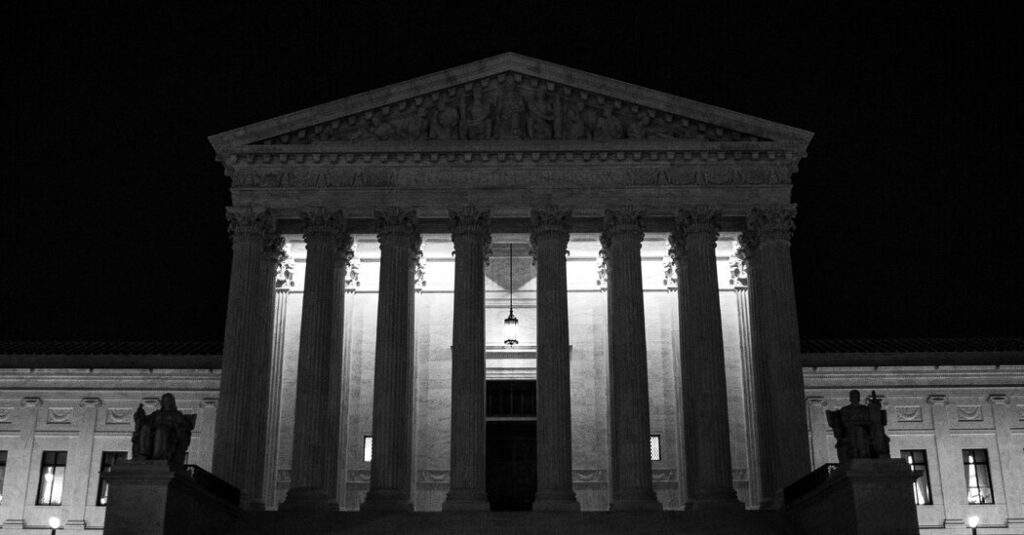
Hello! Over the weekend, The Times published “The Shadow Papers,” a look at a turning point in the Supreme Court’s use of its emergency docket by Jodi Kantor and me. The project, based on a trove of confidential memos from the justices, has engaged all kinds of readers.
Today, in a special edition of The Docket, I want to focus on what we have been hearing from law professors whose insights I have found most compelling.
Their reactions have been all over the map. Some said the article shed much-needed light on what critics call the court’s shadow docket, in which the justices use truncated procedures to issue consequential rulings with scant or no reasoning.
Other said we had merely confirmed their educated guesses about the reasons for an unsigned and unexplained 5-to-4 ruling in 2016 that halted President Barack Obama’s Clean Power Plan, which sought to encourage energy companies to move from coal to cleaner sources of energy
I’m going to focus on the two professors most closely associated with the “shadow docket”: the one who named it and the one who wrote a book about it. They had very different takes on our article.
The Skeptic
Will Baude, a law professor at the University of Chicago and a former law clerk to Chief Justice John Roberts, coined the term “shadow docket” in 2015. In a blog post on Monday, he acknowledged that the court’s ruling blocking the Obama plan was “something of a big deal at the time, and that with the benefit of hindsight it can be seen as something of an inflection point.”
But, he added that the court’s unstated reasoning was inferred by “careful observers” at the time, basically arguing not much substantively new came to light. He cited a 2016 article called “The Supreme Court’s Clean-Power Power Grab” by Lisa Heinzerling, a law professor at Georgetown.
She did indeed write that “there are at least 10 ways in which the Supreme Court’s decision and process on the applications to stay the Clean Power Plan reflected bad choices.”
But one of them, she wrote back then, was the court’s failure to provide any reasoning. “Without a public explanation,” Heinzerling wrote, “we have no idea what question the justices were answering when they voted and no idea what their reasoning was in answering the question in the way they did.”
The papers The Times published supplied that reasoning.
I had reached out to Heinzerling on Sunday, before I’d seen what Baude had written, because I too admired her article. In an email, she told me she thought the papers The Times published were studded with revelations.
“The memos you obtained reveal John Roberts as the cheerleader for and architect of the court’s then-unprecedented approach to the shadow docket,” she wrote, adding: “He comes within a hair’s breadth of saying that significant new rules should be vetted by the Supreme Court before they can take effect.”
The Supporter
In his newsletter on Monday, Steve Vladeck, who wrote a 2023 book called “The Shadow Docket,” said our report shed light on what he sees as the shortcomings of the Supreme Court’s use of expedited procedures to decide momentous issues.
“The court is deciding massively important questions not just out of public sight, or through unsigned and unexplained rulings, but with remarkably cryptic behind-the-scenes deliberations, too,” he wrote.
Vladeck added that the papers showed undue haste.
“The key here is how utterly impoverished the discussion was,” he added. “There was no real debate and no in-person meeting to hash out differences of opinion; just a brief exchange of remarkably short memos over five days (two of which were a weekend).”
Publishing Secrets
A number of scholars have explored our decision to publish the internal memos from the court, which would ordinarily not be made public for decades.
Both Baude and Vladeck, though to different degrees, said that there is reason to let the court shield its internal communications.
“The biggest scandal here is in fact the leaks themselves,” Baude wrote, adding that such disclosures “will damage the institutional culture of the court and do little good.”
Vladeck agreed that “some degree of secrecy and confidentiality is inherent in the ability of a court to do its job.”
But he added that “it seems to me that the lack of depth or detail behind the scenes, or public explanation in front of it, did not serve the court well in the Clean Power Plan cases — and hasn’t served it well since.”
Alexander Bickel, a professor at Yale Law School much admired by conservatives, wrote about the tension between government secrecy and journalistic inquiry in his classic 1975 book, “The Morality of Consent.”
“It is a disorderly situation surely,” he wrote. “But if we ordered it we would have to sacrifice one of two contending values — privacy or public discourse — which are ultimately irreconcilable.”
The Chief Justice in Charge
We wrote that the papers revealed a different, more assertive side of Chief Justice Roberts, who is mild and composed in public. Jack Goldsmith, a law professor at Harvard, wrote on Monday that we had pushed beyond the evidence in the papers on this point, calling our conclusions tendentious.
Some scholars said the papers showed Chief Justice Roberts at the top of his game, outmaneuvering the liberal justices who sought to persuade Justice Anthony Kennedy, who then held the decisive vote, to join them in voting to let the plan proceed.
“There was a race to persuade Justice Kennedy, and Roberts would not take it lying down,” Josh Blackman, a law professor at South Texas College of Law Houston, wrote in a blog post on Sunday about a memo from the chief justice rejecting a plea from Justice Stephen Breyer to move slowly.
“This exchange reminds us of why Roberts was the most gifted lawyer of his generation,” Blackman wrote.
The memos seem to contradict the idea that Chief Justice Roberts is a cautious institutionalist, a description almost reflexively applied to him by lawyers and scholars. But Baude said that idea was misplaced to begin with. And Heinzerling wrote that the chief justice is an institutionalist only if that word means accumulating power for his institution.
She added that the papers revealed just how much Chief Justice Roberts and Justice Samuel Alito were bothered by a blog post and an interview involving officials at the Environmental Protection Agency.
“Court watchers already knew that the court was particularly hostile to E.P.A. regulations,” she wrote. “The memos show us one reason why: the conservative justices don’t trust E.P.A., and they (here, Roberts and Alito) are willing to interpret the most anodyne comments from E.P.A. personnel as signs of a sinister desire to … protect the environment!”
There’s one group of lawyers we haven’t heard from at all: the justices. They did not respond to questions we posed before publication, and they have issued no statements since.
Other Legal News
Mailbag
The Power of Precedent
To what extent does the current Supreme Court disregard or overturn precedent? — Daniel Whitney
By standard political science measures, the court led by Chief Justice Roberts since 2005 is not out of line with earlier courts in how often it overrules precedent.
The court led by Chief Justice Earl Warren from 1953 to 1969 overruled an average of 3.1 precedents per term, according to data prepared by Lee Epstein, a law professor and political scientist at the Washington University in St, Louis.
The number ticked up slightly under Chief Justice Warren E. Burger, who led the court from 1969 to 1986, to 3.4 precedents per term. It dropped under Chief Justice William H. Rehnquist, who led the court from 1986 to 2005, to 2.4 precedents per term.
Through the end of the term that ended in June, the Roberts court has overruled precedents at the lowest rate, at 1.5 per term.
The earlier courts heard more cases and so had more opportunities to overrule precedents. But the percentages of decisions overruling earlier ones varied only a little, from about 3 percent in the Warren court years to about 2 percent in the later ones.
All of this does not address how important the precedents were. The Roberts court has discarded some big cases, including ones involving the constitutional right to abortion, affirmative action in higher education and the power of administrative agencies.
The numbers also miss what scholars call “stealth overrulings,” in which the court hollows out a precedent without saying it has overturned it.
I’d love to hear your questions on the law, the courts or whatever is on your mind. Send them my way at [email protected].
Closing Argument
CNN Fires Back in Challenge to Libel Landmark
In an edition of The Docket in February, I told you about an appeal from Alan Dershowitz, the retired Harvard professor who has represented Jeffrey Epstein and O.J. Simpson, asking the Supreme Court to overturn or modify New York Times v. Sullivan, the landmark 1964 decision protecting press freedom.
Sullivan and the decisions that followed it made it very hard for government officials and public figures to win libel suits. Dershowitz sued CNN in federal court in Florida, claiming that CNN had defamed him by mischaracterizing his defense of Trump during an impeachment trial. He said he would have won but for the line of cases that started with Sullivan.
Lower courts dismissed his suit, though two judges expressed qualms about Sullivan.
The network last week filed its brief arguing the Supreme Court should decline to hear Dershowitz’s case. It called Dershowitz “a uniquely unfit petitioner to force a constitutional showdown over Sullivan.” Among CNN’s reasons: state law in Florida, which is beyond the Supreme Court’s power to change, independently requires libel plaintiffs to overcome the hurdles imposed by Sullivan.
The court will most likely decide whether to consider the case — and potentially re-evaluate the Sullivan precedent — in the coming weeks.
Adam Liptak is the chief legal affairs correspondent of The Times and the host of The Docket, a newsletter on legal developments. A graduate of Yale Law School, he practiced law for 14 years before joining The Times in 2002.
The post Aftershocks from ‘The Shadow Papers’ appeared first on New York Times.