The first Crips appeared on the streets of South Central Los Angeles in blue bandanas, leather jackets, and starched Levis between 1969 and 1971. Co-founder Stanley “Tookie” Williams described their mission as protecting South Central residents from racism, police brutality, and rival gang violence.
In just a decade, that mission had exploded into a criminal enterprise, and the crack cocaine epidemic pushed Crip sets into at least 41 states. “By 1980, there were approximately 15,000 Crips and Bloods gang members in and around the Los Angeles area,” reads a 1993 report from the Justice Department. “The typical age of a gang member varied from 14- to 24-years-old.” And over time, the gangs became fixtures of American popular culture—symbols of everything that had gone wrong in urban America.
Gang violence remains among the most important criminal justice stories in America, and what to do about it is the subject of a transformational documentary film made by the people most affected. Shot almost entirely on iPhones by residents, Nothing to See Here: Watts is not just a gritty portrait of urban violence, although it is that too. The documentary is a working playbook for how communities can reclaim their streets by telling their own stories.
The project began in December 2021, when Michael Soenen, a venture capitalist volunteering with the Healthy Room Project, a non-profit focused on improving youth housing, joined a police ride-along in Watts with LAPD Officer John “Johnny” Coughlin. Over three hours, he witnessed three gang shootings and watched one of the victims die in the street. That single violent night made Soenen understand something obvious that had somehow escaped wider attention: the daily traumas of Watts were invisible to the rest of Los Angeles and cried out for documentation.
“Literally the next day, we bought 20 iPhones and started handing them out to whoever would take them on both sides of the law,” says Soenen. They had to ask more than 200 people—including “gang members, police officers, kids, priests, prostitutes, fellow officers”—to find the 20 people who would turn their cameras on family rituals as well as fraught street corners, jokes, grief, and the constant calculus of survival that never fits into 20 seconds on the evening news. Critics said they would never see those phones again; instead, the filmmakers created 200 hours of footage over three years during which there were over 100 street murders. Then, in the 12 months after they screened the finished film for their own neighborhood, gang-related homicides declined dramatically.
Plenty of outsiders have pointed cameras at Watts. What made this different is that Soenen gave up creative control. After reviewing hours of footage, he concluded the story could not ethically belong to him. He offered to secure editors, technology, and resources only if the people on screen took credit as the filmmakers and retained ownership of the narrative. It took months for members of rival gangs, law enforcement, and families affected by the violence to sit together and shape a 90-minute film. In those edit rooms, people who might otherwise meet only in police reports were arguing over cuts, interrogating one another’s footage, deciding what the world should see—and they filmed that too.
“In the beginning, you could feel the tension, fear, and anger in the room, but as the process continued, it became apparent something profound was happening,” says Suzanne Malveaux, the former CNN anchor and White House correspondent who joined Soenen as a co-producer. “As the filmmakers shared more of themselves, the hostilities began to melt, and they started to view each other as fellow human beings and not stereotypes.”
What emerged was far from a collection of victim stories with occasional “good-news” spots of redemption for outside consumption—rather, the film depicts a community looking at itself and deciding, collectively, how it wanted to be defined. The people of Watts had been documented relentlessly by police cameras and the surveillance architecture of a neighborhood that the rest of Los Angeles preferred not to think about; this was different: self-documentation as self-determination. This is what social scientists call “narrative identity”—the idea that the stories communities tell about themselves shape the behavior of the people within them. Correlation is not causation, and there is no publicly available statistic that cleanly reports gang‑related homicides in Watts. But according to the filmmakers and the LAPD Southeast Division internal data they cite, the neighborhood that endured more than 100 killings in three years then went 12 months without a single gang-related homicide. This is not a coincidence anyone should be comfortable ignoring.
For decades, the dominant story about Watts was one of pathology and hopelessness. Nothing to See Here replaced it with something more complicated and true: a community full of people who love their children, grieve their dead, and are capable of imagining something better. When the filmmakers screened the film for their neighbors, they weren’t just showing a movie. They were holding up a mirror—and the reflection, for once, was one people recognized and respected.
There is also something to be said for the process itself. Three years of production required sustained, structured contact between people who were, in many cases, enemies. Gang members and police officers reviewed footage together. Families who had lost children to drive-by shootings sat in the same room and argued about how to tell their stories. The edit suite became a negotiating table. Everyone had to agree on the final cut. Conflict resolution researchers have long argued that sustained cooperative contact between adversarial groups reduces hostility—but that contact rarely happens in communities fractured by decades of violence and mistrust. The film gave people a reason to be in the room together, and a shared stake in what came out of it.
The next question for producer Soenen was whether he could take a process that emerged organically—built on relationships, trust, and three years of painstaking work—and turn it into a framework that would work in other cities? His answer is built around two principles. First, participants retain full authorship and creative control over how their individual stories are told. If they are dissatisfied for any reason, they can leave and take their film with them. Second, all filmmakers must agree to the film’s final cut. “The process creates shared ownership of the final product,” says Soenen. “That’s the fundamental strength of it.”
Each city presents its own challenges: different gang structures, different relationships with law enforcement, different histories of mistrust. But the underlying conditions are recognizable across all of them: communities whose stories are told by outsiders, and where violence has become so normalized that individual deaths barely register. The Nothing to See Here Foundation, which grew out of the film, funds more than 40 local nonprofits focused on violence prevention and neighborhood revitalization Managed by the filmmakers themselves, it channels proceeds directly into the organizations already providing key services to the community.The infrastructure is being built, and a movement is building.
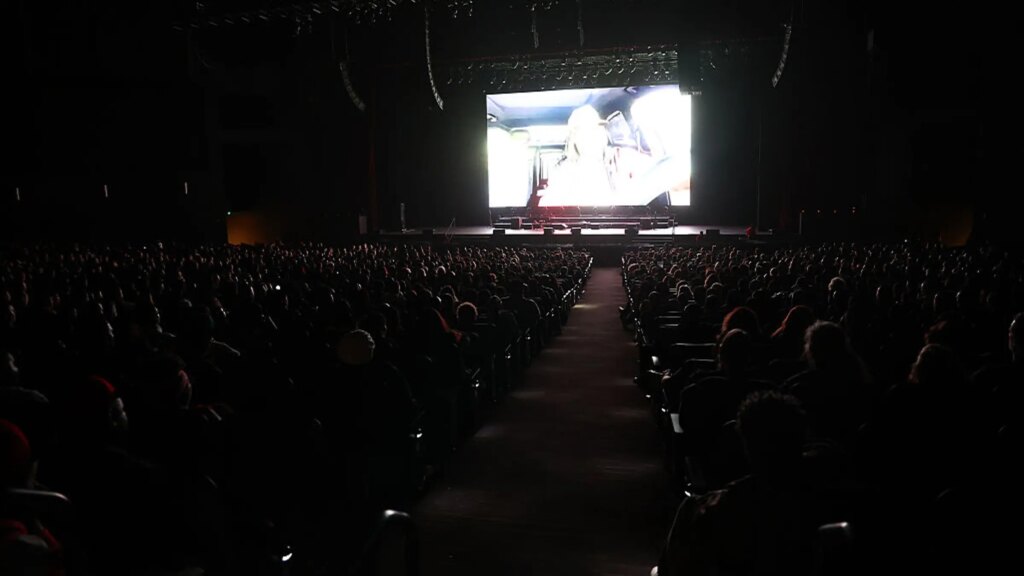
The first major public screening was last October at the Peacock Theater in downtown Los Angeles, where a diverse crowd—city-wide politicians and Hollywood celebrities alongside gang members and police officers — stayed for a panel discussion and a live performance of the soundtrack by Styx after a ten-minute standing ovation. Three months later, the film screened in Atlanta during The King Center’s Beloved Community Global Summit on Martin Luther King Jr.’s birthday, the filmmakers taking center stage and speaking as eloquently for the need for change in Watts as the film itself.
Then, on April 7, the Crips and Bloods came to Harvard—not as subjects of a study, but as filmmakers, and they brought the data. In the halls of Harvard Kennedy School and that evening at the Coolidge Corner Theatre, something unusual happened: people who had spent their lives being explained to others got to explain themselves, with a confidence that quieted rooms, drew tears, and brought more standing ovations. The goal now is to take the model to Detroit, Chicago, Baltimore, and beyond—on one non-negotiable condition: communities must direct their own stories if they hope to transform them.
America has tried to address gang violence in many ways: policing strategies, sentencing reforms, community outreach, public health interventions. Some have worked at the margins. None have produced a result like Watts—zero gang-related homicides in a year, in a neighborhood that had known little but violence for half a century. It may be too soon to call it a solution. But it is not too soon to call it a story worth telling.
The post Can a Documentary Help End Gang Violence? appeared first on TIME.