HOW IT FEELS TO BE ALIVE: Encounters With Art and Our Selves, by Megan O’Grady
Marcel Duchamp once said he believed in artists, not art. The sheer truth of that heresy! It isn’t to deny the transformative relationship a person might have with “Middlemarch,” say, or “Kind of Blue,” or indeed Duchamp’s own “Large Glass” — but to acknowledge that every artwork is mediated by society, money, the changing winds of taste. Whereas the artist, driven to create, has an unchanging integrity that stands athwart power and fashion. That she never defeats them can only affirm that integrity.
Megan O’Grady believes in art. In her conscientious and heartfelt but profoundly conventional new book, “How It Feels to Be Alive,” she ascribes it mystical, far-ranging qualities. “Art meets us wherever we are, with our affinities and weltschmerz, our material circumstances and deeply sunk memories,” she writes. Later, she adds that art “is an unfixed mooring, not a secure berth, in the face of the blackening sky,” and, inevitably, that it “slices deeply into our certitudes and comforts.”
In fact, this reverence ultimately forestalls real engagement with the artists she considers. It’s hard to challenge, or in some sense critically consider, what you worship.
“How It Feels to Be Alive” is a blend of criticism and personal history in the style of Olivia Laing, Maggie Nelson and Teju Cole, among others, all of them indebted to John Berger, whose runic books about art as a mode of understanding the world signal, like the paintings of Géricault, a genre’s crucial break from classicism into romanticism. O’Grady’s novelty is to incorporate into that familiar style her interviews with artists, several of them conducted for T: The New York Times Style Magazine.
She is a thoughtful interviewer, sincerely curious about her subjects. The book’s finest section, “Home Fires,” weaves together a profile of the late performance artist Pope.L — whose revelatory “crawls” through New York on his hands and knees distilled the strange visceral lessons about race, money, revulsion and dark humor that homelessness offers a city dweller — with the story of the fire that destroyed O’Grady’s own Chicago apartment. Here, she is absolutely correct that art marks and diffracts our experience. Focused on her own affective experience or on the viewpoint of an individual artist, she is assured and sensitive.
But in her actual explorations of art, she is a font of received ideas. It’s a tiny instance, but I sighed when she commented on walking past “the slightly treacly Renoirs” in a museum. In the last century Renoir was often counted the finest of the Impressionists. But his feel for color was an innovation so completely assimilated into later painting that it is easy to forget, and his reputation has declined in our time. “Slightly treacly” is probably the exact sentiment that a survey of a hundred people in the art world would express about his work.
Nor is it necessarily wrong. The problem is not that O’Grady’s opinions are wrong; the problem is that they are never wrong. They court no risk. Dozens of her sentences summarize a conventional wisdom. Agnes Martin’s grids are “koanlike.” Barbara Kruger “was always right, but we didn’t know just how right she was until recently.” There’s the warmed-over observation that people of the past saw fewer images in a lifetime “than we do in an hour on our phones.”
The book’s writing bears the same weakness: Too little thought has been put into it. “Is any part of a home more lambently symbolic than a child’s closet?” she asks. That word “lambently” is anxious, a writer sensing that an idea is incomplete and trying to cover the error with style. A front door is pretty lambently symbolic. A bedroom is certainly lambently symbolic. And so forth. “Throughout art history, mirrors have been used to explore the implications of seeing.” Well, there is little doubt of that.
Perhaps all this seems harsh. But our present situation is no joke. America is sick, and the bourgeois capture of the arts, after the beautiful and genuine radicalism of 20th-century painting in particular, is a symptom of that sickness. When O’Grady writes in passing of a dinner party, “I found myself seated next to a billionaire collector,” it is calamitous to our faith in her precisely because, though she distances herself from the encounter with irony, her whole book is written in the tone of just such a conversation. The quietism of “How It Feels to Be Alive,” which presents art as a comforting religious substitute reflecting the personal struggles of the affluent, is exactly what stout critics ought to be battling right now.
Indeed, the book made me realize how ardently I yearn, and I cannot be alone, for an art that is no doubt emerging somewhere, at this very moment — art that is communitarian, subterranean, indifferent to the movements of the last century, anonymous, perhaps, or full of strange materials, fluent in video and performance and A.I. Maybe not even for sale. And, along with it, I would wish for criticism with a corresponding energy of discovery, rather than the consecration of cliché.
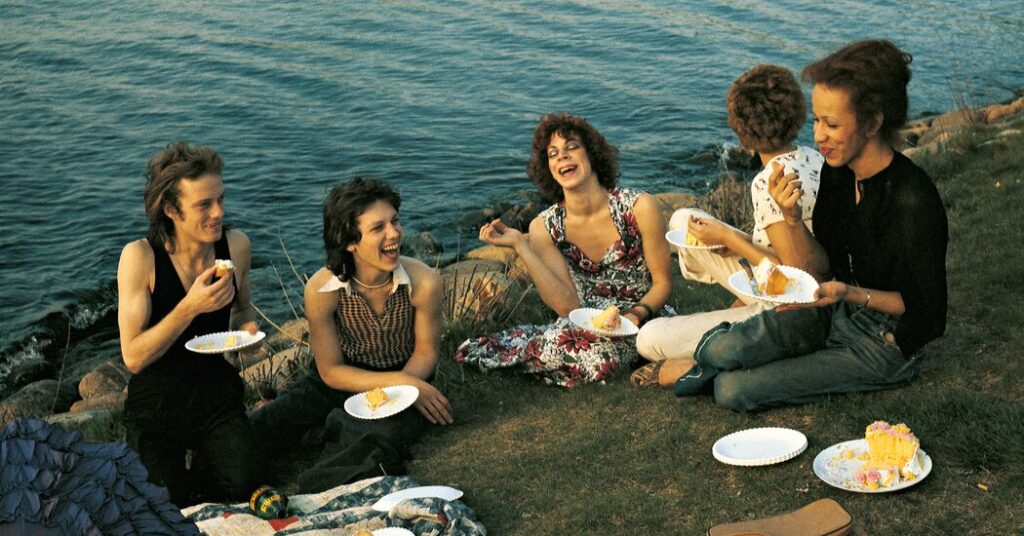
Leave the spiritual definition of art to the sublime photographer Nan Goldin, as O’Grady quotes her. “There is a misunderstanding that my work is about marginalized people,” she says. “But we were never marginalized, because we were the world. We didn’t care what straight people thought of us.” Amen.
HOW IT FEELS TO BE ALIVE: Encounters With Art and Our Selves | By Megan O’Grady | Farrar, Straus & Giroux | 257 pp. | $29
The post Why Look at Art? This Critic Has Some Ideas. appeared first on New York Times.