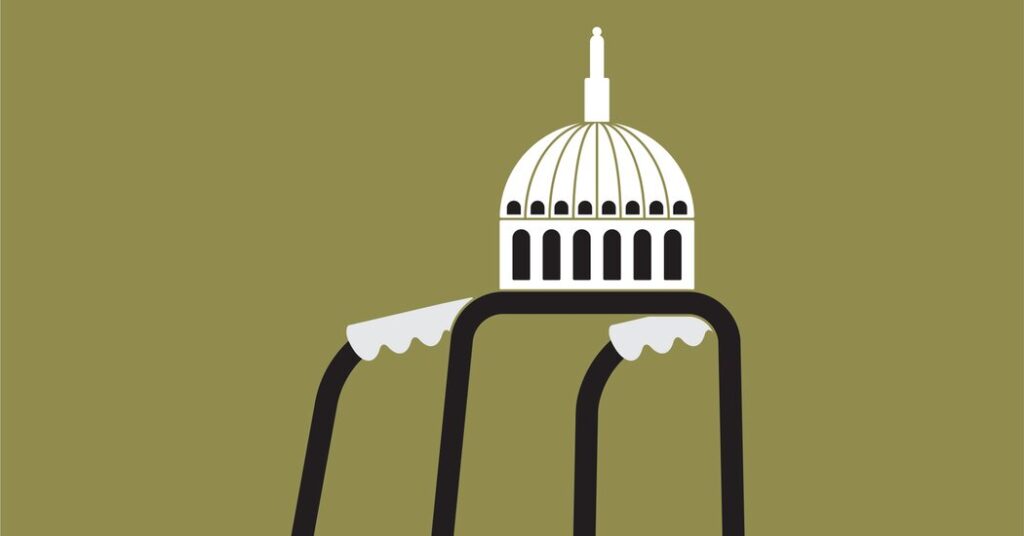
“Ageism” identifies an enduring phenomenon: the mistreatment of older people for no reason other than being older. Americans in middle age and beyond are routinely passed over for opportunities because of the irrelevant fact of a number on paper or how they act and look after getting older.
In today’s world, the unfair discrimination they cite coexists with a different kind of unfairness: a gerontocratic society in which the old control ever more power and wealth, leading to overrepresentation in political life and unequal power in social life.
It is not ageist to ask whether older people should be required to give more to younger Americans and national priorities — it is critical to the future of our democracy and society. America needs to confront gerontocracy before the system collapses under the weight of its inequality and injustice.
Older Americans deserve a say over the future even when they might not live to see it. But they do not deserve the stranglehold over it they currently enjoy through overrepresentation in elections, which produces too many regressive policies and too many seniors in the highest offices.
Older Americans are owed the care that everyone else funds. Indeed, they should get more of it than they get now — including funding for long-term care at home or in nursing homes. But they also need incentives to give up accumulated housing, jobs and wealth.
In little more than a century, the extension of life has transformed American and global politics. It turned older Americans, who had been one of the most underprivileged groups in the country, into some of the most overprivileged.
Some of the excessive power that the aging have amassed harms society, as they enjoy advantages to the detriment of others. That power hurts a large number of elderly Americans themselves. Crucial priorities for the future, like creativity and dynamism, environmental remediation, immigration policies and tax fairness also suffer under gerontocracy. Older Americans favor restrictions on immigration most, even when they need immigrant caregivers most. Likewise, there is a correlation between age and resistance to policies to halt the overheating of the planet or raise funds for education and other civic purposes.
Our presidents are too old. So is our political class in general. But the hidden depth of gerontocracy is the advanced age of voters and the people holding wealth in this country.
Seniors dominate elections, especially local and off-cycle ones, with their comparatively high rates of participation. According to Phil Keisling, a former Oregon secretary of state, the median age of eligible voters these days is about 48. But the age of actual voters is about 52, and on the way up: Outside presidential contests, it is 55 or 56; in primaries, it is 65. Older Americans also disproportionately spend in elections. For example, in 2014, the most common age of the donors who financed that election was as high as 70.
The wealth picture is stark. From 1990 to 2010, the median net worth of households headed by adults over 65 grew by 42 percent. In the same period, in households headed by adults 18 to 34, median net worth fell by 68 percent.
During and after the financial crisis, the gap got even worse. In 2019, it was calculated that Americans under 40 years old, who added up to 37 percent of the population, held a mere 5 percent of America’s wealth, whereas those over 54 — the same number of people — held 72 percent. Only in the few years since the pandemic have young people begun to bridge the chasm that has been established between older haves and younger have-nots.
This is not coincidence. After mandatory retirement was eliminated in most fields in the early 20th century, older workers held on to some of the best positions. The United States has one of the highest wage inequality by age of any country in the world, and the numbers keep getting worse: The pay gap between workers over 55 and those under 35 widened 61 percent between 1979 and 2018. The share of workers over 55 in the work force rose 88 percent in those same years.
Housing follows the same pattern. Older Americans own much of the most desirable real estate in the country’s best cities, and they are not moving. The 70-to-74 age group has the highest homeownership rate in the nation — above 80 percent — and those 75 and older are close behind. The median age of a home buyer was barely 30 in 1981; by 2024, it was 56.
There is no denying that ageism continues to be a scourge. An appalling number of older Americans live in poverty or barely above it and suffer routine discrimination.
But it’s clear that older Americans have helped widen the chasm between classes in our neoliberal era.
Age discrimination also affects the young. In the United States today, six to seven federal dollars go to seniors for every one that goes to children. It is plain that privileging one group can raise legitimate questions of unfairness. The benefits older people get relative to younger people — especially lucrative tax advantages — mean they are already treated differently.
Treating them differently should include limits and obligations, too. It is not ageist, for example, to impose age ceilings on political offices of all kinds (including federal judgeships). Nearly 80 percent of Americans support age limits for federal elected officials, and politicians have made proposals to cut them off at age 75 or some other reasonable threshold. America could, like several other countries, explore age-related quotas to represent groups across the life span, since age limits are likely to leave politicians clustering near any maximum age set.
It is not ageist, either, to begin to save our democracy from gerontocracy. Proposals range from making it easier to cast a ballot — since current requirements routinely hurt younger voters who move around a lot — to institutionalizing mandatory voting. A bigger fix might lower the voting age.
It is not ageist, finally, to impose policies to transfer jobs, houses and wealth down the generational chain. There are ways of doing so indirectly, by reversing the effects of the tax revolts that have uncoincidentally marked America’s gerontocratic age, ever since California’s Proposition 13 passed in 1978.
There are also direct ways of recognizing that age affects opportunity and resources. The most obvious is to reinstitute mandatory retirement in those employment sectors (especially white-collar work) where generational renewal has been obstructed for years.
In housing, besides circumventing the disproportionately high elder participation in town meetings where land-use decisions are made, I advocate a progressive tax on older homeowners to incentivize them to downsize rather than retain. The longer you stay, the more you should have to pay. The funds could allow for new construction and other projects of intergenerational justice, especially educational ones that prioritize unleashing our young people into the creative prime of life.
Some people have attacked the elder skew of federal benefits as a pretext for abandoning the welfare state, but improving it is the better choice. Since 1935, the rise of the Social Security program properly recognized the unique vulnerability of senior citizens, and Medicare provides for some of their care and treatment. At the same time, Medicare’s exclusion of funding for long-term care at home or in nursing homes understandably leads the aging to worry that they will run out of money before they pass away, which exacerbates and rationalizes their choice to stash for a rainy day.
Improving the welfare state for all who need it — including the old — could reduce the motivation for holding onto housing and jobs, not just bank accounts and stock portfolios. In this sense, countering ageism and gerontocracy sometimes involve the same reforms.
Ageism has not ended, but that should not stop those questioning and seeking to rein in American gerontocracy.
Samuel Moyn, a professor of law and history at Yale, is the author of, most recently, the forthcoming “Gerontocracy in America: How the Old Are Hoarding Power and Wealth — and What to Do About It.”
The Times is committed to publishing a diversity of letters to the editor. We’d like to hear what you think about this or any of our articles. Here are some tips. And here’s our email: [email protected].
Follow the New York Times Opinion section on Facebook, Instagram, TikTok, Bluesky, WhatsApp and Threads.
The post Older Americans Are Hoarding America’s Potential appeared first on New York Times.