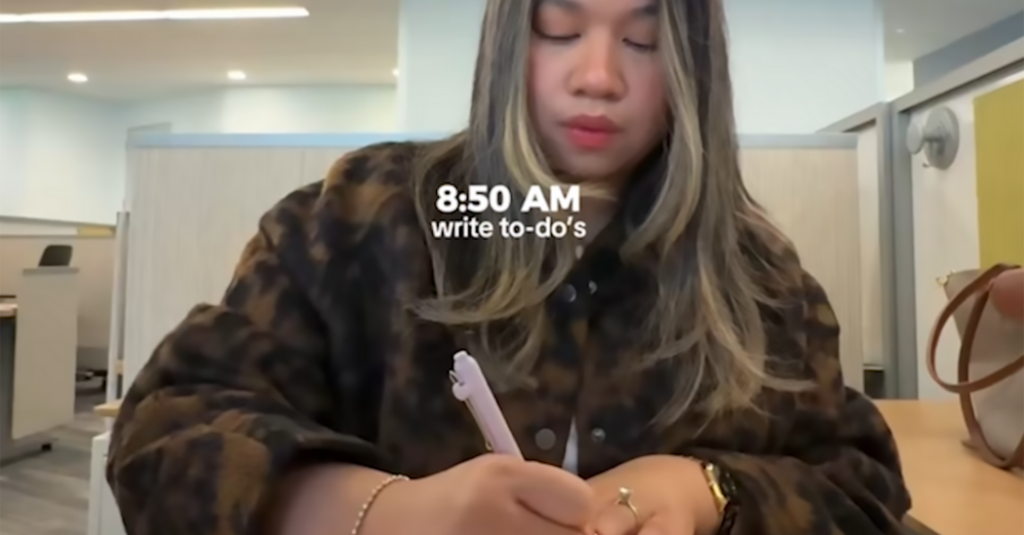
A video opens on a scene of stark banality. A young woman types assiduously on a keyboard in an unnamed office. A headline announcing, “DAY IN MY LIFE: 25-year-old working 9-5 in corporate america,” appears at the top. What follows is a sequence of white-collar tasks, treated with the bland ceremony of pruning a bonsai.
In another video, a woman who works as a “big four management consultant” helps brainstorm marketing ideas with the help of obscure phrases like “Stimulist of Brutal Well Being,” accompanied by propulsive filler music. In another, events like ordinary conversations are tagged with precise beginning and ending time stamps. The daily grind is relieved by nightly streaming, with services like Hulu standing in for any individual show or viewing option.
Post-pandemic, there has been a slow creep of such “day in my life” videos, which trace the rituals and etiquette of standard office culture, framing the mundane as aspirational. As the genre has grown, these routines have taken on a mystical glow of pleasing predictability, yielding a tool kit of repeatedly used tropes. There are the ASMR keyboard clacks, the to-the-minute time stamps, the takeout and the caffeinated beverages, the rapt appreciation of basic consumer goods. They occur in comfortable, if prosaic, accounting or consulting firms, P.R. shops, insurance cubicles or regional government offices.
The genre often highlights different spins on Americana, like a Capitol Hill press secretary preparing a flier commemorating Pearl Harbor or a man who identifies as a dad, a landlord and a “Fed” carving out time for the Pledge of Allegiance and lunch breaks to “fuel the meat suit.” Its conventions are so entrenched that they’ve become elastic, in fact, with one parody video applying the structure to the life of a weapons manufacturer. In previous times, such scenes might have been the backdrop for a satirical novel about crushing corporate tedium or a Mike Judge comedy. Yet, recently, this genre has boomed among creators and their audiences, who seem to yearn for office conventions and etiquette lost in the Covid era to omnipresent blue light and DoorDashed pad Thai.
Some users curate these proliferating videos as semi-ironic souvenirs — mementos of a supposedly extinct way of life that also function as specimens from an emerging online aesthetic. There are even “TikTok anthropologists” of the genre, such as the X user @coldhealing, who observes in the videos a kind of Midwestern sublime, an already forgotten sense of late-aughts “normal.” In this vision, transcendence may be found in a highway-side Taco Bell or in the latent possibilities of an Excel spreadsheet. Imagine “Severance” if everyone were wearing Under Armour.
Part of what feels so searching and meaningful in these videos is a paradoxical mix of nostalgic, suburban communalism with a uniquely contemporary isolation. One emblematic video, which went viral last fall, starts by showing a charmingly solitary man wrapping his workday and pumping his fist joyfully on his way home. He then packs a “snacky” lunch for the next day, cheerily mows his lawn, opines on the benefits of “night showers” and retires to his “man attic” to game.
Comments on the video were split. Some were celebratory, calling this embrace of stability and wholesome amusements “modern enlightenment.” Others dismissively called him an “NPC.” Despite an unseen partner the creator mentioned in the comments, people seemed to fixate on the lack of other people in the frame. A convention of the genre is an “alone in public” aspect — where figures consciously or unconsciously exalt the well-adjusted life in solitude.
This sense of being adrift within ostensible comfort is crystallized in the saga of @hubs.life, an early 9-to-5 “day in my life” poster. In an indicative early video, Hubs describes himself as a 28-year-old with a “normal” job and stoically moves between anonymized desk work and rewards like consuming “leftover jersey mikes” and watching TV. (His placid expression makes you wonder whether he can see beyond the veil to some suburban empyrean.)
An activist in pursuit of “normalizing the norm,” Hubs was seen early on by his fan base as an advocate of staid, unsexy routine. In a twist, he eventually became so popular that he left his 9-to-5 to become a full-time influencer. This violation uncovered two overlapping audiences drawn to Hubs for different reasons: those who found validation in his manifesto of predictability and those who saw it as an ego-shattering paean to the humdrum. For both, devotion to the routine seemed to be nonnegotiable; to break away or perform it halfheartedly was a betrayal of one of the genre’s deepest principles: that you actually want the life you broadcast.
In a time of disruption to everyday existence — whether through A.I. or global instability — these familiar, “normal” jobs have taken on an increasingly auratic sheen. The common denominator of these videos seems, understandably, to be a pining for economic solidity and human connection, an expectation of security that, until recently, felt like something one could always fall back on. Yet the strange worm in the apple of contemporary self-imagining dictates that one must adopt an entertainer’s isolation in order to be the hero of one’s story. Like illusionists buried in ice, these influencers exude calm, yet seem trapped. In a question that could be posed only in a MrBeast video: Could you live the rest of your life in pleasurable doldrums as a bit?
Casey Michael Henry is a writer based in New York City. He publishes the cultural newsletter Slim Jim.
The post The Generations Fantasizing About Boring Office Jobs appeared first on New York Times.