Virginia voters will decide on Tuesday whether to allow Democrats to redraw the state’s House map to give their party an advantage. It’s one of the country’s final redistricting battles before the November midterm elections.
If the referendum passes, Virginia’s Democratic-led legislature will be empowered to create a congressional map that leaves the state with just one safely Republican district. Virginia’s 11-member House delegation currently consists of six Democrats and five Republicans.
Democrats have spent heavily on the election. But voters appear split, according to opinion polls. Even if the referendum is approved, the Democrats’ plan, which has so far survived legal challenges, will face further scrutiny in court.
Here’s what to know:
What is the question in front of voters?
Congressional districts are normally redrawn at the start of each decade. The ballot question asks voters whether they want to change the Virginia Constitution to allow state lawmakers to carry out mid-decade redistricting this year.
It says: “Should the Constitution of Virginia be amended to allow the General Assembly to temporarily adopt new congressional districts to restore fairness in the upcoming elections, while ensuring Virginia’s standard redistricting process resumes for all future redistricting after the 2030 census?”
Why is this happening?
For months, Democrats and Republicans have been engaged in a coast-to-coast redistricting fight. It started in Texas, after President Trump urged Republicans to redraw the state’s congressional map to potentially add five Republican seats.
Democrats in California responded by redrawing their state’s map to potentially add five Democratic seats. Then other states, such as Virginia, joined the fray.
Overall, Republicans have built a small national advantage in the redistricting battles this cycle.
Good-government groups have howled at both sides, and the Supreme Court quashed a redistricting effort by Democrats in New York. But the court upheld the maps in Texas and California.
What is each party’s argument?
Democrats say they are trying to even out the national playing field in response to Mr. Trump’s push to gerrymander districts in deep-red states. In Virginia, they say, they are trying to cancel out Republican redistricting gains in North Carolina, Ohio and Missouri.
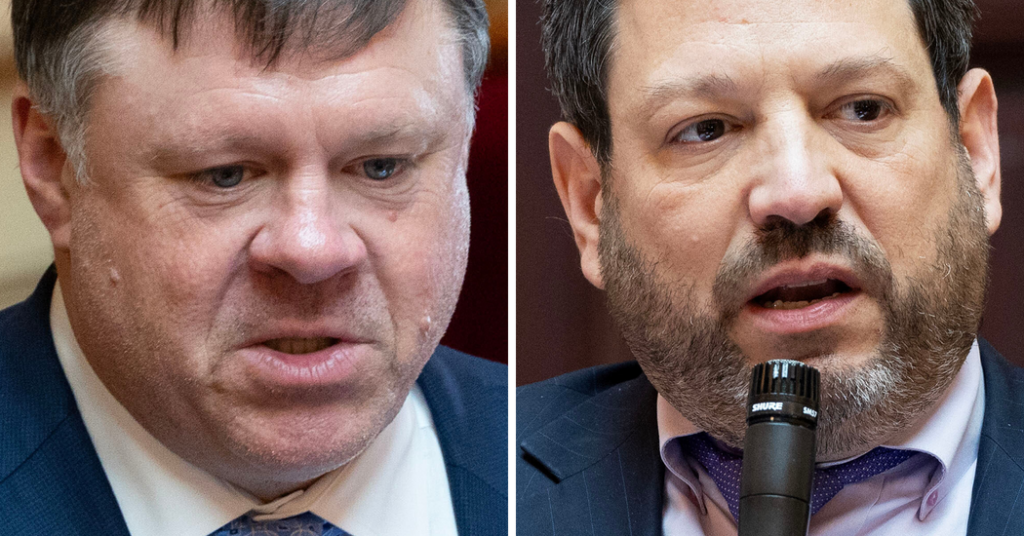
“The future of American democracy is at stake,” said State Senator Scott A. Surovell, the Democratic majority leader.
Republicans have cast the referendum as a partisan power grab that would disenfranchise Virginians.
“Two wrongs don’t make a right,” said State Senator Ryan T. McDougle, the Republican minority leader.
What do the ads say?
The Republican-backed “No” side has run commercials featuring old footage of Barack Obama saying that gerrymandering pushes the parties “further and further apart” and makes it “harder and harder to find common ground.” Republicans have filled mailboxes with fliers showing Black families, whose votes have often been diluted by gerrymandering over the years.
Mr. Obama supports the referendum and has sought to clear up any confusion. On Friday, he released a video in which he urges voters to vote yes — using the word five times in 48 seconds. He says in the video that voters “can push back against the Republicans trying to give themselves an unfair advantage.”
Democrats have tried to use another president to motivate voters. A county Democratic Party in a conservative part of the state put up a billboard with a picture of Mr. Trump next to the words “Vote Yes.”
When are polls open?
Polling places are scheduled to open at 6 a.m. and close at 7 p.m.
Voters are expected to provide a form of identification, such as a driver’s license or a student ID. A list of approved forms of ID can be found here. (Voters who do not bring ID can cast provisional ballots.)
Virginia tends to count ballots relatively quickly.
During the early voting period, turnout was high. It approached the early vote numbers from the 2025 governor’s race, which drew the highest nonpresidential turnout in state history.
If the referendum passes, what’s next?
The Virginia Supreme Court allowed the referendum to take place after reviewing complaints arguing that the vote was set improperly and that wording in the ballot question — calling for new districts to “restore fairness” — was misleading.
But the court has not issued a final ruling on the legality of the effort to overhaul the House map. Instead, it set a schedule to review the issue after the referendum.
The post What to Know About Virginia’s Gerrymandering Fight appeared first on New York Times.