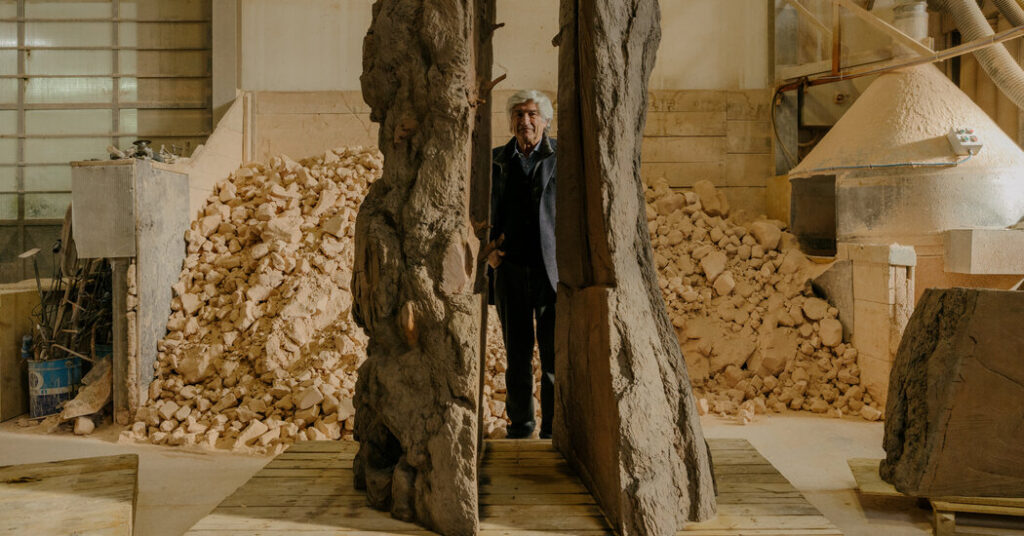
At a warehouse complex in Turin, Italy, the artist Giuseppe Penone swung open a steel door and revealed a world of his making: life-size sculptures of trees standing like a peculiar forest of metal. Slabs of bark carpeted the floor, and a bough of bronze was aflame as it was being soldered to a trunk — all in preparation for the artist’s sprawling new show at the Gagosian gallery in New York.
“A tree is, by its very nature, an extraordinary sculpture,” Penone said, walking among his works. “Every branch springs forth according to its drive to survive, so the tree’s form is a record of its life story.” As artistic subjects, trees also require giant spaces, and Penone has bought up a number of warehouses around his Turin studio where he sculpts and stores them, maintaining his creations on view as if they were in a private museum.
Since the 1960s, Penone has been a leading figure of the Arte Povera movement, whose avant-garde proponents created spare, metaphorical works using humble or organic materials. Today at age 79, he is working with ever-mounting intensity amid a surge of exhibitions in recent years — as he acknowledged with a wide smile, his thick shock of silver hair fluttering as he laughed. (With a woodsman’s robust health, he installed his mammoth works alongside a young team at Gagosian.)
Penone’s work originated in the forests of his native Piedmont region in northern Italy, where he treated nature as a collaborator. For one of his earliest works, he gripped a tree and left a model of his hand in place, photographing the trunk as it gradually enveloped his fist, casting the eventual form in bronze.
In his early 20s, Penone and other artists of the 1960s were rejecting conventions about working in traditional studio spaces; the woods became his studio, and trees his interactive subjects. His work revealed the symbiosis between them and humans, and even posited their equivalence.
“I wanted to place my body in dialogue with the natural world, linking my life with the life of a tree — living, like me, just at a very different rhythm,” said Penone, his fingers pirouetting across the smooth bronze surface of one of his signature debarked trees in the warehouse. In his initial years, he whittled down square wood beams to lay bare the sapling within, following the hairline contour of a growth ring “to reveal the forest inside the timber.”
Penone’s father traded produce among farmers in the Maritime Alps, and Penone would accompany him, entranced by “the primitive, ancestral dimension there, the way nature dominated every aspect of the culture,” he said. “This was the view of reality that shaped my creations.” Today he has his own tract of forest, where the occasional fallen chestnut tree or larch may become an artwork.
Penone married Dina Carrara more than 50 years ago, and she has remained a lifelong force in his studio. Their son joined them as head of archives, and their daughter became a plant biologist — the whole family shaped by Penone’s arboreal sensibility.
When the critic Germano Celant baptized the Arte Povera movement in 1967, Italy was transitioning to a consumer society, and artists were rejecting the market logic imposed on their work by using overlooked materials, and focusing on organic reactions, physical transformation and time — like Jannis Kounellis’s live flame works and Mario Merz’s igloos with broken glass or sand.
Penone’s tool kit included wood, bark, leaves and stone — but also his breath, as well as impressions made from his skin. Bronze, a more canonical material, has also remained constant in his output.
Bronze is a “perennial” medium, he points out, central to sculpture since antiquity. In Penone’s hands, bronze makes a monument of what is otherwise ephemeral: A tree’s younger self, excavated when he strips away its outer layers, is frozen by metal. The title and theme of the Gagosian show, “The Reflection of Bronze,” is drawn from an included work.
Bronze had fallen out of favor when Penone began using it — it was too establishment, too bourgeois for the ’60s — but the artist reclaimed the material for the longevity it represents. To him it “corresponds to the idea of stopping time: creating a work in the present that will, in some way, connect with the future,” he said.
“Why do we make art?” Penone said. “Because of a desire to outlast our destiny — to overcome death through the survival of our work.”
He gave his breaching smile. “The urge to create is the urge to immortalize your own existence.”
The small Tuscan town of Pietrasanta is a stronghold of artisan sculpture production, where Penone visits the Del Chiaro bronze foundry at least a dozen times a year to inspect the progress of his works there.
On a sunny late-winter day at Del Chiaro, copies of classic sculptures stood in the parking lot — the ancient Greek Riace bronzes, a full-size reproduction of the David — while Penone’s sculptures lay on crates in the sun, and crowded a workshop inside.
Amid stacks of plaster molds were big trees in bronze, each carved to reveal the saplings they had once been: four iterations of Penone’s “Clepsydra” (“Water Clock”) headed to the Gagosian exhibition, the tree in its different ages rendering time a visible phenomenon.
Branch by branch, Penone’s trees are formed in molten bronze, using the technique of lost wax casting, a 6,000-year-old process in which a wax model is encased in a mold and melted out, with liquid metal poured into the cavities left behind. Following diagramed maps of the trees, Del Chiaro’s artisans soldered each stem in place, using natural patinas to render the bronze more woodlike. The sculptures were then packed into four shipping containers for the one-month oceanic journey from Italy to New York, paid for
by Gagosian. (The exhibit is on view from April 22 through July 2.)
Del Chiaro casts works by artists — among them, Maurizio Cattelan, Fernando Botero, Igor Mitoraj — and has collaborated for more than two decades with Penone, whose monolithic and multi-ton sculptures can rise several stories.
“Maestro Penone always gives us work that’s quite a challenge to make,” said the owner, Franco Del Chiaro, “but it’s satisfying because he shows up with his dreams, and we turn them into reality.”
That bronze defines the Gagosian show is in part the choice of its curator, Adam Weinberg, the former longtime director of the Whitney Museum. At the American Academy in Rome, where he is a boardmember, Weinberg took a seat in the courtyard by a wall of Roman antiquities.
“Bronze has always been an essential medium for art, because it possesses such sensitivity for texture and materiality that it’s as if it captures the very skin of life,” he said. “It’s a time machine — it fixes a moment forever in place.”
Sculptures like Penone’s husked trees, or casts of a tree grown around the artist’s hand, unite “ephemerality and eternality,” Weinberg said, explaining that what Penone depicts is life in process.
The show at Gagosian presents a sweeping reimagination of the gallery, “turning it into a completely different environment and experience — like a walk in the woods,” as Weinberg described. Almost 700 sheets of cork clad an entire gallery hall, like organic shingles, hushing the space “so it feels like being in a forest in the middle of Chelsea,” he said.
At the center of the room stands “Marsia,” a skinned tree trunk strung up on its bark. In a Greek myth, the satyr Marsyas challenges the god Apollo to a musical contest and loses. As punishment, he is bound to a tree and flayed alive: a brutal symbol of transformation and the ancient Greek preoccupation with metamorphosis as a means to transcend death. In Penone’s visual retelling, the tree’s decorticated wood looks as veiny — and as pitiable — as human flesh.
“Riflesso del Bronzo” (“The Reflection of Bronze”), the namesake work, closes the show: A mirror made of polished bronze, mimicking the mirrors of antiquity, has been waxed and cast multiple times to produce an ever rougher version: A Dorian Gray deterioration has overtaken the mirror, “documenting process and transformation,” Penone said.
His sculpture retrospectives have always been staged at major institutions with expansive gardens or vast halls, like Versailles, the Rijksmuseum and the Centre Pompidou. This show brings both new and historical grand-scale works to a cavernous three-hall gallery housed in a onetime Chelsea truck warehouse, with a show “like a museum experience,” Weinberg said.
Weinberg, a self-declared partisan for public museums, was drawn to the chance, at Gagosian, to “connect people” with Penone’s work, which is sought after by major collectors like François-Henri Pinault and the Glenstone Foundation as well as prominent museums, though he is better known in Europe
than in America. All of the works on view at Gagosian are for sale, priced from $800,000 to more than $2 million.
The opportunity to transport his immense trees across the Atlantic is something “museums can rarely support now, and galleries are taking their place,” Penone said, as he toured another of his private Turin warehouses arranged with art.
A colossal hollowed-out tree lay in halves, stretching horizontally across the former industrial space. He ran a hand along the trunk, where he had whittled away layers of wood, the younger tree inside now forever exposed.
“The role of art is as a container for thought,” he said. “And the ambition of an artist is to give permanence to thought — to leave a trace.”
Penone repeated the invocation skyward: “To leave a trace,” he said. “To leave a trace.”
The post For Italy’s Art Pioneer, a New Bronze Age appeared first on New York Times.