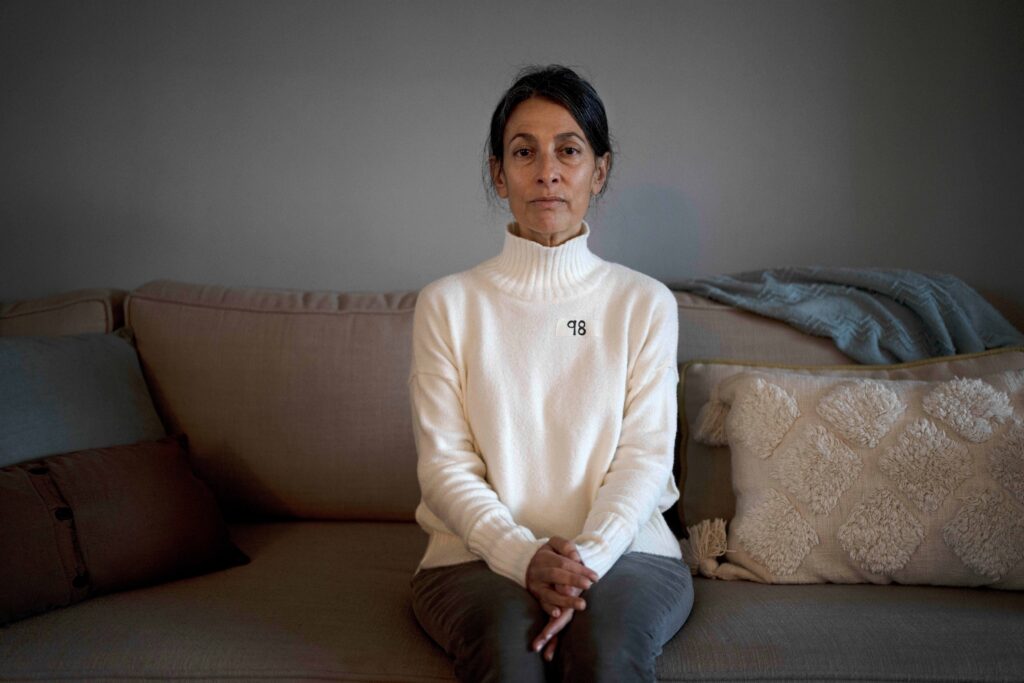
The last time Rachel Goldberg-Polin heard from her son, Hersh, was the morning of Oct. 7, 2023. At 8:11 a.m., the 23-year-old sent two messages: “I love you,” and “I’m sorry.”
Until that day, Goldberg-Polin writes in her new memoir, her family had a “regular and beige” life. They were “blessed and lucky.”
“When We See You Again,” Goldberg-Polin’s just-published book, is an excruciating look at everything that followed.
Hersh was at a music festival when Hamas attacked Israel. His left forearm was blown off by a grenade. Then he was abducted and taken into Gaza, along with about 250 other hostages.
Rachel and her husband, Jon Polin, both originally from Chicago, emerged as relentless and eloquent advocates for their American Israeli son, who was born in California and raised in Jerusalem.
In August 2024, after almost 11 months in captivity, Hersh and five others were killed by their captors in a tunnel deep underground. They were starved and filthy, Goldberg-Polin writes, and Hersh had been shot six times at close range.
Goldberg-Polin’s book is a excavation of a mother’s grief for her only son, a young man who loved to travel and do crosswords and whose “eyes were cookies.”
She spoke with The Washington Post via Zoom from her home in Jerusalem. This interview has been condensed and edited for clarity.
I’d like to start in the present. Could you tell me what the last month or so has been like for you, since the war with Iran began?
For me personally, it’s kind of surreal.
We had a lot of sirens and a lot of running to our safe room, which ironically is Hersh’s bedroom. So there were a lot of conversations with myself [about] where do I go to be safe? I go to this room that has the vapors and fumes and essence of Hersh still, because we have not touched his room. And we really haven’t touched this room, it’s embarrassing, it’s very dusty. I started to dust part of it because we were spending so much time in there during these sirens.
I think like so many of the broken, death is not something that’s scary for me anymore. The anxiety that is triggered when you hear a siren, or when you hear missiles flying over you, a normal person would react with worry or fear. I’ve said that part of my brokenness is that the fear has been scared out of me.
When the book’s release date was announced in January, you had no idea it would be published during a new conflict in the Middle East. I’m curious whether there are particular challenges talking about it at a time when Israel and the U.S. are waging war on Iran and its proxies? Is there a particular message you’re hoping to send in this context?
From day one until right now, I really tend to zoom out and look at the reality that in world history, the people who suffer the most during war and conflict are the innocent people, not the people in power and not the decision-makers. I’m one of those normal, average people. And when Hersh was being held, I kept on trying to talk about these two truths: that I was terribly concerned and worried about the innocent civilians in Gaza, and I was terribly worried and concerned about the innocent civilians in Gaza who were dragged there on Oct. 7. One of them I happened to know very well personally and shared DNA with. You didn’t have to choose, you could hold those two truths. I still feel that now.
There was a journalist who said early on after Oct. 7, “If you only cry when one side’s babies die, it means that your moral compass is broken and therefore your humanity is broken.” A couple of weeks ago I saw a picture on the front of the newspaper of a boy’s face and I burst into tears. It was a boy whose background was not similar to mine. I started to realize I was crying because I was so glad to know that my moral compass was still intact after all this time, because he had lost his family. And that is a tragedy.
This book doesn’t have an agenda. It’s a book about four things in this order: love and pain and pain and love. There’s nothing unique about me. There are millions of mothers who have buried their children, millions. I just happened to say, I would like to give over my pain. The weight of the suffering and the pain was buckling. I couldn’t shoulder it anymore, and I started to write. It wasn’t even as a book. It was just, “Help.” I’m literally drowning. I need to do CPR to myself, or I need do the Heimlich [maneuver] to get this out because I am choking on the suffering.
The book is very restrained in some ways. Tell me about the choice you made to not to mention by name any of the world leaders you met over months of pushing for Hersh’s release.
We met every person you can think of, and I don’t name one of them. Some of them were wonderful, and some of them, it was very clear that they hated me. It wasn’t personal. We were in countries we shouldn’t have been in. We snuck into places, we snuck out of places, we did everything your mother would have done for you and your father would have done for you. And the book was not about that.
When someone’s writing you a love letter, if they start writing about, I don’t know, politics or military tactics, it’s not a love letter anymore. Maybe there’ll be time for that. But that’s not what this book is. This book was, here is my pain, and I love you, my son, my only son, the person who turned me into a mother. And I don’t know how to breathe in this world without air. And I don’t know how walk in the desert without water. This is my challenge. Because I’m still here.
There’s a point at which you describe a deal of sorts to release the hostages that was scuttled when someone in Washington leaked its existence. Can you tell me more about that?
I can’t.
Why not?
Because it would endanger people who are still alive.
There’s a powerful part of the book where you talk about meeting Or Levy, a hostage who was released in February 2025 and who had spent time with Hersh in Gaza. Levy told you that Hersh would repeat a quote from Holocaust survivor Viktor Frankl.
Or [Levy] was released from captivity after 491 days. He had just been told his wife had been killed, he had just been reunited with his 2-year-old son and he asked to speak to us. He and Hersh became very close. Hersh had said to him: “Listen, when Viktor Frankl was in the concentration camps, what got him through is he kept saying something similar to what [Friedrich] Nietzsche originally said. When you have a why, you can bear almost any how.” It became their mantra: What’s your “why” today?
Levy also told you that Hersh heard your voice over the radio while he was in captivity. What was that like?
It was like time stopped. Suddenly I had at least the knowledge that he knew, he knew we were trying, we were running to the ends of the earth. We failed. But he knew. That’s really important as a mother, as a person. That was a real gift.
I have many blessings in my life. I have these two vivacious, dynamic, intelligent, hilariously funny daughters, and I have this magnificent partner in Jon. And I know that there is a god, and a rhyme and a reason and a masterpiece and a tapestry. I may never be privy to the tiny dot that I am and why what happened to me had to happen, but I really know that this is not a punishment and it wasn’t an accident.
One of the things that comes across so strongly in the book is that you have become a kind of repository of other people’s painful stories. Strangers approach you all the time.
We get thousands of messages a week, thousands. We wake up to hundreds of messages a day of people feeling what I felt, which is a need to share. It’s too heavy. It’s too much. I cannot bear this weight. Help me. Even if you take a molecule. Please.
I know I’m a painful symbol for so many people. I walk down the street here and I wear a covid mask and I try to wear a hat because I am someone who causes people to remember things that are exceptionally hard to handle and they cry. It’s hard to be a trigger for people crying.
You know sadly, I would love it much more if I was recognized because I cured cancer. Or because I was a talented artist. But to be known because your child was stolen, maimed, tortured, starved, and then executed at close range and returned to you in a bag is a really horrible reason to be recognized. On the other hand, it is my life. That is who I am now. And people who approach me are coming from a place of the most deep, sincere, attentive, compassion, mercy, love and grace. And none of us know what to say.
I don’t even know how to be in this world like this, but I am. My “why” is not done.
The post An American hostage’s mother on her new memoir of ‘love and pain’ appeared first on Washington Post.