As the sun slowly approaches the horizon, the sand, boulders and scrubby desert plants all around begin to change. Perspectives subtly shift as shadows lengthen and the light turns golden across the Mojave Desert.
Here, as night falls on a dusty parcel of land just steps from Joshua Tree National Park, a group of artists and art lovers has gathered for a benefit dinner to celebrate the 25th anniversary of High Desert Test Sites, or HDTS.
Wearing a prim black dress buttoned at the collar, with her hair tied back, the artist Andrea Zittel is preparing to speak about HDTS, which she founded as an offshoot of her art practice shortly after buying five acres of land here that, back then in 2000, contained nothing but a small 1950s homestead cabin.
Since then, Zittel’s property has grown to 120 acres and the organization has hosted over 450 artists, hailing from as near as the neighboring communities of Twentynine Palms and Wonder Valley, and as far as England and South Africa.
Initially, HDTS was an annual event at which artists gathered to install or perform site-specific works in the desert. Over the years, it evolved into its current state: a nonprofit based on Zittel’s land, hosting short- and long-term residencies, along with year-round, artist-driven programming. More than an incubator for contemporary art, it is a place that invites people — both artists and viewers — to think more deeply about the way they relate to the earth.
“Before moving out here, I saw a lot of artists working in the desert who tried to dominate it or make a big statement in the middle of it,” said Zittel, 60, in a phone interview a few days after the benefit dinner. “I wanted to inhabit the desert in a way that was more collaborative. I wanted to live with it.”
Zittel spent 20 years doing just that, growing her live-work compound, which she calls A-Z West and which — in addition to the original cabin — now contains studios for weaving, ceramics and woodworking, along with a cluster of micro apartments for resident artists.
Although she moved to a smaller property a few miles away in 2022, after HDTS took over stewarding A-Z West, art and life continue to overlap in Zittel’s work. Over the years, she has made portable living units, including the spaceshiplike “A-Z Wagon Stations” that dot the rocky landscape, and furniture prototypes for cooking, dining and bathing.
Zittel is by no means the first artist to retreat to this remote desert landscape, and she certainly will not be the last. In the 1970s, the famed Pop artist Ed Ruscha began amassing property here, and the sculptor Alma Allen had a home and studio in Joshua Tree decades later. The assemblage artist Noah Purifoy arrived in 1989 and soon established his outdoor museum just north of A-Z West, which remains open to visitors today.
Slowly but steadily, artists have migrated to Joshua Tree and the surrounding desert, and the recent proliferation of art events attests to its magnetism. Desert X, a biennial exhibition of art installations in the nearby Coachella Valley, is approaching its 10th anniversary in 2027, and the High Desert Art Fair completed its third installment in nearby Pioneertown in March. However, unlike these transient events, HDTS invites artists to stay a while.
“I think it leads to more thoughtful work when an artist can spend time here before they make something,” Zittel said. During its 20-year run as a sometimes annual, sometimes biennial art event, HDTS invited artists to engage deeply with the land, leading to thoughtful, site-specific works that also captured the rough-and-tumble spirit of the desert.
In an artwork called “Payphone Project” from the 2006 event, the artist Mark Klassen, who lives and works in Milwaukee, installed a solitary pay phone in a sandy desert wash near A-Z West. The lonely phone booth contained massive infrastructure — Klassen dug and laid nearly 1,000 feet of phone wire, connecting it to a twin pay phone in Socrates Sculpture Park in New York, where, Zittel said, people could talk to whoever picked up the phone in Joshua Tree.
“It was a piece about distance, connection, and the weirdness of reaching out to a stranger,” recalled Zittel via email, “made even more surreal by its desert location.”
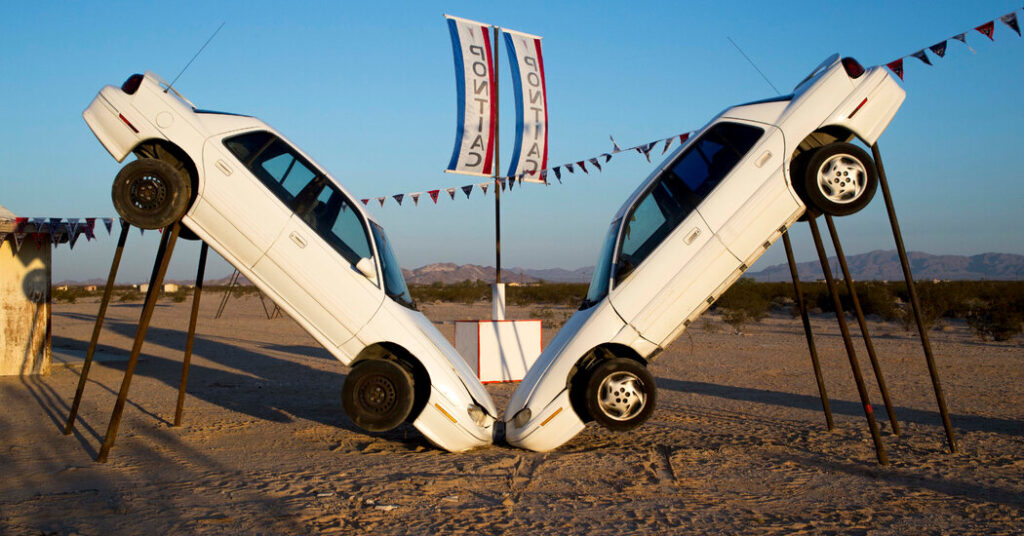
In 2013, the artist Jesse Sugarmann, who lives and works in Bakersfield, Calif., staged an installment of his ongoing series “We Build Excitement” here. In its Joshua Tree iteration, Sugarmann’s work consisted of several salvaged Pontiacs that he perched at odd angles atop a collection of precariously placed steel pipes, some with their noses facing the desert sand. The cars were installed next to an abandoned desert house, which the artist kitted out in the trappings of a car dealership.
“This was a quintessentially HDTS gesture,” Zittel said of the work. “It was absurdist, technically precarious, site-perfect and completely impractical in any institutional context.”
Even though the annual art event ceased in 2022, the desert has remained a constant, the landscape a central protagonist in the story of HDTS and the art produced there.
“In the desert, everything is alive,” said Lita Albuquerque, 80, an artist who has created earthworks in the Sahara and the Mojave and Arabian Deserts. As this year’s HDTS Fellow, Albuquerque has spent most of April in the A-Z West cabin, learning from the desert and ultimately producing work that engages both people and place.
“I’m going there to listen,” Albuquerque said in a recent video interview just days before beginning her residency. “The desert environment is a wide-open space; that’s why artists are so attracted to it. It’s the idea of the void, and within the void, everything exists.”
Much like the desert, the fellowship and the 75 annual short-term residencies are intentionally open-ended, as Zittel, who is now the artistic director of HDTS, wants it to be a place for artists to find deeper contextual engagement, and learn about themselves in the process. The short-term residents — who exchange their labor on projects here for time to live on the property and work in the studios — often find an intertwining of life, art and nature during their time in the desert.
“Learning to care for that land is very much learning Andrea’s philosophy,” said Andrea Bowers, an artist who lives and works in Los Angeles and was this year’s benefit dinner honoree, in a video interview. She added that Zittel’s philosophy “is about living with the land rather than controlling it.”
“Nature is in full force there, and it teaches you to live with less as a way of living with more,” she said.
As a growing population of artist transplants relocate to Joshua Tree and the surrounding areas, and the art scene keeps growing, HDTS remains something apart, something different — a conduit where art can gently touch nature. It is a platform not just for artists to make work, but also to find the mind-set shift that the desert demands.
“Andrea’s art is about reuse, minimalism and thinking about how to create a smaller footprint,” said Hannah Grossman, the current co-director of HDTS, in a video interview discussing the future of the organization. “We are returning to the roots of the organization — the things that were most important then are still important now.”
It is a sentiment that feels appropriate for the desert — a place with limited cell service, where water is scarce and windstorms and flash floods can sweep in on a dime, an ongoing reminder of humanity’s fragility in the face of environmental forces.
“It’s hard not to have deep thoughts about time and the force of nature as you move around the desert,” said Carolyn Pennypacker Riggs, an artist who worked with HDTS to stage an opera cycle in a sandy, boulder strewn wash at A-Z West.
As night fell on the benefit dinner, Riggs performed an excerpt from the opera in front of a massive boulder, while ripplelike projections washed over her under the dark, starry sky.
As Riggs put it, “being here makes you realize we’re just a little blip.”
The post How an Art Event in the California Desert Became a Community appeared first on New York Times.