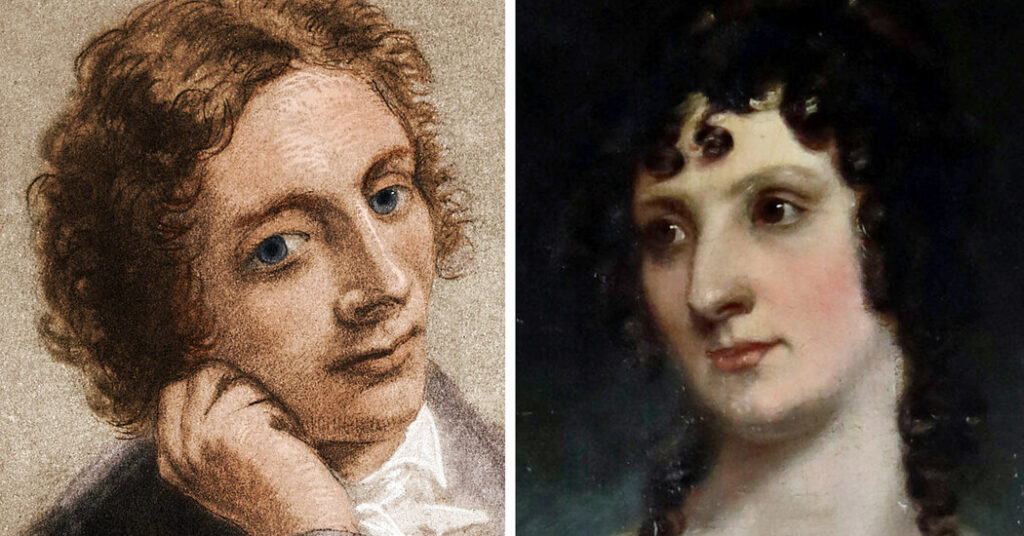
In early July 1819, John Keats sat down to write the first of his nearly 40 impassioned and now celebrated letters to Fanny Brawne, the love of his life.
The letter included one of the most memorable lines from the Romantic poet’s lyrical and often despairing correspondence with Brawne, who would soon become his fiancée.
“I almost wish we were butterflies,” Keats, then 23, wrote “and liv’d but three summer days — three such days with you I could fill with more delight than fifty common years could ever contain.”
Two years later, Keats was dead from tuberculosis, and Brawne, who had met the poet in 1818, when she was 19 and they both lived in London, mourned him deeply, preserving his letters and waiting a dozen years to marry.
Over time, that first letter and seven other handwritten missives to Brawne from Keats were artfully bound in a special leather volume, which was then shelved for decades at the Long Island estate of the Whitney family.
But in the 1980s, according to law enforcement officials, the book was stolen and its location became a mystery for nearly 40 years — until a man turned up with it at a Manhattan rare books store in 2024.
Since that moment, all manner of investigators, antiquarian booksellers and Keats scholars have been involved in an effort to authenticate the letters and track the book’s movements from the time of its disappearance. On Monday, in a ceremony at the Manhattan district attorney’s office, the book, valued at $2 million, will be returned to a Whitney heir.
“This is the literary find of a lifetime,” said Susan J. Wolfson, a Keats expert and an English professor at Princeton University who helped authenticate the book. “Every major archive in the world will want in on this.”
Keats’s love for Brawne became a consuming force in his short life, and helped inspire his sonnet “Bright star, would I were stedfast as thou art.” Keats devotees have venerated the Brawne letters for both their literary virtues and their window into one of the Romantic era’s most heart-rending love stories.
Keats’s genius as a poet was not widely recognized in his lifetime, though decades later his works drew high praise, and some of them, such as “Ode on a Grecian Urn,” became the stuff of English 101. His poem “Ode to a Nightingale” gave us the phrase “tender is the night,” which Fitzgerald used as the title of a novel a century later. (He also wrote the verse “a thing of beauty is a joy forever.”)
Keats is believed to have written 37 letters to Brawne between 1819 and 1820. Their contents were known — transcripts of all of them were first published in 1878 — but the exact whereabouts of the eight missing originals had long perplexed Keats scholars.
When Keats met Brawne, he was struggling to make his mark as a poet and coping with the early stages of the lung disease that would kill him. They quietly became engaged in 1819, but by 1820 Keats was so ill that he sailed for Rome to avoid the wet English weather and the letters ceased.
Brawne hid the letters, and when she died, in 1865, they went to the three children she had with Louis Lindo, whom she had married in 1833. The children agreed to publish them in the 1878 book “Letters of John Keats to Fanny Brawne.” Some Victorian-era critics derided the tone of the letters as immodest and unmanly, but others found them to be eloquent and often scintillating.
In 1885, Sotheby, Wilkinson & Hodge, a London auction house, sold the original 37 letters, and they were scattered among wealthy collectors. The eight in question are believed to have become the property of the Whitney family no later than 1915, and they were “beautifully bound into an extraordinary presentation,” as Ms. Wolfson, the Princeton professor, said.
(Other originals are held by Harvard University, Keats House in London and the New York Public Library.)
For years, the book owned by the Whitneys sat on a shelf inside the family’s 400-acre Greentree estate in Manhasset, N.Y. The estate, which was built in the early 1900s by Payne Whitney, heir to the Whitney fortune, is now run by a nonprofit foundation that promotes peace, human rights and conservation.
No one noticed that the book was missing until 1989, when it did not turn up as the Whitneys took an inventory of the estate’s holdings. The Whitney family filed a report with the Nassau County police in which the book was characterized as a “richly gilt” portfolio valued at more than $5,000. Each letter was described by its date and page length.
Nothing more was heard about the book until 2024, when a customer walked into B&B Rare Books on Madison Avenue and asked for help in selling the Keats volume and other rare works, including books by Oscar Wilde and the Brothers Grimm.
Joshua Mann, who owns the store with Sunday Steinkirchner, said the customer told them that the books had been bequeathed to him by his grandfather, who had kept them in a box at his retirement home in South Carolina.
But something about the man’s account made them pause. Mr. Mann said he and Ms. Steinkirchner convinced the seller to leave the book while they reviewed its authenticity and tried to establish a price. In fact, Mr. Mann locked up the book and began to research its history. Ms. Steinkirchner meanwhile approached Ms. Wolfson, who said she could tell immediately that the letters had been written by Keats.
A few days later, Mr. Mann said, the seller returned and asked for the book back. Mr. Mann said he told the seller, “I believe this book is stolen.”
Mr. Mann recalled having said to the seller, “The only way this book is leaving here is if you can show proof that you own it.” According to Mr. Mann, no such documentation was provided.
While researching the book’s history, Mr. Mann contacted the Art Loss Register, a London company that maintains a database of stolen art and other precious items. Within days, he said, the register responded that it had on record the 1989 police report describing the theft.
Around the same time, Matthew Bogdanos, who runs the Antiquities Trafficking Unit in the Manhattan district attorney’s office, also learned of the possible discovery of the letters and began a formal investigation.
Mr. Bogdanos arranged for the seizure of the Keats book, and he seized 16 other books that he said the seller, who was not identified, had also tried to consign for sale. All 17 books were identified as having belonged to the Whitney collection, and all were set to be returned on Monday. Mr. Bogdanos said the seller, through a lawyer, had agreed to relinquish the books.
Mr. Bogdanos said in a statement that “tireless efforts” lasting a year had allowed the district attorney’s office to return “an irreplaceable piece of literary history to its true owners.”
Antiquarian experts say the quality of the Keats book’s binding and the excellent condition of the letters make the emergence of the volume a literary sensation that is bound to attract high bids at auction.
“It’s shocking to learn that even one of these letters exists,” Mr. Mann said, “but to see eight of them together is honestly just insane.”
The post Stolen Letters That John Keats Sent to His Beloved Are Found appeared first on New York Times.