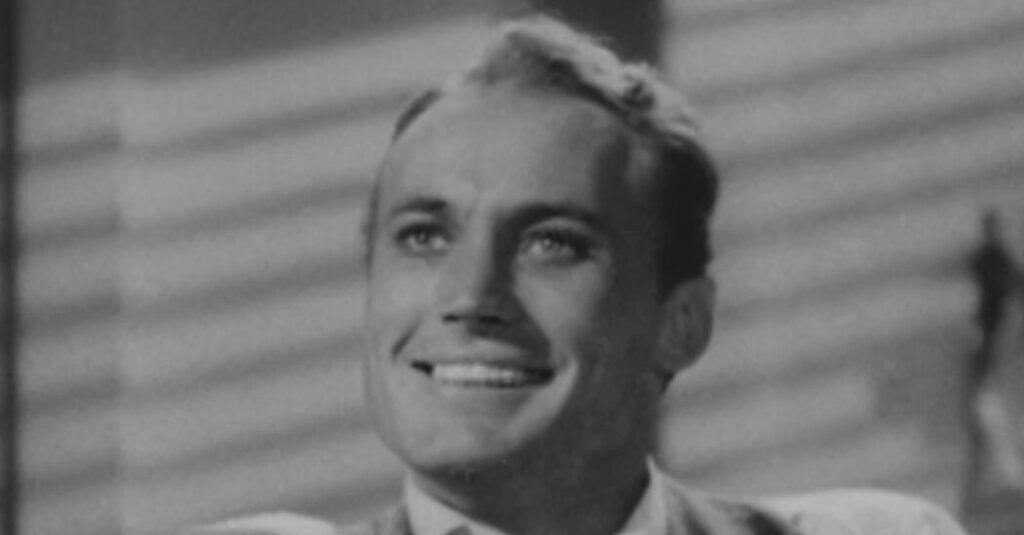
What’s a “good-bad” movie? It’s the kind of flick that might have you cackling, hollering or groaning, one that is not necessarily great cinema but is great fun. It’s highly watchable even though — or maybe because — it’s memorably ridiculous. And it always has at least one element that pushes it into absurd territory.
In the world of “Reefer Madness,” there is no greater indication that someone is on the verge of marijuana-induced lunacy than laughter — “sudden, violent, uncontrollable laughter,” the opening crawl warns.
Then, naturally, laughter turns to “dangerous hallucinations,” “fixed ideas,” “monstrous extravagances,” “emotional disturbances,” “acts of shocking violence” and “incurable insanity.” Yes, in that order.
The 1936 propaganda film directed by Louis J. Gasnier was initially a morality tale about the dangers of cannabis, or “The Real Public Enemy Number One!” that is “destroying the youth of America,” as the film declares.
A couple of years later, “Reefer Madness” — originally titled “Tell Your Children,” and also known as “Dope Addict” and “Doped Youth,” among other titles — was re-cut as an exploitation film.
Its legacy may well have fizzled there, but in 1972, Keith Stroup, founder of the National Organization for the Reform of Marijuana Laws, discovered the film in the Library of Congress archives.
He screened it at a New York benefit, catching the eye of Robert Shaye, founder of the new production company New Line Cinema. Shaye knew it had potential as an accidental satire so he rereleased it, holding midnight showings marketed to college students across California campuses in particular.
The rest is campy cult classic history, one that includes a 1998 stage musical, which has been revived in productions big and small around the country since, and a 2005 TV movie musical starring Kristen Bell, Alan Cumming and Neve Campbell. “Reefer Madness” may be the first film to be embraced by a generation because it’s so bad — or so bad, it’s good.
“I’m ashamed to say that it’s the only one of my films that’s become a classic,” Thelma White, who played one of the pot peddlers in the original movie, said in 1987. “I hide my head when I think about it.”
Here’s what’s kept audiences hooked.
What Makes It Good?
A Time Capsule
Capturing the vibe of youth culture was essential to how successful “Reefer Madness” would be in delivering its message. And in that, it failed fantastically. Its creators were clearly not knowledgeable about the effects of cannabis or how teenagers act (or, frankly, people in general). Almost a century later, the film’s claim that it’s “based upon actual research” reads like the footnote on the most unreliable Twitter thread.
One enduring merit of the movie is how it stands as a key artifact of a particular brand of moral panic of the 1930s. “Reefer Madness” is closely associated with the Motion Picture Production Code, or Hays Code. Adopted in 1930 and enforced in earnest in 1934, the code was a measure that established so-called moral guidelines for American films.
“Reefer Madness” embodied the spirit of this new code but was able to skirt those strict guidelines and show a good deal of what was prohibited in part because it was framed as educational material.
What Makes It Bad?
When It Misses the Joke
This movie was of course not conceived as the comedy it’s become, and the fun comes from the fact that it takes itself so seriously. But there are a couple scenes that don’t quite fit the narrative of watching it for kicks: most notably, an attempted rape scene, one that culminates in the woman’s death. It’s among several examples of the film’s hyperbolic warnings against promiscuity and sexual behavior.
What Makes It Good-Bad?
Hysterical, in Every Sense
From the first moment of “Reefer Madness,” viewers are plunged into some of the most melodramatic language and overacting ever committed to film. There are killings. There’s suicide. There’s maniacal jitterbugging and speedy piano playing. Good ol’ American teenagers, after two puffs, go from reciting Shakespeare to a state of mental unraveling that — well, let’s just say, whatever is happening with this friend group, don’t blame the weed.
But perhaps the most quotable bits come from the opening crawl — which lavishly uses phrases like “soul-destroying” and “ghastly menace” — and from the high school principal who opens and closes the action with sobering words during a P.T.A. meeting.
“The next tragedy may be that of your daughter, or your son, or yours, or yours,” he intones while pointing to parents in the room, before breaking the fourth wall to point at the viewer on the other side of the screen, “or yours!”
Maya Salam is an editor and reporter, focusing primarily on pop culture across genres.
The post ‘Reefer Madness,’ the P.S.A. That Backfired Spectacularly appeared first on New York Times.