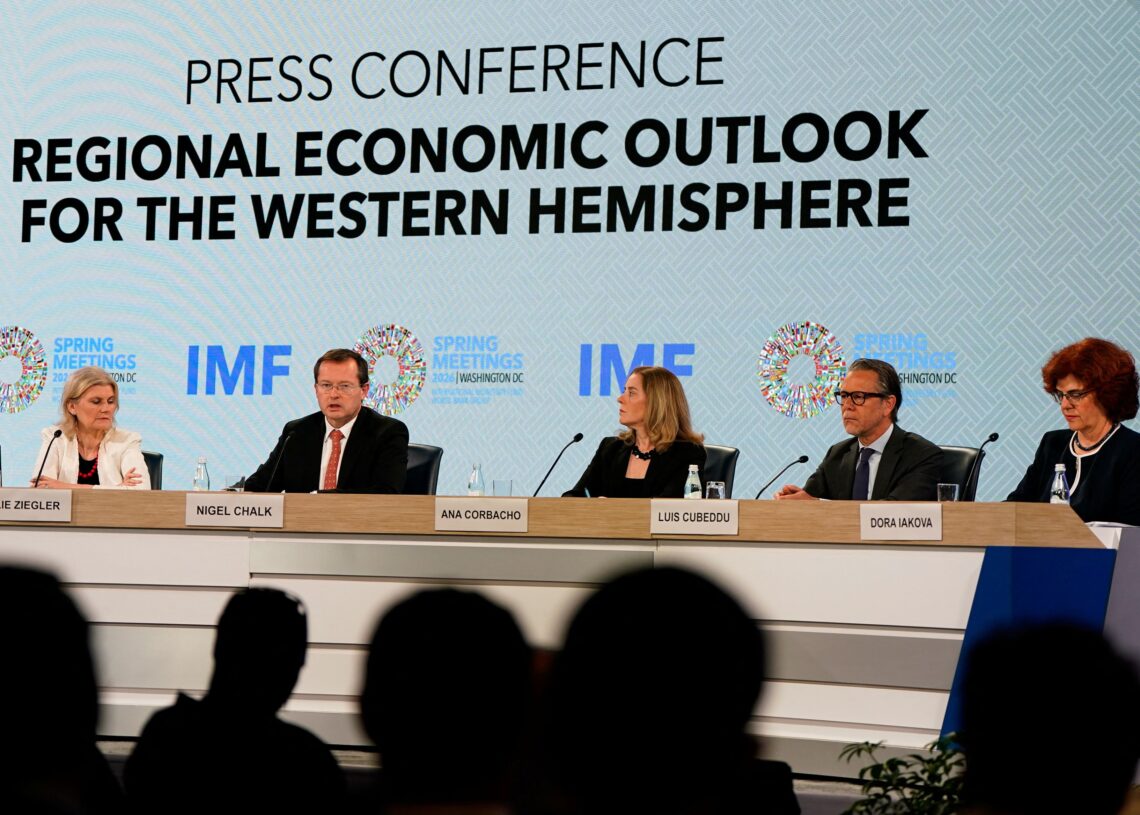
One year after Treasury Secretary Scott Bessent publicly blasted the International Monetary Fund and the World Bank for deviating from their core missions in favor of trendier pursuits, the two global bodies have worked their way back into the “America First” administration’s good graces.
Other multilateral institutions, including the North Atlantic Treaty Organization (NATO), remain targets for President Donald Trump’s slashing social media posts. But the two financial organizations have avoided the president’s ire by adapting to his demands, an evolution that was on display last week during the annual spring meetings of the IMF and World Bank.
The turnaround is striking. In an April 2025 speech, Bessent assailed the fund for dabbling in “climate change, gender and social issues” rather than monitoring the global economy, and accused the bank of pursuing “vapid, buzzword-centric” initiatives.
Bessent last week struck a much different tone speaking to a financial industry group, saying both institutions were back on track. The shift illustrates the malleable contours of Trump’s brand of economic nationalism. Normally allergic to anything that smacks of globalism, the administration has warmed to these pillars of the global system created under U.S. auspices more than 80 years ago.
“Having a large pool of capital, both at the bank and at the fund, available to advance your specific narrow interests in some cases and your broader global financial stability interests, without dipping into U.S. taxpayers’ funds, turns out to be a good thing,” said Douglas Rediker, chairman of International Capital Strategies, which advises institutional investors.
For the Trump administration, the retooled Washington-based institutions have proved valuable in the worlds of both diplomatic nuance and hard finance. They have amplified U.S. complaints about how Chinese exports distort the global economy and buttressed nations that could be destabilized by the war in Iran, such as Pakistan, Egypt and Jordan.
All of this comes at a relative bargain. U.S. financial backing for the IMF carries no annual budgetary cost, according to the Congressional Budget Office. The president has proposed spending $867 million in the fiscal year that begins Oct. 1 for the International Development Association, the World Bank’s lending arm for the world’s poorest nations.
Under pressure from the administration, the IMF and World Bank have modified their policies, de-emphasizing issues that irk the president such as climate change and taking steps to support key U.S. foreign policy objectives in places like Argentina and Ukraine. The World Bank last year abandoned its long-standing refusal to finance nuclear power development and moved closer to the Trump administration’s preferred “all of the above” energy policy, which makes room for fossil fuels including coal.
On Thursday, the IMF said it would resume dealing with Venezuela after a seven-year break, effectively recognizing the government of President Delcy Rodríguez, who assumed power following the U.S. capture of former president Nicolás Maduro in January.
“I think they understand the U.S. point of view. I think there was some inertia and some weeding out to do, of these programs,” Bessent told reporters this week. “But I think we are very aligned now.”
Both institutions faced challenges in the early months of Trump’s second term. Project 2025, the Heritage Foundation report that served as a blueprint for many administration policies, called for the U.S. to withdraw from the IMF and the World Bank, saying they were “inimical to American free market and limited government principles.”
The organizations were established at a 1944 conference in Bretton Woods, New Hampshire, in an effort to avoid the economic failures that led to the Second World War.
The IMF is tasked with preserving global financial stability, while the bank promotes economic development and fights poverty. For decades, presidents from both parties have seen their work battling financial crises or impoverishment as being in the interest of the United States.
But U.S. complaints about the institutions’ lack of focus have a long history. During the Biden administration, Jay Shambaugh, Treasury’s undersecretary for international affairs, called for the fund to concentrate on its “core mission” of monitoring the global economy.
“The IMF should not be experts on climate issues,” he said in a 2023 speech.
His predecessor in the administration of President George W. Bush issued a similar plea. The fund too often had been “asleep at the wheel” on its principal responsibility of calling out nations with currency values that were higher or lower than justified, said Timothy Adams, undersecretary of treasury for international affairs.
The Trump administration’s dissatisfaction has centered on the IMF and its managing director, Bulgarian economist Kristalina Georgieva. Her expansion of the fund’s remit to include lending designed to counter long-term challenges such as climate change drew particular criticism.
The nearly $50 billion Resilience and Sustainability Trust was introduced in 2022 to help low- and middle-income nations armor their finances against economic shocks arising from climate-related natural disasters. New 20-year loan terms were seen at the fund as a key tool to enable nations to weather the unexpected. But Bessent saw the novel financing scheme as a distraction from the IMF’s central role and from work that should have been done by the bank.
The fund appears to have gotten the message. Two years ago, in her “curtain raiser” speech to kick off the annual spring meetings, Georgieva mentioned “climate” six times. In this year’s speech, the word appeared just once.
“Kristalina had gotten over her skis in talking about climate and gender and inequality and whatnot. And I think basically she made herself an easy target for Bessent. Now, over the last year, she’s stopped talking about climate. She has kept the IMF beneath the radar screen, and she’s avoided poking the Trumpian bear,” said Mark Sobel, who spent nearly 40 years at Treasury, including as the U.S. representative to the IMF from 2015 to 2018.
The fund also crafted some of its economic analyses with an eye toward Washington, analysts said. This year, its annual review of the Chinese economy, known as an “Article IV” report, called for a “more forceful” turn toward boosting domestic consumption, a step the U.S. has long urged to bring the global economy into better balance and ease tension between China and its major trading partners.
“This Article 4 was certainly an improvement over the previous two Article 4s. The fund did highlight that China is growing on the back of net exports [and] it did link that to China’s exchange rate policies,” said economist Brad Setser of the Council on Foreign Relations.
In response to questions, the IMF said that over the past year it has sought to address the administration’s concerns, including by sharpening its policy advice and supporting “an orderly rebalancing” of the global economy.
“We have a very constructive engagement with the U.S. authorities, which we highly value,” said a fund spokesperson, who asked not be named discussing relations with a member nation.
In October, Bessent dispatched his chief of staff at Treasury, Dan Katz, to serve as the IMF’s first deputy managing director. The former Goldman Sachs investment banker acts as an effective bridge between his current and former employers, analysts said.
While Bessent also criticized the World Bank last year, it was easier for Ajay Banga, who became the bank’s president in 2023, to mollify administration officials. The former Mastercard executive chairman is fluent in the language of business that Bessent and his boss appreciate.
Even before Trump was elected to a second term, Banga had begun overhauling the bank’s development portfolio to emphasize job creation rather than humanitarian endeavors. He met Bessent’s criticism about gauzy do-gooderism by championing a strategy that emphasized laying the groundwork — with infrastructure investment and supportive regulation — to allow the private sector in borrower nations to flourish.
One example: The bank committed $30 billion in lending to Mission 300, an initiative designed to provide electricity to 300 million Africans by the year 2030.
Banga also joined Trump’s Board of Peace, a move that many analysts saw as illustrative of his desire to get in harness with the administration. A coalition of nonprofit groups complained about what they saw as an inappropriate political move. But the bank said it was mandated by a United Nations resolution on the postwar reconstruction of Gaza.
Bessent is pushing for additional changes. He wants the bank to eliminate specific targets for climate-related financing, increase lending for natural gas developments, and refocus lending on the poorest and most fragile countries rather than better-off borrowers. He’d also like help diversifying supply chains of critical minerals beyond the near-chokehold China now enjoys.
The treasury secretary this week criticized the bank’s “myopic focus” on climate financing. But there is a limit to how much change can be driven by Washington. The bank is a “demand-driven institution,” said Clemence Landers, a former World Bank official.
If developing nations seek financing for clean energy projects that offer strong financial returns, the bank will fund them.
“The bank and a lot of the international financial institutions have been very good at changing the rhetoric around, ‘This is no longer about green energy; it’s about energy independence,’” said Landers, now vice president of the nonprofit Center for Global Development. “But at the end of the day, a clean tech project is a clean tech product. You can just change the nomenclature.”
The post Trump administration warms to IMF and World Bank, in rare nod to global bodies appeared first on Washington Post.