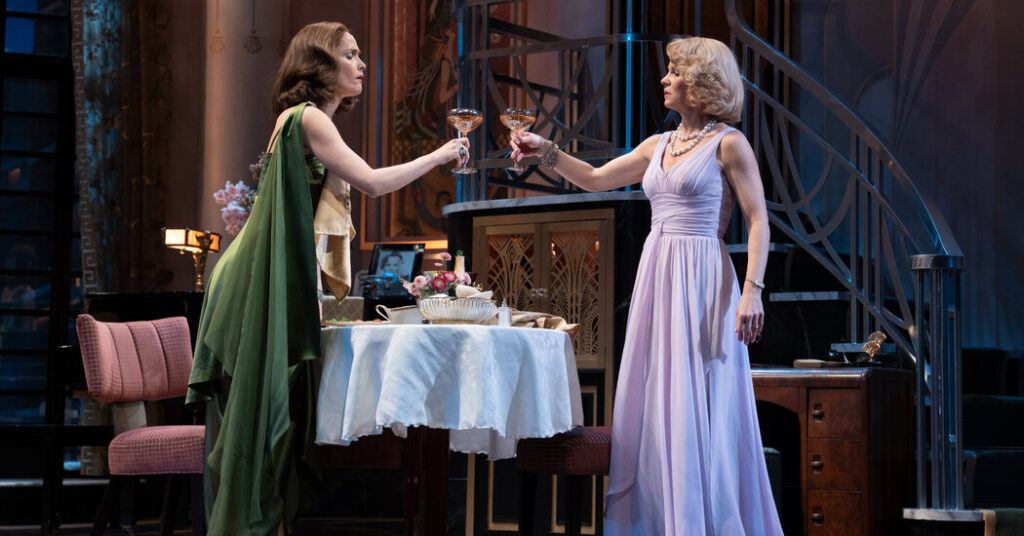
You see it in the fevered way Rose Byrne shakes her feathered fan and the clenched smile of Kelli O’Hara. It’s also simmering under the surface of the sparkling banter about the canals of Venice, perfectly nice husbands and ravenous appetites.
This powerful force, the comic engine driving the action of “Fallen Angels,” a riotous revival of one of Noël Coward’s early plays, is lust. The funniest, most combustible kind: suppressed lust. To be as precise as the deathlessly witty jokes littered through this play at the newly reopened Todd Haimes Theater, the transgressive lust of proper-seeming, upper-crust English wives suffering through stale marriages.
Wielding cigarette holders that seem to get longer every act, Jane Banbury (O’Hara) and Julia Sterroll (Byrne) lavish attention on their own ever-so-beastly desire inside a grand apartment belonging to Banbury over the course of two days in 1928. “To put it mildly, dear,” O’Hara says with blasé. “We’re both ripe for a lapse.”
Such quintessentially British horniness is activated in the most stereotypical way possible: A Frenchman has come to town. His name is Maurice (Mark Consuelos), and when these giddily flamboyant actresses pronounce his name in plummy accents and elongated vowels, the emphasis is on “More.” They both had affairs with him before they were married. With spouses out of town on a golf trip, what else is there to do but put on a gown, get drunk and up to no good?
This ebullient farce scandalized critics and censors when it premiered a century ago, which, as will surprise no one who follows stories of cancel culture, helped turn it into a buzzy hit. Today its moral concerns (sex before marriage? Gasp!) may seem dated, but its spirit, not to mention wit, are thoroughly modern.
“Fallen Angels,” which hasn’t been on Broadway for 70 years, has long been considered one of Coward’s second-tier efforts, a better vehicle for stars than the actual play. Scott Ellis’s assured production makes a persuasive case for it, but make no mistake: The dynamite performances of Byrne and O’Hara are the main event.
Comedically, they’re intrepid, landing every joke, but also unearthing many new ones between lines. They play off each other with superb chemistry and deliver bon mots with the same snap. Their sly insults (“I should be following her around and picking up all the names she dropped”) come at you quickly, spoken with a rat-a-tat pace. (If there were Tony nominations for voice coach, Kate Wilson deserves one.) They drop suitcases at the same moment and instead of a hug, they flutter fingers at each other like they are playing dueling pianos. Their friendship is not just the core of the play. It’s the subject.
O’Hara is more sensible, dry, pragmatic if not slightly sociopathic when it comes to the feelings of others. She tells her husband, Fred (Aasif Mandvi), that they are no longer “in love” with offhandedness, then later dismisses the conversation as a fun “psychological romp.”
Actors performing Coward can get carried away by the seen-it-all nonchalance of his wit. Just because characters are bored does not mean they are boring. This is a young man’s play (Coward wrote it before he turned 25), with all the fearless meanness, irreverence and superficiality that entails. And Byrne and O’Hara bring an apt and rambunctious energy to it.
In scene-stealing roles in “Bridesmaids” or “Spy,” Byrne, one of our finest comic actors, deployed her graceful beauty to play supercilious pride or even villainy. But in last year’s Oscar-nominated breakthrough performance as a mother coming unglued in “If I Had Legs I’d Kick You,” she showed more layers, displaying intensity, poignancy and terrifying danger.
Following this up by playing a frisky wife in a Coward play may seem like a departure, and it clearly is in a bubblier style, getting laughs through gangly dance moves and using her napkin as a scarf. But there’s also continuity. Byrne’s performance contains a violence that can take you by surprise. She has a desperate neediness that slowly, gradually comes out over the course of an intoxicating drunk scene where her aggression emerges, barking at her friend through slurred attacks. O’Hara counters with a different comic energy, doing elaborately slow descents down a staircase and a lounge chair, among other near pratfalls.
When her husband calls her “unhinged,” O’Hara corrects him, shooting back: “I’m perfectly hinged.”
Byrne more clearly isn’t, and watching her fall apart, and clash with O’Hara, is mesmerizing.
Tracee Chimo, as the maid, Saunders, provides a formidable counterweight to the leads, finding laughs in odd cackles and the oddly effortful way she fluffs a pillow. In one of the funnier bits of the show, the temperature of the room shifts when she enters, as the wives clumsily pivot from talk of adultery.
“Whoever decided that undergarments should be white?” O’Hara says, straining to strike a thoughtful tone. To which Byrne responds by musing: “I often wonder if the ocean would be deeper if there were no sponges.”
When Saunders leaves, they return to the good stuff. Showing up early and late, as necessary plot devices, the husbands are pointedly marginal, dopey buffoons of different stripes. Mandvi plays Fred Sterroll (a pun on sterile?) as a pompous bore, while Christopher Fitzgerald’s Willy Banbury has a puppy-dog dopiness.
The sexism of this class of men is clarified, but not underlined. Everything is kept light and stylish. Jeff Mahshie’s Roaring Twenties costumes (the hats! the gloves!) are supreme fun. And David Rockwell’s well-appointed Art Deco set makes the most of its staircase and chandelier.
Most importantly, this 90-minute production (the perfect length for a comedy) has mastered the right pace. It starts fast, then puts on the brakes for the fun of Byrne and O’Hara drinking themselves silly and salty. Patience is afforded when it comes to the serious business of vamping, pratfalls, funny hairdos. Ellis’s staging leans into the frivolity, but its real feat to put on a tight entertainment that somehow has the looseness of a hangout comedy.
It wasn’t that long ago that comedy seemed like an endangered species on Broadway. Perhaps because of the steady drumbeat of grim news, producers have been giving audience more amusing options. “Oh, Mary!” bursts with enervating silliness. “Becky Shaw” delivers dark laughs that catch in your throat. “Dog Day Afternoon” exudes anxiety-ridden humor. But if you’re looking for pure escapist fun to provide some immediate relief, “Fallen Angels” can’t be beat.
Fallen Angels Through June 7 at the Todd Haimes Theater, Manhattan; roundabouttheatre.org. Running time: 1 hour 30 minutes.
Jason Zinoman is a critic at large for the Culture section of The Times and writes a column about comedy.
The post Review: They May Be ‘Fallen Angels,’ but This Comic Duo Is Heavenly appeared first on New York Times.