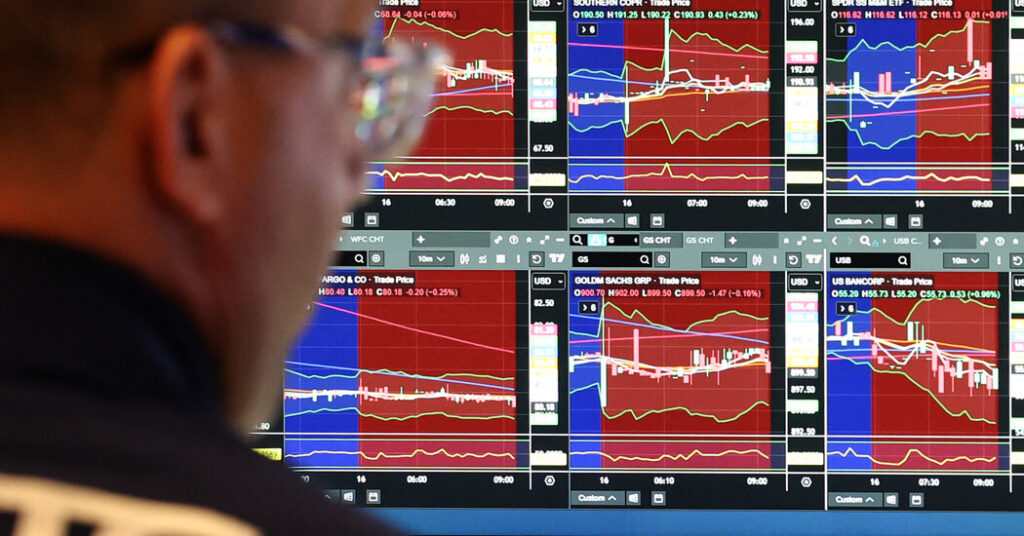
It sure feels as though the world is on fire. But even as a peace agreement in the Middle East remains elusive and oil prices stay high, raising the odds that inflation will worsen, unemployment will rise and growth will slow, stock markets are happy — so happy.
The S&P 500 hit another record high last week. It’s now higher than before the fighting began on Feb. 28. What’s going on? Do traders really not care about the war? Or do they know something we don’t? Today my colleague Joe Rennison, who covers markets, explains the seeming paradox of this exuberance.
The wartime rally
By Joe Rennison
Because of the Iran war, the world is teetering on the brink of an energy crisis that threatens to unleash global inflation, crimp consumer spending and weigh on corporate profits.
Yet the S&P 500, the benchmark U.S. stock index, just notched a series of record highs. Major indexes in Japan, South Korea and Europe are also near their own peaks.
“The velocity of this ascent has been nothing short of astonishing,” said Jim Reid, an analyst at Deutsche Bank, in a research note last week.
I’m writing this at the start of what could be a tumultuous week. Investors are weighing mixed messages made by U.S. and Iranian officials over the weekend about whether ships can pass through the Strait of Hormuz. But even if traders start the week discouraged by the news, history suggests that they won’t be for long.
What gives? Why have markets been so upbeat?
It’s not that investors around the world are oblivious. Instead, it has to do with what exactly the markets are measuring. There is an important gap between the immediate upheaval from the war, and its long-term effects on corporate profits.
What markets really care about
The stock market isn’t the entire global economy — far from it. Because of higher energy prices, many people are struggling to fuel their cars, heat their homes and buy groceries. The International Monetary Fund expects the war, even if it’s short-lived, to slow economic growth, fuel inflation and increase the odds of a global recession.
But stock market investors are primarily concerned with one thing: how profitable companies are going to be in the future.
For quite a while now, companies have been very profitable indeed. Quarterly financial results for the companies in the S&P 500 are expected to show double-digit earnings growth for the sixth quarter in a row.
Investors are absolutely worried about the impact of the Iran war. But so far, that effect has been limited for many big companies. Data shows that most consumers are worried, but still spending. Inflation has risen, but not by very much, outside of energy-related goods and services.
Those effects could intensify the longer the upheaval goes on. And it is always possible that a further plot twist could send stocks lower again.
But the move toward U.S.-Iran peace talks, however erratic, has already been an important change from just a few weeks ago, when an end to the fighting — and therefore an end to the disruption of global oil supplies — seemed a more distant possibility.
The big tech factor
The S&P 500 steadily slid over the first month of the war in Iran, but then rapidly rebounded — and then some — since President Trump announced a cease-fire a few weeks ago.
Investors are not simply taking Trump at his word that the war is “almost over.” But they are paying attention to his administration’s apparent eagerness to find a way to end the fighting.
Investors might not believe Trump, exactly, but they do seem to believe that the worst of the war has already passed. That has allowed them to pivot back to focusing on the strong backdrop of continued earnings growth.
The other thing to remember is that the markets at this point are dominated by big technology companies that are still riding a wave of enthusiasm over artificial intelligence, providing an engine for the market that is largely separate from the conflict in the Middle East.
Under the surface, some consumer-facing businesses, especially those that rely on lower-income customers who are particularly sensitive to inflation, are struggling: Dollar General and Dollar Tree are both down by double-digit percentages since the war began, for example.
But the relative market size of those companies is dwarfed by businesses like Alphabet, Microsoft and Meta, which have a much bigger effect on the broad indexes that many investors track as a barometer of the stock market.
Buying the dips
There is also a broader psychological shift in the markets, analysts say, accelerated by the rise of retail investors — individuals trading from their mobile phone or computer at home.
Those investors have learned that geopolitical upheaval doesn’t weigh on the stock market for very long. The stock market has repeatedly fallen in response to global shocks, only to rebound and climb even higher. (Part of this comes from having an American president who, as many have noted, is sensitive to market unhappiness, and can sometimes change his policies as a result.)
Investors have become used to this pattern and have therefore started to see these market drops more as an opportunity to buy the stocks they like at a lower price, rather than the start of a long-term sell-off.
As analysts at Deutsche Bank noted on Tuesday, when the S&P 500 had already recovered all the ground it had lost since the war began, this “geopolitical playbook” paid off again.
The result is markets that are less responsive to short periods of upheaval, and more reflective of investor sentiment about stocks’ long-term prospects. What we’re seeing today are investors who think, despite the current sense of chaos, that the stock market is still a good long-term bet.
MORE TOP NEWS
The U.S. attacked an Iranian ship while preparing for talks
A U.S. Navy destroyer yesterday attacked an Iranian cargo ship that defied an American blockade of Iran’s ports, Trump said. The attack threatened the cease-fire that is set to expire on Wednesday. Follow our live updates.
Trump also said that American officials would travel to Pakistan for a second round of negotiations on ending the war with Iran. But Iranian state media said Tehran had not yet agreed to any such meeting.
Vice President JD Vance will again lead the delegation, accompanied by the Trump aides Steve Witkoff and Jared Kushner, according to a White House official.
Other developments:
-
Thousands of displaced people returned to Lebanon’s devastated south as the cease-fire between Israel and Hezbollah appeared to be largely holding.
-
Neither its strong ties with the U.S. nor its cordial relationship with Iran have spared Qatar from a blow to its economy.
Top of The World
The most clicked link in your newsletter on Friday was a graphic on the Strait of Hormuz.
OTHER NEWS
-
Senior Hamas officials in Gaza said the group was ready to hand over some weapons, a concession that falls short of Israeli-U.S. demands.
-
Exit polls from elections in Bulgaria showed voters had swept aside the center-right party that has dominated for the last decade. A new coalition, Progressive Bulgaria, was leading.
-
My colleague Andrew Higgins describes why voters in Hungary chose Peter Magyar over Viktor Orban in a landslide, ending Orban’s 16 years in power. Watch the video below.
-
Pope Leo said news outlets had misinterpreted some of his remarks as criticism of Trump.
-
U.S. officials visited Cuba to discuss a deal to address the island’s humanitarian crisis.
-
The British counterterrorism police are investigating “linked arson attacks” in London against Jewish sites and properties with ties to Israel.
-
Eight children between the ages of 1 and 14 were killed in a domestic violence shooting spree in Louisiana.
-
The police shot dead a gunman who killed six people and wounded several more in Kyiv. It was the deadliest mass shooting in Ukraine in years.
SPORTS
Football: Manchester City beat Arsenal 2-1, closing the gap in the Premier League title race down to three points.
World Cup: FIFA’s president defended ticket prices in the U.S. amid fan frustration and confusion.
FUN INSECT FACT OF THE DAY
A ‘carwash’ for ants
A researcher spotted a peculiar partnership in the Arizona desert: tiny cone ants appear to run a carwash-like cleaning service for larger red harvester ants. The harvesters stand frozen outside cone ant nests while the smaller ants climb aboard to lick and nibble them.
MORNING READ
Almost every night, Sugey Amaya stands outside a prison system building on the outskirts of San Salvador, waiting for her brother’s name to be called. Inmates cannot be released unless someone is there to pick them up.
Her brother was detained nearly four years ago, swept up in mass arrests of people accused of gang ties. But with no news of him, she has taken to helping strangers. She signs for their release, helps them buy clothes and makes sure they get home, never asking why they were locked up. “I see my brother’s face in them,” she said. Read more about the routine that has become her life.
AROUND THE WORLD
The secrets of New York City’s storage lockers
In New York, a city of shoe-box-size apartments, people store a lot of stuff. So my colleague Anna Kodé visited the storage units of six New Yorkers to understand what people hold on to, and why.
Inside she found nearly 3,000 license plates, boxes of plastic flowers no longer sold in stores, a mother’s Depression-era cake-plate collection, a desk from a Broadway production of “Sunset Boulevard.”
“We’re living through turbulent times right now,” said a professor who studies possessions and materialism. “Things give us a life buoy to hang on to.” Read more.
RECOMMENDATIONS
Teach: Here are nine great children’s books that celebrate the natural world.
Listen: Baby Keem, a Kendrick Lamar protégé, tells his whole story in “Casino,” his new album.
Organize: These free tools on your phone can help you level up your meal planning and prep.
Compete: Play our flashback history quiz.
RECIPE
Spaghetti Napolitan is Japan’s yoshoku (“Western-style”) interpretation of Italian tomato spaghetti. More of a fried noodle dish than an Italian-style pasta, it calls for stir-frying noodles in ketchup and a generous amount of oil over high heat to create a deeply satisfying sauce.
WHERE IS THIS?
Where is this ice cap?
TIME TO PLAY
Here are today’s Spelling Bee, Mini Crossword, Wordle and Sudoku. Find all our games here.
That’s it for today. See you tomorrow! — Katrin
Joe Rennison was our guest writer today.
We welcome your feedback. Send us your suggestions at [email protected].
Katrin Bennhold is the host of The World, the flagship global newsletter of The New York Times.
The post Messy War, Happy Stock Markets appeared first on New York Times.