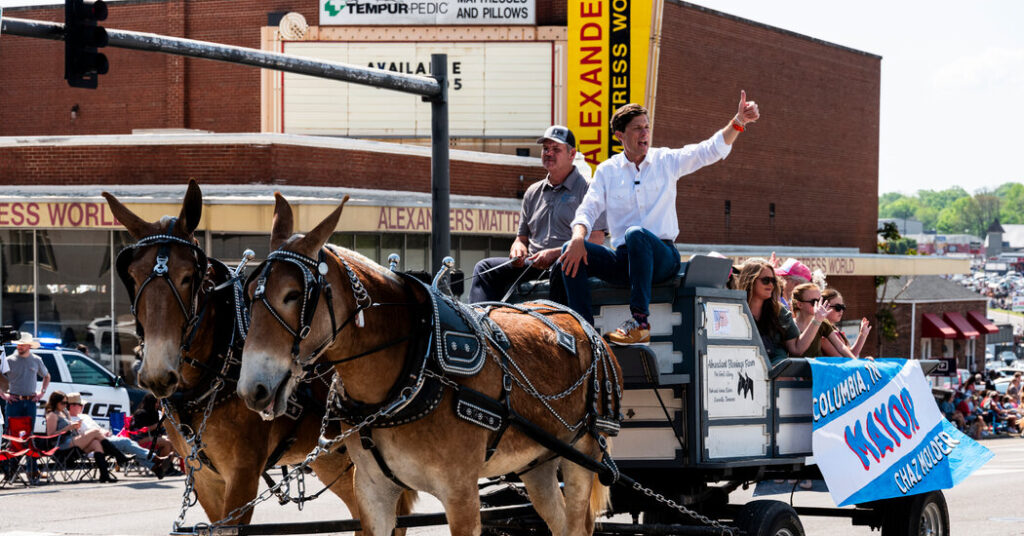
As the mule-drawn floats and carts lined up for the annual Mule Day parade in Columbia, Tenn., Mayor Chaz Molder, a Democratic donkey in conservative country, was bantering with Republican officials when one official called out, “With as much money as you raised, you should have two more donkeys.”
Mr. Molder, 42, waved off the remark, but onlookers in mule T-shirts and floppy mule ears weighed in on the mayor’s unlikely challenge to Representative Andy Ogles, with either a hardy “go get ’em, Chaz” or a quieter call of support for the incumbent, a hard-core conservative who in any other year would be hard to beat.
That Mr. Ogles’s seat is even in the conversation is an indication of the political shape Republicans find themselves in as they approach the midterm elections. Anger over President Trump’s war in Iran, spiking gas prices and persistent affordability concerns have led to shifts of up to 20 percentage points in recent elections compared with the 2024 election that returned Mr. Trump to the White House.
Tennessee Republicans thought they drew a safe seat during the last redistricting cycle, slicing a Democratic district in Nashville into three districts stretching into rural areas. The Fifth Congressional District now reaches south of even Columbia, a town of nearly 50,000 about 50 miles south of the state capital. Mr. Ogles won it for the first time in 2022, by nearly 14 percentage points. The question is whether Mr. Trump’s 18-point advantage in the district in 2024 is enough to guarantee a win this fall.
Democrats are becoming increasingly aggressive at targeting Republican seats once considered out of reach. In recent weeks, the House Democratic campaign arm began paying for digital advertising in a South Texas district where Mr. Trump prevailed by 18 points and where a Tejano singing star, Bobby Pulido, is challenging a Republican incumbent, Representative Monica De La Cruz. Democratic digital ads are also attacking Representative Nick Begich in the at-large House contest that covers all of Alaska, where Mr. Trump won by 13 points.
Democrats are also expanding their ambitions in Senate elections, where the four-seat pickup needed for control once felt impossible. Democrats initially focused on maintaining seats in Georgia, Michigan and New Hampshire, with possible pickups in Maine and North Carolina. Now they are looking at Ohio, Alaska, Texas and Iowa — and wondering how to support independent candidates challenging Republicans in Nebraska and Montana.
And in the House, there are plans to soon add more seats that Mr. Trump carried by as many as 20 percentage points. On Friday, the Democratic Congressional Campaign Committee launched Spanish-language digital ads in the Florida districts of Representative Cory Mills, which Mr. Trump won by 13 percentage points, and Representative Laurel Lee, which Mr. Trump won by 11 points; a Miami-area district that he won by 15 points; and a neighboring seat, which he won by 25 points.
Meantime, outside opportunities keep opening up, in Western Montana, where Representative Ryan Zinke is retiring from a seat that Mr. Trump won with 54 percent, and in West Texas, where Tony Gonzales resigned amid a sex scandal from a seat the president won with 57 percent. (In contrast, Eric Swalwell, a Democrat under similar scandal, left a district that Kamala Harris won with 66 percent.)
“Democrats are on offense, Republicans are running scared, and our expansive map reflects it,” said Representative Suzan DelBene, the Seattle-area chairwoman of the campaign committee.
In a House where Republicans hold a three-seat majority, Democrats need to flip just a few seats to win a majority next year. Kamala Harris won nine Republican-held districts, as currently configured, but House Republicans represent 21 additional districts that Mr. Trump carried by 10 points or less. Another 55 are in districts Mr. Trump carried by 10 to 20 points.
The special election in Northwest Georgia two weeks ago saw a 25-point swing away from Mr. Trump. No one thinks the country will put up numbers like that in November.
But some of the Democrats seen as more likely to make gains in Republican-leaning districts have cleared more than $1 million in fund-raising hauls.
Federal Election Commission reports filed last week showed Mr. Molder sitting on a war chest of more than $1.2 million, while Mr. Ogles’s campaign reported just $85,000 in cash on hand at the end of March.
“For any Republican that identifies as a Republican voter, they need to take this seriously,” Steve Hickey, the chairman of the Williamson County Republican Party, said of Mr. Ogles’s race and other midterm races. With part of his county included in the district, he added, “we are certainly not resting on our laurels.”
Republicans in Washington and Tennessee remain confident that districts like Mr. Ogles’s will remain under their party’s purview.
“Democrats targeting safe Republican seats in red states like Tennessee is pure political hallucination,” said Reilly Richardson, a spokesman for the House Republican campaign arm. “They’re operating on our turf, and they’ll be stuck wasting their money in unwinnable districts.”
Spending from Republican-aligned super PACs and other independent expenditure committees is likely to more than make up for whatever money candidates raise anyway.
Mr. Ogles’s district replaced what, for 150 years, had been a solidly Democratic seat. Representative Jim Cooper, the centrist Democrat who first won the old district in 2002, retired, leaving it for Mr. Ogles, the former mayor of rural Maury County.
Since then, Mr. Ogles, 54, has garnered scrutiny and controversy, including a federal investigation into his finances and backlash over a slew of anti-immigrant and anti-Muslim comments.
“There’s a number of people that are running for Congress across the country that are a lot like me, that just think we can do better, think that we need to be a little nicer, think that we need a focus on issues that actually matter,” Mr. Molder said, his voice barely above a whisper in a tented turkey blind during opening weekend for hunting this month.
But Mr. Ogles has batted back both Republican and Democratic challengers in the past. In recent days, he has highlighted the renaming of a Columbia post office; his support for plans to open a new veteran’s clinic in the district; and his fierce opposition to undocumented immigration, temporary protected status for Haitian migrants and Muslims of all kinds.
“I’m sorry to hurt your feelings, but ‘America First’ means Americans first,” Mr. Ogles said during a conference call with constituents on Thursday, responding to a question about his opposition to a pathway to citizenship for refugees and other immigrants.
After watching two Nashville-based Democratic candidates lose to Mr. Ogles, the party is pinning its hopes on Mr. Molder, a two-term, small-town mayor with a baritone drawl, a penchant for dove hunting and an ease with traditional retail politicking.
“We have to focus on the issues that actually matter, the kitchen table issues, and perhaps that focus has been lost,” Mr. Molder said in an interview, after more than an hour of waving and compliment-tossing at the Mule Day parade, a yearly homage to the town’s history of breeding mules.
Long before the August primary, where Mr. Molder will face three other Democrats, his party has added the race to its list of seats viewed as the most competitive. (House Republicans have so far kept Mr. Ogles off their list of vulnerable incumbents, along with some other districts targeted by Democrats.)
“People want good government,” said Mr. Cooper, who backed Mr. Molder before the primary and pushed at least one other Democrat aside. Mr. Molder, he added, seemed “right out of central casting.”
Emily Cochrane is a national reporter for The Times covering the American South, based in Nashville.
The post Democrats Eye a Broader Battlefield to Capture Congress in November appeared first on New York Times.