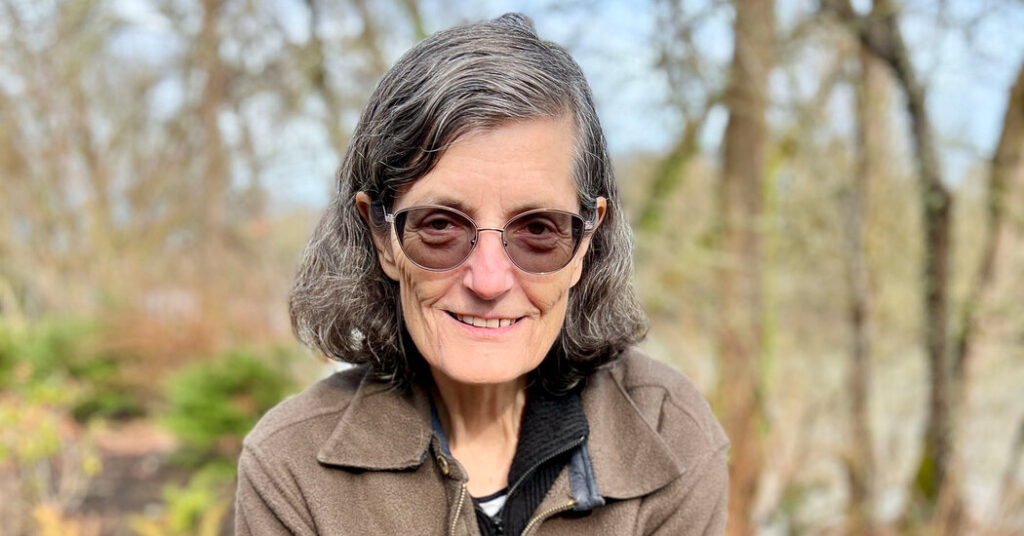
Elaine Ingham, a soil scientist who got growers to see the earth beneath their feet as a web of life teeming with biological activity, not simply as dirt, influencing farmers and gardeners to sow and protect crops without chemicals, died on Feb. 16 in Fort Mill, S.C. She was 73.
Her death, in a memory care residence, followed a diagnosis of dementia last year, her daughter, Jenna Noel, said.
Dr. Ingham, a leader in the organic gardening and farming movement, popularized the concept of the “soil food web,” an understanding that soil is a complex realm of microscopic organisms.
Her research upended a common view that a plant simply sucks nutrients through its roots like a straw. She showed that plants actively orchestrate an underground world. Plant roots exude sugars to attract bacteria and fungi, which in turn nourish the roots and protect them from parasites. Protozoa and nematodes also play crucial roles in the soil food web.
By managing the soil beneath a plant, Dr. Ingham said, growers could prevent pests and diseases aboveground, protect against erosion and retain water.
“Dr. Elaine is largely responsible for the understanding by gardeners and farmers that soil is alive,” Jeff Lowenfels, a gardening writer, wrote in The Anchorage Daily News after Dr. Ingham’s death, using an affectionate nickname.
From 2011 to 2014, Dr. Ingham was chief scientist at the Rodale Institute, a research organization for organic farming in Kutztown, Pa.
Before that, for 15 years, beginning in 1986, she was a research scientist in the department of botany and plant pathology at Oregon State University, in Corvallis, where she lived until moving to South Carolina last year.
Dr. Ingham lectured around the world, evangelizing for organic farming in clear layman’s language. Her enthusiasm for soil was such that she once told an agricultural conference in Texas that she could speak for “the next three months.”
Her ideas were also spread through a book she helped write, “Soil Biology Primer,” published by the Soil and Water Conservation Society; and, especially, through the Soil Food Web School, which she founded in 2014.
The school certifies students for work as lab technicians, running compost businesses and consulting with farmers and growers. It grew out of her own consulting business, which offered soil analysis at the microscopic level to farmers, as well as advice on how to replace synthetic fertilizers with organic compost.
“Growing up, there was always a FedEx package of soil in our refrigerator,” her daughter recalled in an interview.
Dr. Ingham suggested that her relationship with administrators at Oregon State led her to leave academia to run her consulting business full time. She said her opposition to genetically modified organisms, or GMOs, in the food supply clashed with the agricultural business sector, whose interests influenced university research and teaching.
“Oregon State University and I had very opposing views on genetically engineered organisms, and they didn’t like it,” she told the Joe Gardener Show podcast in 2019. “Some of the large donation people they work with were very unhappy with what I was saying.”
GMOs became a flashpoint between environmentalists and agribusiness beginning in the 1990s. Dr. Ingham voiced opposition to GMOs at an international biosafety conference in Madrid in 1995.
In 2001, she kicked the hornet’s nest by testifying to a government commission in New Zealand about research that she and a graduate student had done in the ’90s on a genetically modified soil bacteria, Klebsiella planticola.
Dr. Ingham said the modified bacteria, which had been engineered to convert plant waste into alcohol, killed wheat plants in the laboratory. She added that research published by her and her student had effectively halted a field test of the GMO that had been approved by the Environmental Protection Agency.
“This could have been the single most devastating impact on human beings, since we should likely have lost corn, wheat, barley, vegetable crops, trees, bushes, etc.,” she said. “Conceivably all terrestrial plants.”
Those doomsday-urgent remarks were picked up by media outlets and amplified by environmental activists, but other scientists accused Dr. Ingham of alarmism and questioned aspects of her testimony.
She acknowledged some of the criticism. She said she was wrong that the E.P.A. had approved a field trial of Klebsiella planticola. Her prediction of a planetary apocalypse of all plant life was just “one possible scenario,” she added in a statement, and she said that more research was needed.
The following year, she left Oregon State to focus on her outside work.
Elaine Ruth Stowe was born on June 26, 1952, in St. Paul, Minn., the middle of three daughters of Clarence and Ruth (Sweet) Stowe. Her father was chairman of the department of veterinary science at the University of Minnesota.
Elaine graduated in 1974 with a bachelor’s degree in biology and chemistry from St. Olaf College in Northfield, Minn., where she met her future husband, Russell Ingham.
They became a couple during a semester studying tide pools in the Florida Keys, when Elaine cut her foot on a sea urchin and Russell brought her to an emergency room. They married in 1975.
Dr. Ingham earned her master’s degree in microbiology from Texas A&M in 1977 and her Ph.D. in microbiology from Colorado State University in 1981.
Her husband, who earned a Ph.D. in the same program, became a nematologist — an expert on tiny worms — and both joined the faculty of Oregon State.
Besides her husband and her daughter, Dr. Ingham is survived by a son, Scott; a sister, Carol Stowe, and two grandsons.
Throughout her career, she criticized the widespread farming trope that crops could only flourish with ample synthetic fertilizers and pesticides. She advocated making organic compost tailored to local soils.
“Mother Nature,” she said, “figured out this system for keeping everything properly balanced approximately four billion years ago.”
Trip Gabriel is a Times reporter on the Obituaries desk.
The post Elaine Ingham, Who Taught That Soil Is Alive, Dies at 73 appeared first on New York Times.