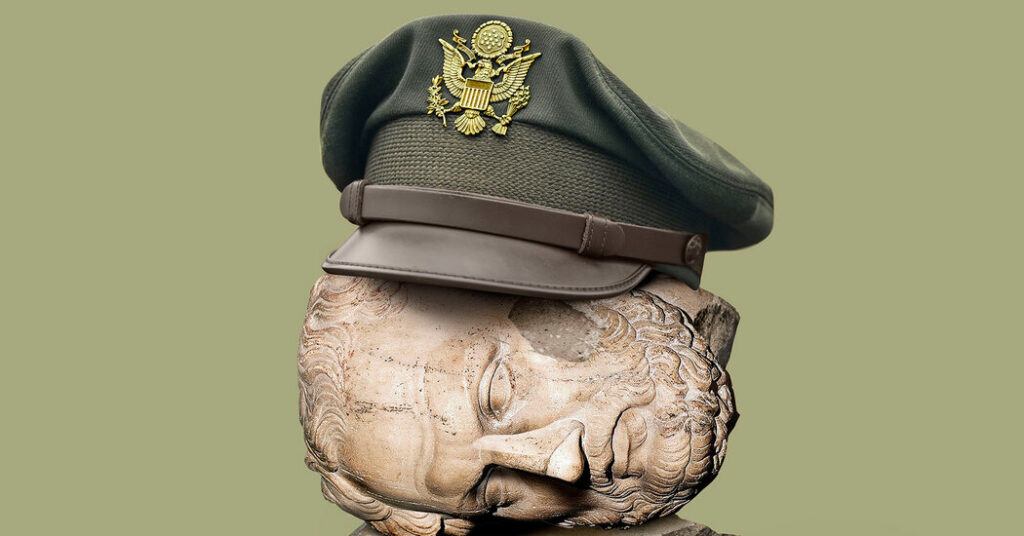
Members of the Trump administration have been channeling their inner Thucydides, paraphrasing the Greek historian’s aphorisms about the pitiless realities of power in a world of self-interested nations.
In January, the president called the unilateral military intervention that ended in the kidnapping of Venezuelan leader Nicolás Maduro an example of the “iron laws that have always determined global power.” Challenged about the U.S. operation, the White House senior policy adviser Stephen Miller mocked Jake Tapper on CNN for his naïveté about “international niceties” like the United Nations Charter. “We live in a world, in the real world, Jake, that is governed by strength, that is governed by force, that is governed by power.”
The Iran war has only reinforced these instincts. On April 7, Mr. Trump warned the Iranian regime to capitulate to American might. Otherwise, he menaced, “A whole civilization will die tonight.”
Such references to the timeless verities of power politics often draw inspiration from Thucydides, whose “History of the Peloponnesian War” remains a foundational text for professed foreign policy realists. Policymakers and analysts regularly invoke the tome to explain the inevitability of great power rivalry and justify domination of the weak. But their analyses do not offer a close enough reading — and often overlook the historian’s deeper lessons about the perils of wielding power without limits or legitimacy.
The most famous vignette in Thucydides’ “History” is the Melian Dialogue. In it, an Athenian delegation delivers an ultimatum to the island of Melos: Submit to the superior power of Athens and become a tributary state in its war against Sparta, or face destruction. The Melians plead to remain neutral but are rebuffed. “You know as well as we do,” the Athenians explain, “the strong do what they can and the weak suffer what they must.” Melos is vanquished, its adult men put to death and its women and children sold into slavery.
The second Trump administration has embraced the logic of the Melian Dialogue with gusto. It echoes in the president’s blunt declaration to President Volodymyr Zelensky of Ukraine that “you don’t have the cards,” his browbeating of Denmark to cede control of Greenland, his unilateral imposition of tariffs on smaller nations, his threats to “take” Cuba at a time of U.S. choosing and his demands that NATO allies — who were not consulted before the war in Iran — help open the Strait of Hormuz. These are the actions of a rogue superpower that has abandoned any pretense of enlightened leadership or aspirations to legitimacy in favor of pure global dominance.
The Trump administration’s relentless bullying ignores a central lesson from classical antiquity: Athens’s shift from benevolent hegemony to malevolent empire paved its road to ruin.
From the seventh century B.C. onward, the city-states of ancient Greece recognized one of their number as their natural leader, entitled to pre-eminent status and special rights for its disproportionate contribution to collective defense. They called this power the hegemon. Such leadership was often contested, however. The most famous such clash was the Peloponnesian War, which pitted Athens against Sparta. Ultimately, Athens was vanquished.
“What made war inevitable,” Thucydides famously wrote, “was the growth of Athenian power and the fear which this caused in Sparta.” Many contemporary scholars have latched onto this line as a succinct explanation for the inevitability of great power war. Like Athens and Sparta, we are told, the United States and China risk falling into a “Thucydides trap.”
But, as the historian himself makes clear, the war’s causes ran deeper. What made Athens’s surging power so worrisome was its violation of Hellenic norms, in seeking to transform its consensual leadership into a coercive empire. During the Spartans’ debate over whether to go to war, a visiting Athenian delegation justified their own country’s imperial turn: “It was not we who set the example, for it has always been law that the weaker should be subject to the stronger.” The gambit backfired, confirming suspicions of Athens’s imperialist intentions and leading the Spartans and their allies to approve a declaration of war.
What made war inevitable, in other words, was not merely the presence of rival great powers, but the fact that one of those powers was abusing the rules of the system that had enabled its rise to greatness in the first place.
The temptation to exploit dominance is a recurrent historical impulse — one to which Trump’s America has succumbed. Tired of assuming burdens in the general interest, the United States is now leveraging and abusing its structural dominance for maximal gain, coercing and extracting benefits from even its closest partners. As in Thucydides’ time, this posture promises short-term gains but long-run disaster.
The genius of post-1945 U.S. foreign policy was in embedding America’s awesome power in a framework of international institutions and law in which all nations, large and small, could participate and benefit. It was far from perfect and coincided with plenty of episodes of imperialist intervention. But the strategy overall paid off for the United States. It cushioned the reality of American dominance, legitimated American power and produced an order broadly consistent with American interests.
All these advantages are now being abandoned. The Trump administration is destroying any remaining faith that the United States can be trusted to exercise power responsibly. It is also erasing any distinction between the exercise of American might and Russian conduct in Ukraine and Chinese behavior in the South China Sea or (potentially) over Taiwan.
Leaders, at the end of the day, require followers. Mr. Trump may insist, as he has in the Iran conflict, that “WE DO NOT NEED THE HELP OF ANYONE!” But if the United States stays on this course, it will find itself bereft of allies and friends, a lonely superpower in a lawless international system it has helped to create. It is not too late to reverse course — and that starts with a closer reading of Thucydides.
Stewart Patrick directs the Global Order and Institutions Program at the Carnegie Endowment for International Peace. He is the author of “The Best Laid Plans: The Origins of American Multilateralism and the Dawn of the Cold War” and “The Sovereignty Wars: Reconciling America With the World.”
The Times is committed to publishing a diversity of letters to the editor. We’d like to hear what you think about this or any of our articles. Here are some tips. And here’s our email: [email protected].
Follow the New York Times Opinion section on Facebook, Instagram, TikTok, Bluesky, WhatsApp and Threads.
The post The Warmongers Are Getting History All Wrong appeared first on New York Times.