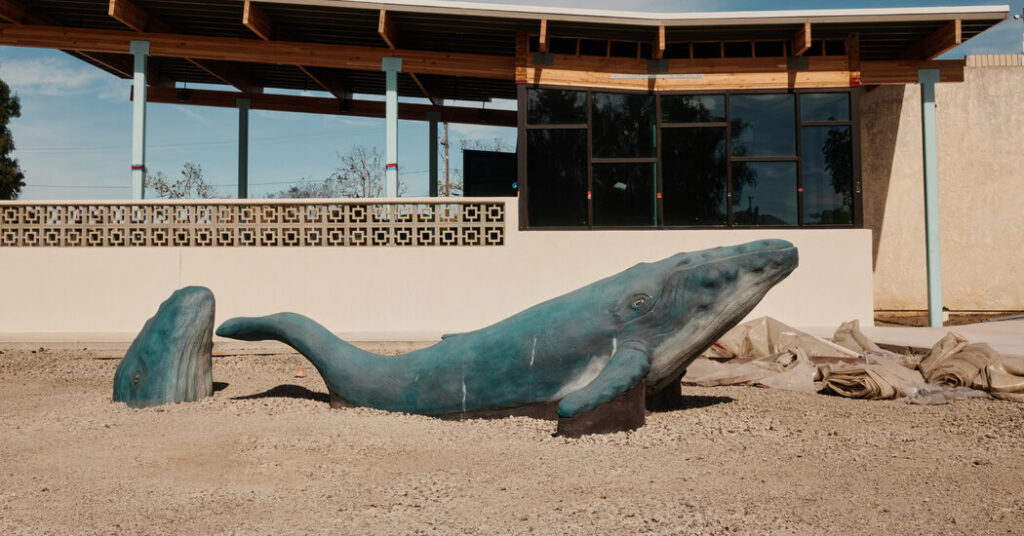
Kristie Akl still remembers the day the idea for KidSTREAM first began more than 12 years ago.
The founder of the new children’s museum in Camarillo, in Ventura County in Southern California, had arrived at a local museum, Gull Wings Children’s Museum in Oxnard, with her three young daughters, only to find it closed.
To salvage the outing and entertain them for the day, Akl drove an hour east to Kidspace Children’s Museum in Pasadena. “Looking at my babies in the rearview mirror on the drive home, a nagging question took hold,” she said. “Why don’t we have this?”
The thought lingered. Akl said that her impetus was also shaped by her years as a high school biology and biotechnology teacher at Foothill Technology High School in Ventura, where she watched students arrive in ninth grade already convinced they were not good at science. Their natural curiosity, she said, had often been replaced by an aversion to failure, and many had begun steering away from subjects they assumed were beyond them.
Together, those experiences led Akl to begin building KidSTREAM, a hands-on learning museum devoted to STREAM education — science, technology, reading, engineering, arts and math.
“I didn’t want my daughters to lose that spark,” Akl said. “I realized that if I wanted a runway for their curiosity, I would have to build it.”
The journey from that realization to a physical institution took nearly a decade.
When the first phase opens in May in the former Camarillo Public Library, the museum will encompass about 21,000 square feet of indoor and outdoor exhibits within a planned 30,000-square-foot campus. The $7 million initial phase has been financed through donations from individuals and companies, including Driscoll’s, the biotech firm Amgen and the Gene Haas Foundation, established by Gene Haas, the founder of Haas Automation.
Amgen, based in the Ventura County town of Thousand Oaks, contributed $1 million, while its philanthropic arm, the Amgen Foundation, donated another $1 million.
“Ensuring that every child has the opportunity to engage in science and to be inspired in different fields is core to who we are,” said Scott Heimlich, the foundation’s president. “As our home, and with the foundation’s commitment to STEM education, it felt like a natural fit to support this work for our local community and the next generation of scientists.”
The project fills a significant gap in Ventura County, home to more than 200,000 children, where access to a major children’s museum has been limited, said Arthur G. Affleck III, the president and chief executive of the Association of Children’s Museums. He described its debut as major in the children’s museum field.
“When a children’s museum opens in a community like this, it becomes more than a destination for families. It strengthens the local learning ecosystem, supports community vitality and creates a shared space where children can grow,” he said. “Its impact will be felt far beyond its walls.”
Affleck added that new children’s museums had a boom from the 1970s to the 1990s, but opened far less frequently today. “Growth has moderated because there are many already in existence, and it takes five to seven years and significant capital to get one off the ground,” he said. ”That makes KidSTREAM’s debut even more notable.”
The following interview with Akl has been edited and condensed.
How did your experience as a teacher deepen your understanding of what children need beyond traditional school settings?
When I taught, I’d ask my freshmen to describe a scientist. Most drew someone who looked like Albert Einstein, not like themselves. Many arrived in my classroom already believing they were “not good at science,” a mind-set I took on as a personal challenge to dismantle.
In traditional classrooms, failure often feels final, but real discovery requires experimentation, and experimentation requires the freedom to fail — and try again. By offering alternative ways for students to show what they knew, inspired by the idea that we all learn differently, I watched students who struggled with tests light up when given a hands-on challenge. KidSTREAM was designed to reach them while that curiosity is still loud, reminding them they are capable investigators of their world.
Ventura County has more than 200,000 children, yet many families travel an hour or more to visit a children’s museum. How did that fact inform your ambitions for KidSTREAM?
My concern was for the children whose ZIP code currently dictates their access to informal learning. Through our mobile outreach, we saw that when you bring a high-quality engineering experience to a child, their background or income doesn’t limit their brilliance. But outreach isn’t enough; we needed a permanent home for that curiosity.
As we brought mobile engineering and science programs across the region, we reached nearly 10,000 children annually, and seeing that hunger for discovery firsthand only reinforced the need for the museum
Several of KidSTREAM’s exhibits draw directly from the region, including agriculture, the Channel Islands environment and outdoor play landscapes. How did local geography and culture influence what visitors will encounter?
KidSTREAM is rooted in Ventura County: the Channel Islands inspire our ocean ecosystems, and agriculture, the cornerstone of our local economy, is represented in sensory-rich spaces that teach land stewardship. Our outdoor play landscapes take advantage of our year-round climate to encourage movement and connection to nature.
What does hands-on STREAM education look like in practice for children who visit?
We have activities both indoors and outdoors, and learning is embedded in every exhibit.
Outside, in our Channel Islands exhibit, children can excavate replicas of pygmy mammoth bones in a fossil dig. Pygmy mammoths inhabited the Channel Islands thousands of years ago. They can also climb through a kelp forest and experiment with water flow in a surf-themed engineering area.
Nearby, an agricultural exhibit includes an edible garden with berries and herbs that reflect the region’s farming roots. Children can pick produce, taste it and learn about it from museum guides. You might see a 4-year-old driving a toy tractor through the garden or selecting wooden vegetables in a farmers’ market to “prepare” a simple meal at a cooking station.
Inside, the museum includes an engineering design lab, A Maker’s Space, where children tackle building challenges using everyday materials like coffee filters and pipe cleaners. Another installation, Amazing Airways, explores cause and effect: children feed colorful scarves through clear tubes and watch as air pressure sends them racing through a maze, even redirecting the flow themselves.
You’ve spoken about the importance of early childhood education and social development, especially in the years following the pandemic. What gaps do you hope this museum helps address?
The early years are foundational for brain development and social skills. I am deeply influenced by the Reggio Emilia philosophy, which posits that the environment itself acts as a teacher.
In the years following the pandemic, we saw widening gaps in social interaction and collaborative play. Many children experienced prolonged isolation and increased screen time. While technology is part of our world, children need tactile, face-to-face experiences to build empathy and resilience.
A children’s museum provides shared, multigenerational play; a place where they negotiate roles and recover from small failures in real time. We understand that basic needs like food and housing come first, but once those are met, children deserve environments that nurture curiosity.
Accessibility is central to the project, from sensory-friendly spaces to subsidized programs. Why was it important to build that into the museum from the beginning?
We believed from day one that the museum should belong to every child, regardless of ability or income.
This means designing sensory-friendly spaces, offering parallel play opportunities and creating subsidized programs so cost is never a barrier. Inclusion benefits everyone: When children of different backgrounds share a space, they develop empathy and patience. The goal is to ensure no child feels like a visitor, but rather feels a sense of ownership and belonging.
What did you learn about the community’s needs once the project became real, and how did that change the museum you’re building?
We spent years listening to parents, educators and civic leaders. Because we didn’t have all the funding at once, we had time to test our concepts through outreach programs. This allowed us to see what resonated: hands-on engineering, collaborative spaces and sensory-inclusive design.
Community feedback reinforced the importance of phased growth. Instead of building everything at once, we are launching with a focused indoor footprint and expansive outdoor space, allowing us to remain responsive and grow alongside community support.
The post A New Museum in California Aims to Draw Children to Science appeared first on New York Times.