The sun beat down on the tents of a farmers’ market at Grand Army Plaza in Brooklyn on Saturday, as customers of all kinds — arriving on foot, by bike and in the case of the youngest ones, by scooter — lined up for flowers, vegetables and baked goods.
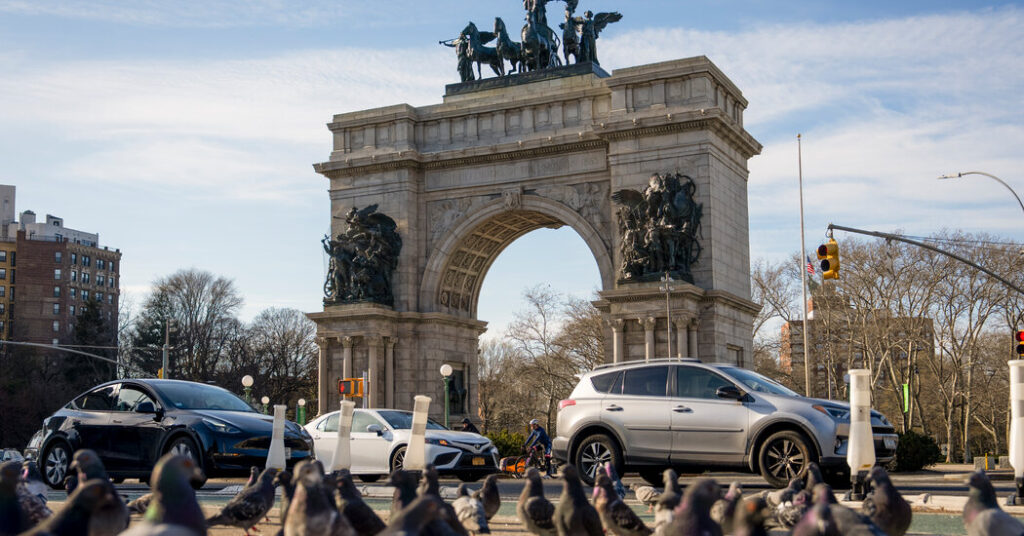
Amid the sales of babka and sliced mango, conversation bubbled up about the proposed changes to the iconic plaza that Mayor Zohran Mamdani announced last week. The mayor’s proposal would transform a dangerous stretch of road surrounding Grand Army Plaza into a pedestrian zone, effectively connecting the plaza’s centerpiece, the Soldiers’ and Sailors’ Memorial Arch, to the northern entrance of Prospect Park, the market’s weekly home.
On Saturday, the aisles of the market were packed, with runners weaving between customers lined up for goods and cyclists in the bike path along the market’s edge coming to premature stops to avoid jaywalking pedestrians.
But across the street — the one that would become a pedestrian zone according to the mayor’s plan — the plaza was nearly empty, with only a few people passing through on their way to or from the market, a journey that involved hopscotching between concrete islands like a game of Frogger.
Just under the memorial arch, Steve Flack, 44, a volunteer with Transportation Alternatives, a safe-streets advocacy group that supports the redesign, was doing what he called a “victory lap” — informing passers-by of the proposed changes and answering any questions. He said he hoped the plan would allow more people to appreciate the plaza.
“We just want people to enjoy this area again,” Mr. Flack said.
Also near the arch sat Egya Appiah, 46, who was enjoying bagels and orange juice with his 8-year-old daughter, Adoma.
“We live on the plaza and I have children so the idea of them being able to move around a bit more freely without the danger of cars would be good,” Mr. Appiah said. “You have to keep your wits about you, but I don’t think I’d say it was dangerous.”
Mr. Appiah said that Grand Army Plaza became an important meeting place in 2020, serving as both a center of pandemic socializing and a town square during the protests that summer after the police killing of George Floyd.
“It definitely to me feels like it’s the central nervous system of transportation for this part of Brooklyn,” he said.
Michael Eikim, 93, who has lived in an apartment overlooking the plaza since 1992, said that the traffic in the area had vastly improved since he first arrived. The traffic in the ’90s was like the “Wild West,” he said.
“I’m anxiously following the extensive discussions from people in my building about the new plan and what it will do,” Mr. Eikim said.
He said he was nervous, but that as long as he could walk through the area seamlessly, he was confident that the changes would be OK. Mr. Eikim said that he came to the market every weekend. “For pastries,” he said with a chuckle.
One of the purveyors of those pastries, Zara Kerr, 31, who works at the Francesca’s Bakery stand at the market, said she was excited that the new plan might allow the market, which is crammed into a small area directly in front of the entrance to Prospect Park, to expand.
“It would bring more foot traffic and there would be less cars passing through,” she said.
Ms. Kerr said that the plan would have to allow for the vendors’ trucks to access the market.
“I’m assuming because there’s so many trucks here they would have to figure out a way to maneuver that,” she said.
Aida Marquez-Romero, 53, who runs a food truck selling tamales and empanadas outside the Brooklyn Public Library nearby, said she was also worried about not being able to get her truck through the new pedestrian area.
“For us, for the sellers, it’s our living,” she said, adding that the market was essential for her business. “Today’s market is like 60 percent of my total sales.”
Overall, though, most people were enthusiastic about the plan and excited for a clearer way to cross the streets near the plaza. Even those who were a bit nervous about the proposal remained optimistic.
“I guess it could be nice,” Mr. Eikim said.
Claire Fahy reports on New York City and the surrounding area for The Times.
The post New Yorkers Warm to Mamdani’s Redesign Plan for Iconic Brooklyn Plaza appeared first on New York Times.