As a sprawling inquiry expands into whether former federal officials committed crimes in investigating President Trump, two unusual factors could ease the way toward securing the indictments he craves.
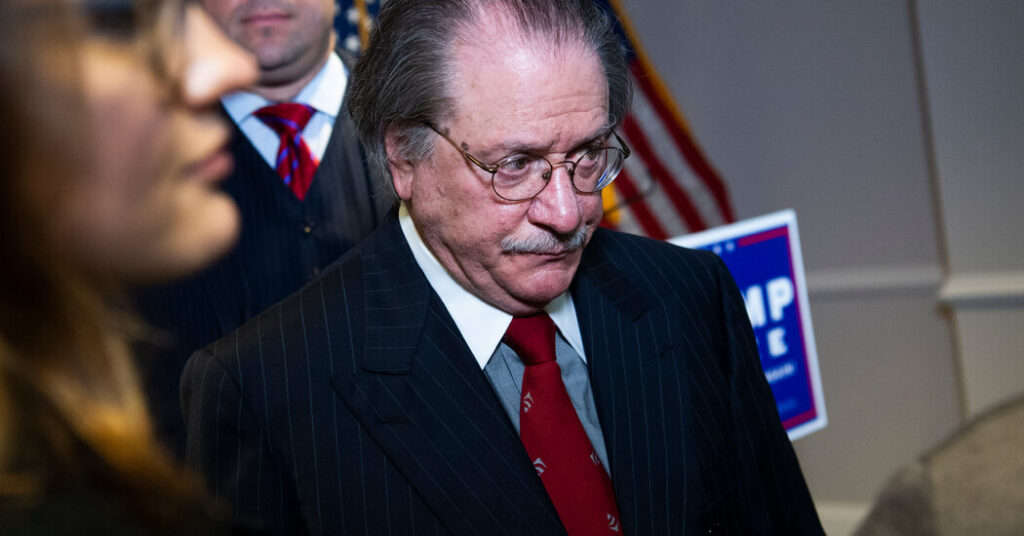
A former lawyer for Mr. Trump’s campaign, Joseph diGenova, has been selected to lead the inquiry after a career prosecutor in Miami was removed from that post this week, a senior law enforcement official said on Saturday.
And at least part of the investigation appears to be using a grand jury based in Fort Pierce, Fla., overseen by a federal judge, Aileen M. Cannon, who issued rulings favorable to Mr. Trump during the classified documents case against him, the official added. Mr. diGenova is expected to split his time between Miami and Fort Pierce.
Together, the moves show how the Justice Department under Mr. Trump’s control has been willing to embrace politically charged tactics and unorthodox personnel decisions in its efforts to satisfy his demands to prosecute his perceived foes — even as other prosecutors loyal to him have encountered forceful pushback from courts against his wide-ranging retribution campaign.
Mr. diGenova, 81, who served as a U.S. attorney in the Reagan era, has been given the title of counselor to the attorney general and detailed to the Southern District of Florida, where the U.S. attorney, Jason A. Reding Quiñones, another Trump loyalist, is supervising the inquiry.
Mr. diGenova’s appointment comes after Maria Medetis Long, a senior career prosecutor in Miami who had been in charge of the investigation, was abruptly removed from the case. Ms. Meditis Long, who leads national security investigations for Mr. Quiñones’s office, is said to have objected to moving forward with a portion of the inquiry focused on John O. Brennan, the former C.I.A. director.
The law enforcement official familiar with the matter spoke on the condition of anonymity to discuss a sensitive internal issue.
Because Judge Cannon is the only federal jurist in the Fort Pierce courthouse, she could be in a position to make critical decisions if Mr. diGenova uses the grand jury there to subpoena documents or witness testimony and the recipients balk, asking her to quash the demands.
Judge Cannon was criticized by an appeals court in 2022 after she effectively stalled the investigation into Mr. Trump’s mishandling of classified documents by appointing a so-called special master to sort through reams of materials seized from Mar-a-Lago, his private club and residence in Florida. Later, Mr. Trump praised her lavishly, calling her “strong” and “brilliant,” after she tossed out the indictment altogether, ruling that Jack Smith, the special counsel who filed the charges, had been improperly appointed.
In another unusual move, Christopher-James DeLorenz, who worked as a law clerk for Judge Cannon during the documents case and later served as an aide to Todd Blanche, the acting attorney general, was sent from the Justice Department’s headquarters in Washington to Mr. Quiñones’s office earlier this year to work on the inquiry.
Last year, Mr. Trump’s allies began pushing for what they referred to as a “grand conspiracy” case that would portray all of the criminal inquiries of Mr. Trump as a unified plot to violate his constitutional rights. The conspiracy, by their telling, began with the investigation into Russia and its potential ties to the 2016 Trump campaign, then extended to the classified documents and 2020 election indictments.
That far-fetched theory would allow the Justice Department to scrutinize in a single case matters that would normally be barred by the five-year statute of limitations. It would also give Mr. diGenova and Mr. Reding Quiñones the authority to scrutinize events that took place in Washington from their jurisdiction in Florida.
The Justice Department has also given Mr. Reding Quiñones special authority under a statute known as Section 515, the official said. That would enable him to bring indictments in jurisdictions where he is not the U.S. attorney.
While many details remain unknown, Mr. diGenova is inheriting an inquiry whose most developed portion appears to be focused on trying to find a basis to charge Mr. Brennan with lying to Congress over a January 2017 intelligence community assessment. It concluded, among other things, that Russia had interfered in the 2016 election in part because Moscow hoped to improve Mr. Trump’s chances of winning.
As the top federal prosecutor in Washington in the 1980s, Mr. diGenova secured an espionage conviction against Jonathan Pollard, a former U.S. Navy intelligence analyst who passed sensitive information to Israel. He later became a political commentator who gravitated toward Mr. Trump during his first term in the White House.
Mr. diGenova has claimed the Russia investigation was a law-enforcement plot to frame Mr. Trump and keep him out of the White House during his first presidential campaign. In 2020, as part of the legal team for the Trump campaign, Mr. diGenova said that Christopher Krebs, a cybersecurity official who had contradicted false pro-Trump claims of election fraud, should be “shot.” (Mr. diGenova later apologized.)
A special counsel appointed by Attorney General William P. Barr in Mr. Trump’s first term, John H. Durham, already scrutinized the actions of senior law enforcement and intelligence officials involved in the early stages of the Russia investigation.
When that inquiry began in 2019, Mr. diGenova was among the Trump supporters who celebrated, telling Fox News that he believed people like Mr. Brennan, James R. Clapper, the former director of national intelligence, and James B. Comey, the former F.B.I. director, would go to prison.
“James Comey, Brennan and Clapper have said to themselves, ‘Which one of us is going to pay the Barr bill?’” Mr. diGenova said, adding, “This conspiracy began with John Brennan and ends with John Brennan.”
But Mr. Durham, who completed his investigation in 2023, did not find a basis to prosecute any of them, and Mr. Barr later said the Durham investigation found that the C.I.A. had “stayed in its lane.”
Grand jury subpoenas already issued under Mr. Reding Quiñones have sought records related to the 2017 intelligence community assessment. The effort appears focused on trying to build a perjury case against Mr. Brennan over a 2023 deposition to Congress. At the time, he discussed the relationship between the assessment and the Steele dossier, a compendium of later-discredited political opposition research making various claims about Mr. Trump and Russia.
The F.B.I. had wanted to include information from the dossier in the intelligence community assessment, but C.I.A. analysts balked. Mr. Brennan, in his testimony, told lawmakers that “the C.I.A. was very much opposed to having any reference or inclusion of the Steele dossier in the intelligence community assessment.” Ultimately, as a compromise, a summary of the dossier was attached to the assessment as an appendix, as Mr. Brennan had long said.
Documents the Trump administration declassified last year complicated that account by showing that a sentence in the main body of the assessment alerted readers to the existence of the appendix, although they also showed the appendix had a header stating that its claims did not contribute to the judgment. Released files also showed that C.I.A. analysts had objected to the appendix, too, but portrayed Mr. Brennan as having pushed back in support of the compromise arrangement with the F.B.I.
Last October, Representative Jim Jordan, Republican of Ohio and a Trump ally, made a criminal referral, saying Mr. Brennan’s statement about the C.I.A.’s opposition amounted to a false statement. Mr. Brennan’s lawyer, Kenneth L. Wainstein, has said it did not.
Last December, Mr. Wainstein wrote to the chief federal judge in South Florida, Cecilia M. Altonaga, urging her to block the Justice Department from steering the case to Judge Cannon. The Justice Department, he wrote, appeared to be planning to “manipulate grand jury and case-assignment procedures” to put the investigation under her.
It has not been clear whether Judge Altonaga took any action. But the broader investigation has since expanded, including with subpoenas issued earlier this year for documents about the F.B.I.’s investigation into ties between the 2016 Trump campaign and Russia.
Charlie Savage writes about national security and legal policy for The Times.
The post U.S. Installs a Trump Loyalist to Lead ‘Grand Conspiracy’ Case Into Trump Foes appeared first on New York Times.