This article is part of our Museums special section about how institutions are commemorating the past as they move into the future.
No museum wants to have leaks in its skylights or problems with climate control. But sometimes those conditions can force a renovation project that necessitates a temporary closure, providing an opportunity — lemonade from lemons — for a museum to thoroughly rethink what hangs on its walls and reinvent its presentation.
This spring, the staff of the Chazen Museum of Art in Madison, Wis., is in the midst of shuffling the deck of its collection, following a well-laid plan but staying open to last-minute inspiration as they go. The museum will be closed for around two months this summer, with the grand reopening scheduled for September.
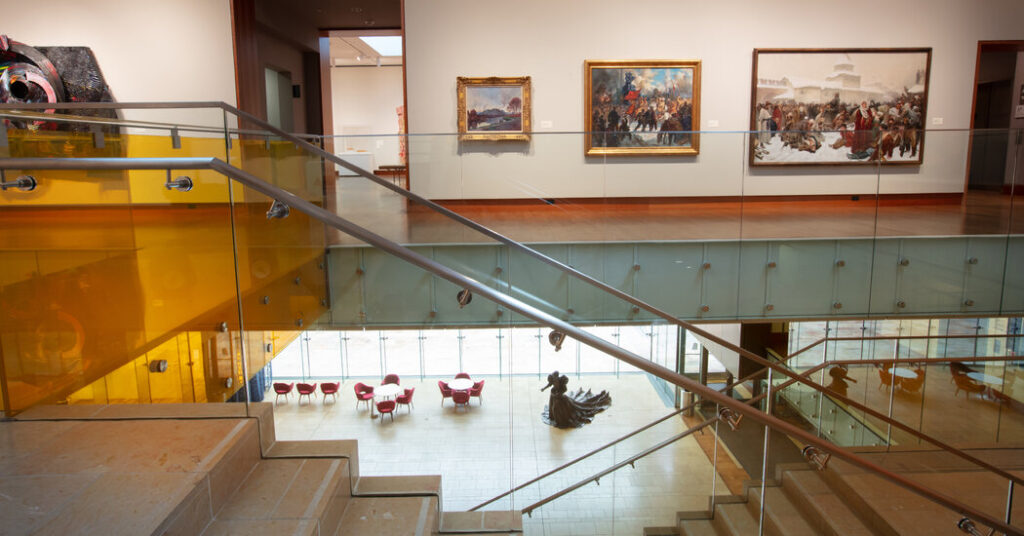
It started in 2023 when the Chazen, part of the University of Wisconsin-Madison, had to close the older of its two structures, the Elvehjem Building, a Brutalist-style design from 1970. (The newer, 2011 addition, known as the Chazen building, has remained open.)
While the exterior stone was being replaced, the skylights sealed up and the floors redone, the museum’s director, Amy Gilman, and the chief curator, Katherine Alcauskas, wanted to use the moment to come up with an entirely new way to look at their collection (which has around 25,000 objects).
Their initial conversations came fairly soon after the era of pandemic-related closures and restrictions had ended, and the hangover from that time informed their thinking: The value of seeing art in person was brought home with clarity.
“People wanted so badly to engage with real things, and museums are brilliant at that,” said Gilman, who became director in 2017. “We are object-based. That became a core value for this project.”
But which real things of the many thousands on hand? And how should they be arranged?
Gilman said they felt boxed in by two traditional ways to arrange galleries: chronologically or thematically.
“We both were very frustrated by the limitations of those approaches,” Gilman said. “Not that they can’t be really rich, but they didn’t serve our collection well.” She added that the Chazen’s collection is “quirky” and needed special attention.
Like Archimedes in the bathtub, Alcauskas had her “Eureka!” moment in a respite from work. “Katherine sent me a text saying, ‘I was out on a bike ride and I figured it out,’” Gilman recalled.
The solution was essentially a hub-and-spoke approach.
“The Chazen will be anchoring each gallery with a single, deeply researched focus object, around which we’re drawing out certain themes through a constellation of other artworks in the collection,” said Alcauskas, who joined the museum in 2019.
She added, “We’re listening really closely to what the artwork is trying to tell us, and we’re hoping to share that with the Chazen’s audience.”
More is not necessarily better when it comes to reinstallations. Previously, when all the galleries were open in 2022, the Chazen had some 1,765 works on view; with the new installation, it will be around 1,500 in total.
The Chazen’s galleries are laid out in an overall U-shape, with each building containing a ring of rooms that are bridged at one end by Gallery IX, which connects the two structures.
Gallery XI, arranged around the “focus object” of John Steuart Curry’s 1941 oil “Wisconsin Farm Scene,” typifies the new strategy. Instead of filling the space solely with other local landscapes, the gallery’s themes, listed on an overall gallery label, are Wisconsin Nature, the Wisconsin Idea and Wisconsin Communities.
Along with another oil by Curry, the presentation finds room for photographs of the Wisconsin State Capitol building — one from 1928 and one from 2001 — as well as a striking ceramic jug, “Pig Jar” (1979), by the Wisconsin artist Bruce Howdle.
“We’re not just showing what you would expect,” Alcauskas said. She pointed to Truman Lowe’s “Feather Tree” (1990), a spindly sculpture made partly of willow sticks and rawhide that is planned for the same gallery, as further proof of the concept’s flexibility and richness.
Lowe, who grew up in Wisconsin’s Ho-Chunk Indigenous community, was an influential professor at the University of Wisconsin-Madison. A retrospective of his work is currently on view at the Smithsonian’s National Museum of the American Indian in Washington.
Half of Gallery XVII is anchored by “Pink Flutter” (1970) by the acclaimed abstract painter Sam Gilliam (1933—2022). As a focus object, it presented challenges and opportunities, Alcauskas said.
“It was difficult because there are not as many figurative elements to call upon,” she said. “What we gravitated to was this sense that there is no gravity in the piece, that there’s this floating quality that Gilliam actually refers to in the title with the word flutter.”
Even though Gilliam’s work is sometimes characterized as “lyrical abstraction” in the scholarship about him, the Chazen team is avoiding art jargon generally, but especially “when there’s nothing visual to see in the term,” Alcauskas said. They chose “Defying Gravity” and “Surprising Hues” as their explicit subthemes because they seemed understandable and welcoming.
Some works that “Pink Flutter” suggested to the curators are immediately recognizable as similar, like Helen Frankenthaler’s color-drenched “Pistachio” (1971), one of several paintings in the gallery made around the time of the Chazen’s founding in 1970. But it is also paired with Dale Chihuly’s shell-like glass sculpture, “Blue Persian with Red Lip Wrap” (1999).
University museums, with their built-in audiences and collegiate context, may have a certain measure of freedom that helps enable the Chazen’s project.
“Academic museums typically have more latitude to experiment and try new things,” said Craig Hadley, the treasurer of the Association of Academic Museums and Galleries. “Theoretically, our work isn’t tied to the bottom line. A public museum has to be more conservative.”
Hadley, who is the executive director and chief curator of the Dennos Museum Center at Northwestern Michigan College, in Traverse City, Mich., added that he was familiar with the outlines of the Chazen’s rehang.
“What’s so beautiful about their reinstallation is the different points of entry,” he said of the themes and styles that will be on view. “The Chazen has always been a pretty innovative museum. It’s an opportunity for the rest of us to study what they’re doing.”
The post Finding a New Approach to Displaying a Museum Collection appeared first on New York Times.