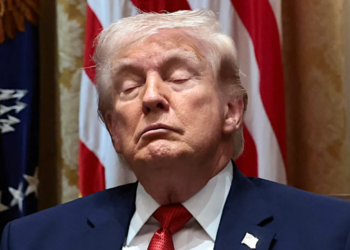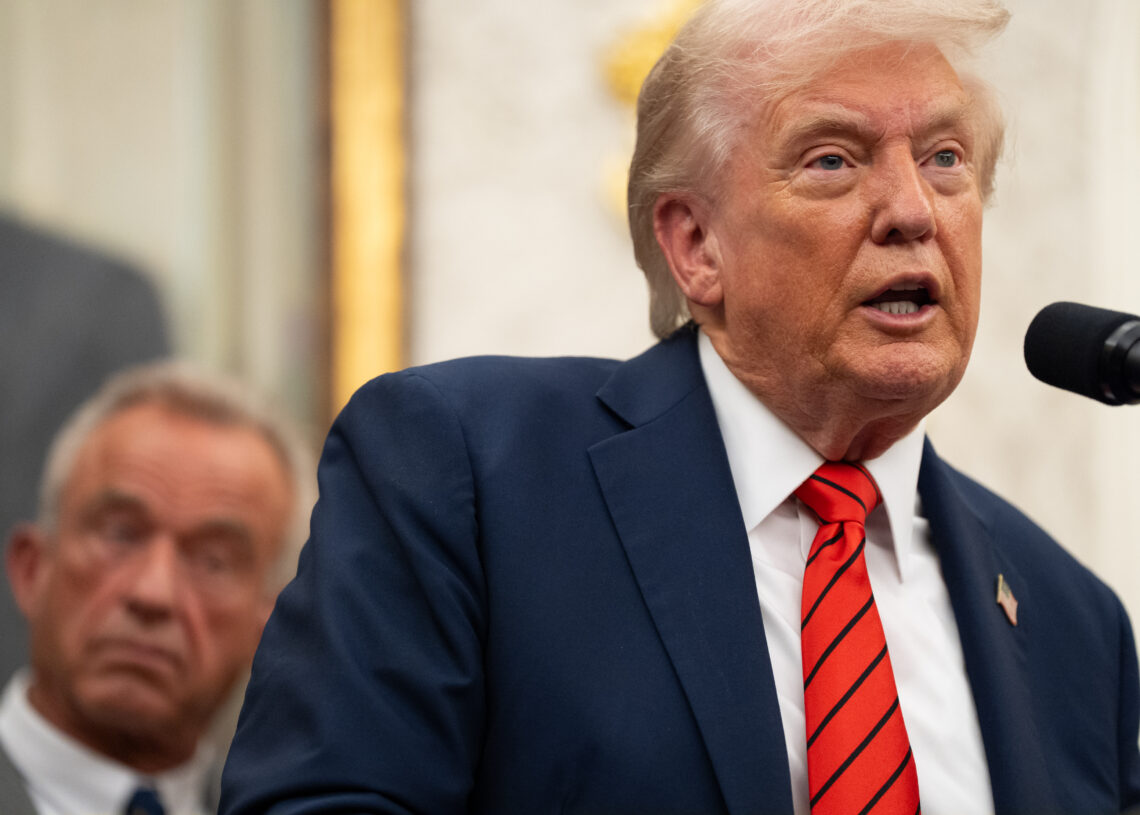
President Donald Trump on Saturday ordered new efforts to boost federal research into psychedelics and make the drugs available in controlled therapeutic settings, flanked by military veterans who said the move would save lives.
“We’re taking this decision, this decisive step, to confront one of the most urgent public health challenges facing our nation, the mental health crisis,” Trump said Saturday morning in the Oval Office. The president was joined by federal health officials and Joe Rogan, a popular podcaster who had urged Trump to increase access to psychedelics.
Some attendees characterized Trump’s move as a turning point in the federal “war on drugs” begun by the Nixon administration nearly 60 years ago.
“Federal prohibition of psychedelic medicine in America is over,” said W. Bryan Hubbard, an advocate for access to ibogaine, a psychedelic that is illegal in the United States but available in other countries, such as Mexico.
Under the president’s executive order, the Food and Drug Administration will support new clinical trials for ibogaine, psilocybin and other drugs that are known as serotonin receptors, and move swiftly to approve drugs deemed to be safe and effective. The drugs, which also include LSD and MDMA, can cause hallucinogenic effects and are illegal in the United States. FDA Commissioner Marty Makary said the agency would issue priority vouchers next week to accelerate federal reviews of several psychedelic drugs and potentially approve them this summer, although he did not specify which drugs were being examined. Trump said that the federal government had just committed $50 million in additional funding for ibogaine research.
Some drug policy experts criticized Trump’s plan, warning that expanding access to the substances could have unintended public health consequences. Kevin Sabet, who was a White House drug policy adviser across three presidential administrations, said the order will “send the wrong message” by encouraging hasty, potentially dangerous research.
“People need to realize there is little to no evidence for most of these drugs and most of the conditions they claim to alleviate,” Sabet, president of Smart Approaches to Marijuana, wrote in a text message.
Several federal officials on Saturday acknowledged the need to conduct more research. “This is something that we’re still studying, and we have to keep studying,” said National Institutes of Health Director Jay Bhattacharya.
Several attendees offered personal testimonies that they said prove the drugs work. Former Navy SEALs Marcus Luttrell and Robert O’Neill spoke about how psychedelics have helped veterans struggling with mental health challenges.
“We had prayed for this day to come,” Luttrell said, invoking his work to help military veterans travel to other countries where they could obtain psychedelics for treatment.
Federal officials spent weeks locked in internal deliberations over how far Trump’s order would go, said three people who spoke on the condition of anonymity to discuss private conversations. Those officials concluded that psychedelics had significant potential to help veterans and other people facing mental health conditions, especially if administered in controlled settings such as an FDA trial, the people said.
Health Secretary Robert F. Kennedy Jr., who joined Trump at the announcement, was among the officials championing the idea of using psychedelics to help with depression and mental health conditions. He said Saturday that officials owed it to military veterans “to turn over every stone” to address their mental health needs.
“It’s disturbing to me and to the president that hundreds, in fact, thousands of veterans are having to travel to Mexico or other countries to experiment with interventions that hold great promise,” Kennedy said.
Trump said he had also been privately encouraged by Rogan to make the drugs more available.
“Joe is an amazing guy, and he wrote me a little note about this, and I had it checked out,” Trump said.
The federal government currently categorizes psilocybin, ibogaine and other psychedelics as Schedule I drugs, which means that they have no accepted medical use and a high potential for abuse. Ibogaine, for instance, has been linked to heart risks. Federal law prohibits the cultivation and possession of Schedule I drugs, except for approved research studies.
Trump said Saturday that any FDA-approved psychedelics would be rescheduled, making them easier to access.
Before Trump’s announcement, politicians had increasingly touted the potential of psychedelics for mental health treatment, a shift in rhetoric after decades of leaders — particularly Republicans — calling for crackdowns.
Former Texas governor Rick Perry (R) and former U.S. senator Kyrsten Sinema (I-Arizona) are among the politicians who have cheered ibogaine’s potential to address mental health conditions.
“Few things have moved me like what I’ve witnessed with a psychedelic drug made from a shrub in Africa,” Perry wrote in a Washington Post op-ed last year.
Kennedy also raised the idea of making psychedelics more available during his independent presidential campaign. He continued to tout the concept after throwing his support to Trump in August 2024 and announcing his “Make America Healthy Again” agenda.
“My mind is open to the idea of psychedelics for treatment,” Kennedy wrote in a September 2024 Instagram post. “People ought to have the freedom and the liberty to experiment with these hallucinogens to overcome debilitating disorders.”
Andrew Kessler, the founder of behavioral health consultancy Slingshot Solutions, said restrictions on psychedelics such as psilocybin — sometimes known as “magic mushrooms” — have hampered research into their clinical applications, despite evidence of their potential.
“The research on psilocybin at the [Department of Veterans Affairs] and elsewhere has been incredibly promising for dealing with PTSD, addiction and other mental health issues,” Kessler said. But he contrasted that work with the need for more federal investments into other ways to support people dealing with those conditions, such as more funding for a federal agency that supports mental health care, the Substance Abuse and Mental Health Services Administration, which has faced cuts and pressure under the Trump administration.
“Even if research on psychedelics is successful, we are years away from it having an impact,” Kessler said. “We are still in crisis mode and need immediate help as well.”
Rachel Roubein contributed to this report.
The post Trump orders more access to psychedelics like LSD, psilocybin and ibogaine appeared first on Washington Post.