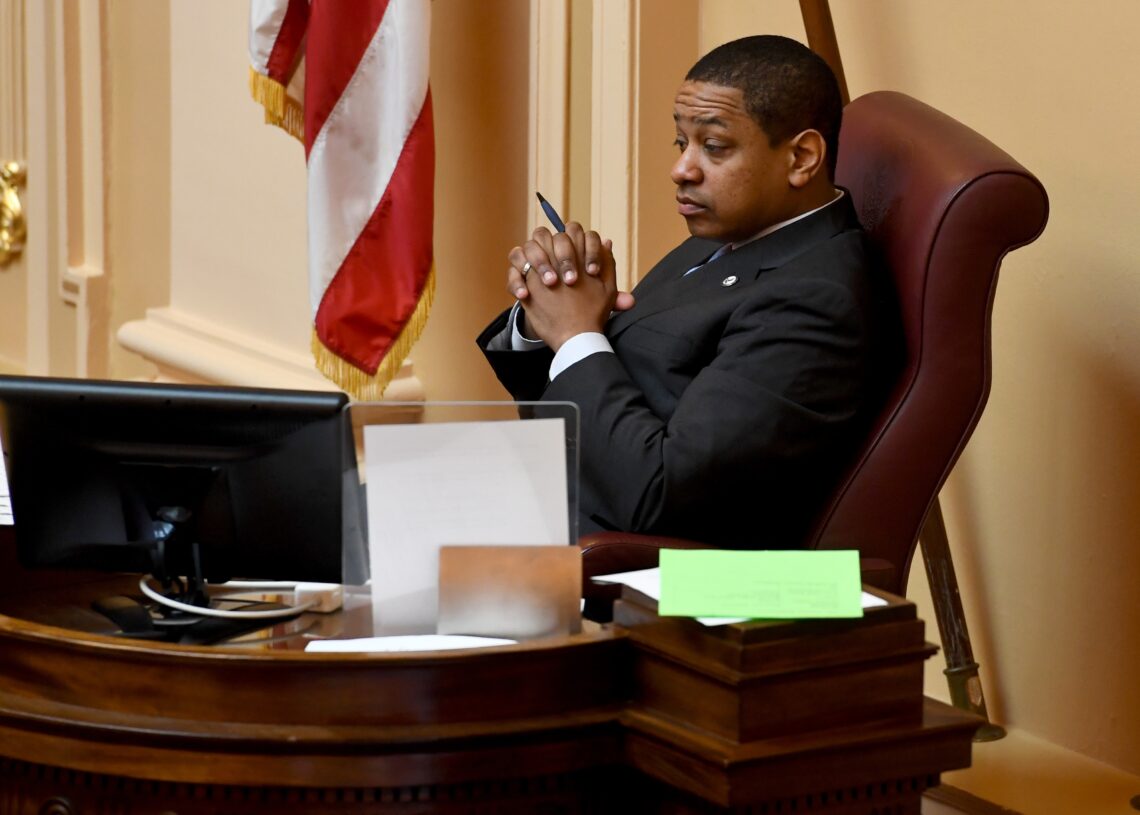
When their phones began lighting up early Thursday morning with news about Justin Fairfax, his closest circle of friends braced for an outcome they had long dreaded: that he had harmed himself.
The actual news was far worse.
Fairfax, 47, a former Virginia lieutenant governor whose promising political career was cut short eight years ago by allegations of sexual assault, had killed his estranged wife, Cerina Wanzer Fairfax, 49, a dentist, before turning the gun on himself in their home in Annandale, police said. Their two teenage children were in the house; one called 911.
That horrific act capped a years-long descent over an obsession that had seemed to worsen in recent months, according to interviews with a half-dozen friends and former colleagues who had tried, over the years, to walk Fairfax out of the darkness. The shooting, two weeks before a court-imposed order to move out of his house, claimed the life of an accomplished woman known by her friends and patients for her quiet intellect, her empathy for people in pain and her devotion as a mother.
Fairfax had been a polished, jovial politician and lawyer who made history as the second Black person elected statewide in Virginia. In early 2019, he seemed poised to become governor, following in the footsteps of his mentor, former governor L. Douglas Wilder.
But two women came forward that year to accuse Fairfax of separate sexual assault incidents from two decades earlier. He defied calls to resign from office, but his political career never recovered. Fairfax was shunned by other Democrats, failed badly in a later attempt to run for governor and struggled to reestablish himself as a lawyer.
All the while, he could not reconcile the damage done to his reputation. He emailed journalists, sometimes enclosing screenshots of long-ago stories or social media posts to highlight what he claimed was inaccurate. He called repeatedly for the FBI to investigate him, believing he would be exonerated, and then fought to get documents he said the agency had in its files that could help his cause. He pestered old acquaintances to speak out.
“He never got away from that place, that’s what was disturbing,” said author Sophia Nelson, who had broken with Fairfax over the allegations but reconciled with him a few years ago. “No matter what we said, he stopped there, if that makes sense. He was still looking for justice, for vindication, and for somebody to hear him.”
Interviews with those close to him suggested a worsening of his outlook in recent months as his marriage unraveled and as news of other politicians facing sexual misconduct charges revived old grievances. Fairfax spent long hours holed up in his home office, present but almost completely detached from the people closest to him, as wine bottles and dirty laundry piled up on the floor, emerging only occasionally to step outside for a smoke, according to court documents filed in his divorce case. His regular text exchanges with friends became sporadic and lately began to sound especially worrisome.
Several of his confidants said they had long feared Fairfax was nearing a breaking point. But they never envisioned that this man who wanted desperately for the public to believe he had not assaulted two women would commit an act of such violence against the woman who had stood by him during and after the scandal, and who had assumed the role of the family’s primary breadwinner and almost sole caregiver to their children.
***
On Inauguration Day 2018, Fairfax was beaming. As he worked the crowds — shaking every hand, his laugh always a little too loud — Cerina came across very differently.
“She was not in her comfort zone,” said Phillip E. Thompson, a lawyer and former Loudoun County NAACP president who had known the Fairfaxes for years. Cerina was his dentist. “I think at one point, I might’ve come up to her and said, ‘You know, you don’t look like you want to be here. And she just gave me that look like, ‘Hell yeah.’ … I think that wasn’t her goal in life, to be some politician’s wife.”
She did her best to play the part, friends said, but sometimes took refuge upstairs during political meetings or fundraisers at the house. Fairfax had made sure to thank his family for their sacrifices after winning election, singling out “my brilliant and beautiful wife, Dr. Cerina Fairfax” in his victory speech.
At that moment, Nelson said, they were the apex of success: good educations, successful careers, adorable children. “The guy is everything you want, particularly in the African American community. Everything you want to see,” Nelson said.
Both Fairfaxes earned undergraduate degrees at Duke University. She grew up in Prince William County; he was raised largely in his grandparents’ home in Northeast Washington. His mother was a pharmacist and had moved back in with her parents with her four children after divorcing their father, who was a Harvard-educated consultant to nonprofit organizations.
Friends had an affectionate nickname for the couple, Thompson recalled: “They’re the Huxtables,” he said, referring to the doctor-lawyer pair portrayed on “The Cosby Show.”
That high point lasted a little more than a year. In February of 2019, scandal engulfed Virginia’s executive branch when a conservative blog revealed that a racist photo had appeared on the medical school yearbook page of Gov. Ralph Northam (D).
Democrats called for Northam to step down, and Fairfax began preparations to take over as governor. But in a couple of days, two women came forward to allege that Fairfax had sexually assaulted them 20 years ago. Northam denied being in blackface in the photo, kept his job and finished a successful term as governor. But Fairfax was suddenly a pariah to his party.
It was a breathtakingly rapid fall from grace. “He never recovered,” Nelson said.
***
Fairfax became driven by a desire to clear his name of what he said were false allegations. He called for an FBI investigation. He railed against the media that wouldn’t take his word.
Caring for their family, meanwhile, fell to Cerina. Court records would later show that she took on full domestic duties — cooking, grocery shopping, caring for the children — as Fairfax became more and more withdrawn. Cerina served as “a port in a storm for her children. Their remarkable resilience and early success in life is down to what can best be described as Mother’s grit,” Fairfax County Circuit Court Judge Timothy J. McEvoy wrote.
Cerina’s friends described her as a calm presence who preferred keeping the spotlight on others. She didn’t post much on social media. Her dental practice’s website shared few personal details: She loved reading, Bikram yoga, running trails with her “energetic” Vizsla dogs and spending time with her family.
Terron Sims II, 48, was her patient for six years. They had grown up in the same neighborhood in Prince William County and attended the same high school, but Sims didn’t really get to know Cerina until he became a regular in the place where she felt comfortable — the dentist’s chair.
When he didn’t floss, she rebuked him “as if I were her own child,” the Arlington consultant recalled with a laugh. But when he did take care of his teeth, she beamed with genuine pride. And when he made a joke, she would crack one right back. He liked her so much that he had invited Cerina to his birthday party next Saturday.
If Cerina was thriving in her career, her husband struggled once he left office. He thought that party leaders were dismissing him, or had even engineered his downfall by coordinating the revelations to block his rise. He ran for the Democratic gubernatorial nomination in 2021 but came in fourth place. He landed job interviews at big law firms but got no offers, according to a close associate who spoke on the condition of anonymity to share private details.
So Fairfax opted to hang his own shingle and, at times, seemed like he might find his footing. Working with another lawyer in 2023, Fairfax helped the family of a Black man killed by Virginia Beach police reach a $3 million wrongful-death settlement with the city. Fairfax ultimately came away with about $300,000 for himself.
But by the next year, his legal work and income had dried up. His obsessions had resurged, and his marriage was failing.
Cerina filed for divorce in the summer of 2025. Fairfax stayed in the house despite increasing pleas from several friends to go somewhere for his own mental health. Fairfax told one friend he feared that moving out would signal to the court that he was abandoning his family.
When the couple interacted, it was to argue, until Cerina adopted an attitude of “gray rocking,” which she described in divorce proceedings as a way of staying calm and not responding to her husband’s provocations. He took it as being marginalized, according to the documents.
The judge would later describe Cerina as “the primary caregiver for both children for almost the entirety of their lives. … Among other things, she is the planner, the scheduler, the caretaker, the cook, the disciplinarian and the primary nurturer. … It also appears [she] is the primary earner right now.”
Nelson remembered Fairfax complaining that “I have nothing left. I’ve lost my reputation, lost my career and my livelihood.” And now he was losing his wife and children.
“He was suffering depression and isolation and hurt. … There was a darkness that had descended on Justin, a depression. And we all knew it, and we wrestled with trying to get him to see somebody, to talk to somebody, to talk to the pastor, to get back into the game of living,” she said. He refused.
In the first months of this year, as the divorce headed toward a conclusion, friends worried that Fairfax’s mindset was deteriorating. Thompson received a text from Fairfax late the night of March 21 — the day after closing arguments in the divorce case. “Love you, Chief Lion!” Fairfax wrote, using a nickname. “Thanks for everything!! Keep going. Much love, JF.”
Thompson was concerned the notes sounded like a goodbye and reached out to other friends, who had received similar messages. None knew what to think.
Fairfax also surprised former Virginia governor Robert F. McDonnell, a Republican who had endured a federal corruption trial and conviction that the Supreme Court eventually tossed out, by calling him on March 27. They did not know each other well, but Fairfax for a full hour poured his heart out about his ruined reputation and looming divorce.
“I assured him at some point this would be over and he’d be able to get back on track,” said McDonnell, who offered Fairfax, a fellow Catholic, a mix of scripture (Book of Job), practical advice (eat well and exercise) and job leads. “We had a warm ending to our conversation, and I felt that I’d be hearing good news about Justin.”
Nelson’s last message from Fairfax came on Tuesday, two days before his death. Recent news stories about former congressman Eric Swalwell (D-California) and other politicians facing sexual misconduct charges had triggered Fairfax all over again, she said, and Fairfax was once more begging for someone to stand up for him.
By this point, Fairfax was utterly broke, locked out of the family WiFi and refrigerator, with Cerina keeping groceries in a small fridge in her bedroom. (In court, Cerina said she had begun denying him access to groceries because she had grown “tired … of his constant taking without any semblance of reciprocity.”)
He relied on Panera Bread’s free WiFi to file his court pleadings and on donations from friends, family and his parish priest to pay court fees and put gas in the tank of his car, a Honda CRV owned by his mother, said Father Michael J. Kelley of St. Martin’s Catholic Church in Northwest Washington, a close friend of the family, who noted that he used his personal funds, not parish funds.
At 7:44 a.m. Wednesday, the day before he shot his wife and himself, Charlene Fairfax wired the $3,030 her son owed in court fees in Fairfax v. Fairfax, according to a receipt provided to The Washington Post.
“Thank you very much, Mama,” Fairfax emailed her back at 8:10 a.m. “Love you.”
***
Fairfax’s final, violent act has left his friends doubly bereft. The man consumed by the need to clear his name — and who some friends believe deserved redemption — has done something they can never forgive.
“Now, it’s way worse,” Nelson said. “Now your epitaph is you murdered your wife and you shot yourself while your two children were upstairs. … Anybody who ever said he was a bad man or an abuser, they’ve been validated. That’s the tragedy of this. There’s nothing else I can say except that’s where he left this.”
Those who knew Cerina don’t want her life to be defined by the way it ended.
John Reid IV grew up with Cerina Wanzer, as she was known then, in Prince William County and recalled her as “a light.”
As students at Woodbridge Senior High School, he said, she consoled him when he was angry and confused about race riots that had erupted in Los Angeles. “All we can really do is to be there for others,” he said Cerina told him one day between classes. “If you ever feel like you’re angry, please know that I’m here for you.”
The same sort of quiet, dependable spirit is what Reid said he thought motivated her to stick by Fairfax’s side amid the allegations of sexual assault. “She had a very forgiving spirit, and looking from the outside in, perhaps there was a door still open for healing,” said Reid, 49, now a teacher. “That’s just who she was, she was a healer. … She thought a heart could be healed as well.”
When Rebecca Geller saw Cerina a few weeks ago, she mentioned no problems at home. Nothing seemed off about her longtime friend with the youthful laugh, a dentist who came up with silly songs to comfort her patients. (“Tap and grind, tap and grind,” she would sing to Geller, a pal turned client, when checking her bite.)
But the Fairfax Station lawyer, 46, knew Cerina to be a private person. That day, the women talked, as usual, about their kids. Cerina shut down her office during her children’s spring break so she could be present for them. She crafted her work around their schedules, Geller said.
“They were everything to her,” she said. “Those kids are her legacy.”
If you or someone you know needs help, visit 988lifeline.org or call or text the Suicide & Crisis Lifeline at 988.
Schneider and Vozzella reported from Richmond, and Armus and Paquette reported from Washington. Karen Tumulty, Juan Benn Jr. and Joe Heim contributed to this report.
The post How Justin Fairfax’s obsessive quest to clear his name destroyed his family appeared first on Washington Post.