Over five days in the winter of 2016, the justices of the Supreme Court exchanged an extraordinary series of confidential memos about how the court should address an ambitious climate change initiative from President Barack Obama. The debate yielded an order halting the program by a 5-to-4 vote — without any explanation.
Legal scholars have called the episode the birth of the modern shadow docket, in which the court has used truncated procedures cloaked in secrecy to block or allow major presidential initiatives in terse rulings. Ordinarily, justices’ confidential papers are not disclosed until after their deaths, meaning the public might not learn what happened, and why, for decades.
The New York Times has obtained the memos and confirmed their authenticity. Here are key excerpts, along with our analysis. (You can read the full 16 pages of memos here.)
Feb. 5, 2016
An extraordinary need for speed
Chief Justice John G. Roberts Jr. is responsible for overseeing the D.C. Circuit, and emergency applications concerning its work are directed to him.
The circuit court justice can act on his own or, as is the practice in important cases, refer the application to the full court. Either way, the circuit justice takes the lead in setting deadlines, framing the issues and playing traffic cop as he and his colleagues exchange memos and vote.
The chief justice kicks things off with a memo to his colleagues, telling them that 26 states and many businesses filed five separate requests asking the court to temporarily block the Obama initiative. They were similar, and the court addressed them together.
The applications landed the week before, and Chief Justice Roberts ordered the administration to respond by Feb. 4. With response in hand, he wastes no time.
Chief Justice Roberts says he is referring this emergency request to “the conference,” which is Supreme Court lingo for the nine justices. He also casts the first vote. He says he is doing so “to preserve the status quo,” but how to determine the status quo in challenges to government actions is much debated.
Time is of the essence, the chief justice says in 2016. He notes that earlier regulations of power plants under this part of the Clean Air Act called for reducing emissions at the source using scrubbers and similar methods.
The new plan contemplates something different, he says: a systemic regulation of the power grid, including by encouraging coal-fired plants to be shut down and replaced with ones powered by cleaner technologies. And it would start locking in those changes immediately.
But the regulation did not call for states to submit compliance plans until September 2016, and they could seek a two-year extension. The first deadline for power plants to reduce their emissions was in 2022, with full compliance not required until 2030.
Though he doesn’t say so in so many words, Chief Justice Roberts’s citation of a 2014 precedent makes clear that he is invoking the “major questions doctrine” to block the plan.
That precedent said that agencies can make decisions of vast “economic and political significance” only if Congress explicitly grants them that power. In the years since, that doctrine has played an increasingly important role in the court’s work.
The chief justice stresses that investments in clean energy may be irreversible.
Chief Justice Roberts accuses the E.P.A. of sidestepping the court following a recent ruling.
The previous June, the court overturned an Obama administration rule on mercury emissions. But the regulation remained in effect while the litigation moved forward. The day after the agency lost, an official said in a blog post that most power plants were already in compliance or well on their way. This seemed to anger the chief justice, who cites the episode in his memo.
The memorandum is signed with two sets of initials: first the chief justice’s, and then in lowercase, those of Joseph Ben Tyson III, the clerk who worked with him on the case and helped prepare the memo. Mr. Tyson is now the chief counsel at Boeing, but in February 2016, he was less than two years out of law school.
Every year, each justice employs four of these lawyers, traditionally early in their careers, who assist them with research and writing. The joined initials suggest how closely involved the clerks are in key decisions.
Feb. 5, 2016
An attempt to pump the brakes
Justice Stephen G. Breyer responds the same day, saying he would deny the stay requests — allowing the Clean Power plan to go into effect for the time being — but add safety valves to minimize immediate burdens on the states that sued while the D.C. Circuit considers the case. He includes a proposed order along those lines.
Justice Breyer says, with considerable understatement, that such stays are unusual. He adds that the court should not signal its view on how the case should come out until the appeals court rules.
Unlike the chief justice, Justice Breyer has nothing to say about the lawfulness of the Clean Power Plan.
Feb. 6, 2016
A ruling following the usual course would be too late
The chief justice sounds irritated by Justice Breyer’s proposal.
The sums involved, which Chief Justice Roberts says may approach $480 billion, require the court to act.
Unlike Justice Breyer, the chief justice is prepared to offer his view on the “merits” of the case, that is, on the legality of the plan. He says he does not believe the court will ultimately conclude it is lawful.
Chief Justice Roberts fears that the D.C. Circuit will not rule in time for the Supreme Court to hear the case in the term starting in October 2016. If the justices do not hear arguments until the following fall, their decision would very likely land in 2018. He suggests this outcome would be unacceptable to him.
The chief justice does not discuss another possibility for prompt action: to simply set the case down for oral arguments.
Chief Justice Roberts takes the unusual step of quoting from a 2015 BBC interview with the administrator, Gina McCarthy. In response to a question about a potential Republican victory in the coming presidential election, the chief justice writes, she said the agency was baking the Clean Power Plan into the system in ways that later presidents and Congress would not be able to undo.
That off-the-cuff remark plays an outsize role in the chief justice’s reasoning. He says it is an echo of the agency’s approach to the “ill-fated” mercury ruling.
Feb. 7, 2016
Caution about something profoundly new
Justice Elena Kagan, referring to Justice Breyer by his first name, backs his proposal, adding that the Supreme Court should urge the D.C. Circuit to move quickly.
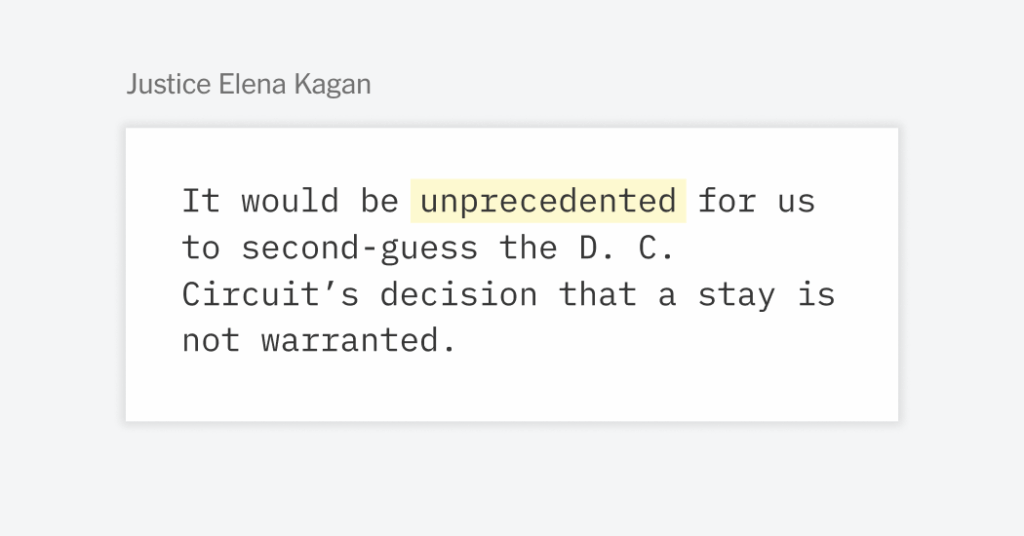
Justice Kagan is the first member of the court to acknowledge that it is contemplating something entirely novel. The lower court had decided a stay was not necessary and had put the case on a fast track. Why, she asks, would the Supreme Court short-circuit that process?
(Years later, in a 2022 dissent, Justice Kagan told the public what she had told her colleagues here. “That action was unprecedented,” she said of the court’s 2016 order. “Never before had the court stayed a regulation then under review in the lower courts.”)
Justice Kagan gives voice to a complaint that would become familiar with the rise of the emergency docket: that the court should not make grave decisions based on hurried proceedings. But she adds that she is leaning toward finding that the Clean Air Act authorizes the Obama plan.
Justice Kagan is not buying Chief Justice Roberts’s insistence that immediate action from the court is necessary.
Justice Kagan’s memo is the only one signed with a first name — “Elena.”
A third liberal asks the court to slow down
A memo circulated to other justices’ chambers appears to set out the views of Justice Sonia Sotomayor.
(The version obtained by The Times does not include a signature but the next memo, from Justice Samuel A. Alito Jr. on Feb. 7, refers to statements in this memo, attributing them to “Sonia.”)
The memo is not on letterhead and bears the date of Feb. 16, 2016, almost certainly incorrect given that by then, the court had already issued its order.
Like Justice Kagan, the memo’s author calls Chief Justice Roberts’s proposed approach unprecedented.
Saying the case calls for “our considered, unhurried attention,” the author adds that the chief justice’s factual assertions are open to question and that “at first glance” the administration seems to have the better of the argument.
Feb. 7, 2016
Another justice is ready to rule
Justice Alito seems to have made up his mind.
Justice Alito explains that he believes the court’s very “institutional legitimacy” is at stake, reasoning that a ruling in the usual course would come too late to stop the impact of the Clean Power Plan.
The memorandum was apparently signed on Justice Alito’s behalf by the law clerk who helped prepare it, Barbara S. Grieco, now an appellate lawyer in St. Louis. (She married Mr. Tyson, the clerk for Chief Justice Roberts who worked on the case, and is now known as Barbara S. Tyson.)
Feb. 9, 2016
The swing justice speaks
Justice Anthony M. Kennedy was, characteristically, the decisive vote. He was at the time the court’s ideological fulcrum, controlling the outcome in many closely divided cases.
He reasoned that the court would block the plan after the D.C. Circuit ruled and that there was no good reason to put off the inevitable.
It is not known whether the other members of the conservative wing — Justices Antonin Scalia and Clarence Thomas — prepared memos. Likewise, it is not known whether the court’s fourth liberal, Justice Ruth Bader Ginsburg, circulated her own memo.
Feb. 9, 2016
What the public sees
The court issues five identical versions of the same spare order staying the Clean Power Plan. The vote is 5 to 4, with the four liberal justices noting dissents.
Despite the seven memos spanning 16 pages debating the action, neither side discloses their reasoning to the public, and the debate has remained a secret — until today.
Produced by Jenni Lee.
Adam Liptak is the chief legal affairs correspondent of The Times and the host of The Docket, a newsletter on legal developments. A graduate of Yale Law School, he practiced law for 14 years before joining The Times in 2002.
The post A Breakdown of Five Days of Secret Supreme Court Memos appeared first on New York Times.