The Inside Story of Five Days That Remade the Supreme Court
Secret memos obtained by The New York Times illuminate the origins of the court’s now-routine “shadow docket” rulings on presidential power.
April 18, 2026
Just after 6 p.m. on a February evening in 2016, the Supreme Court issued a cryptic, one paragraph ruling that sent both climate policy and the court itself spinning in new directions.
For two centuries, the court had generally handled major cases at a stately pace that encouraged care and deliberation, relying on written briefs, oral arguments and in-person discussions. The justices composed detailed opinions that explained their thinking to the public and rendered judgment only after other courts had weighed in.
But this time, the justices were sprinting to block a major presidential initiative. By a 5-to-4 vote along partisan lines, the order halted President Barack Obama’s Clean Power Plan, his signature environmental policy. They acted before any other court had addressed the plan’s lawfulness. The decision consisted of only legal boilerplate, without a word of reasoning.
At the time, the ruling seemed like a curious one-off. But that single paragraph turned out to be a sharp and lasting break. That night marks the birth, many legal experts believe, of the court’s modern “shadow docket,” the secretive track that the Supreme Court has since used to make many major decisions, including granting President Trump more than 20 key victories on issues from immigration to agency power.
Since that night a decade ago, the logic behind the Supreme Court’s pivotal 2016 order has remained a mystery. Why did a majority of the justices bypass time-tested procedures and opt for a new way of doing business?
The answer would remain secret for generations, legal experts predicted. “We’ll never know (at least, until our grandkids can read the justices’ internal papers from that time period),” Stephen Vladeck, a law professor at Georgetown, wrote in a newsletter in February marking the anniversary of the order.
The New York Times has obtained those papers and is now publishing them, bringing the origins of the Supreme Court’s shadow docket into the light.
The 16 pages of memos, exchanged in a five-day dash, provide an extraordinarily rare window into the court, showing how the justices talk to one another outside of public view.
Writing on formal letterhead, but addressing one another by their first names and signing off with their initials, they sound notes of irritation, air grievances and plead for more time. In addition to the usual legal materials, they cite a blog post and, twice, a television interview. They sometimes engage with one another’s arguments. But they often simply talk past each other.
In public, Chief Justice John G. Roberts Jr. has cultivated a reputation for care and caution. The papers reveal a different side of him. At a critical moment for the country and the court, the papers show, he acted as a bulldozer in pushing to stop Mr. Obama’s plan to address the global climate crisis.
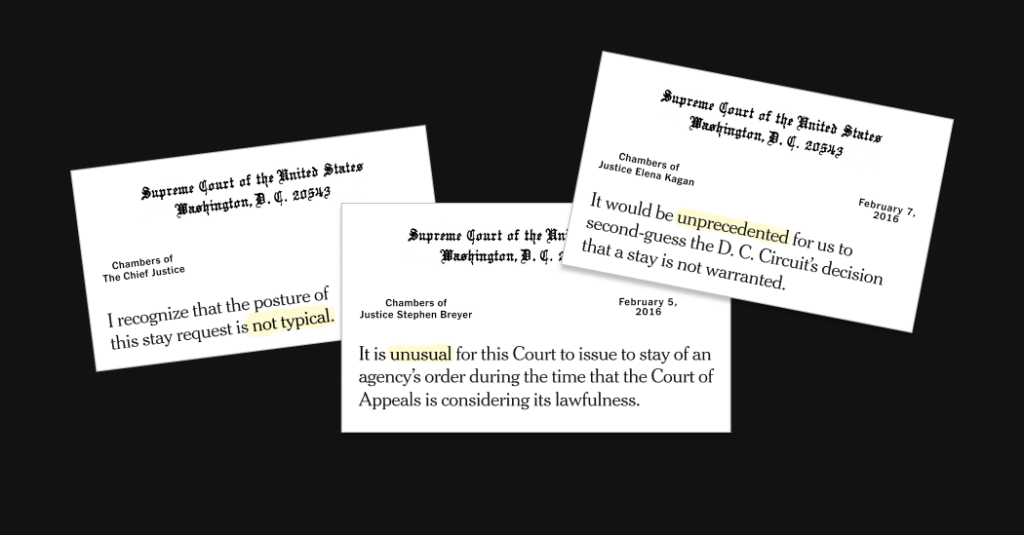
When colleagues warned the chief justice that he was proposing an unprecedented move, he was dismissive. “I recognize that the posture of this stay request is not typical,” he wrote. But he argued that the Obama plan, which aimed to regulate coal-fired plants, was “the most expensive regulation ever imposed on the power sector,” and too big, costly and consequential for the court not to act immediately.
In the Trump era, he and the other conservative justices have repeatedly empowered the president through their shadow docket rulings. By contrast, the papers reveal a court wielding those same powers to block Mr. Obama. Justice Samuel A. Alito Jr. warned that if the court failed to stop the president, its own “institutional legitimacy” would be threatened.
The court’s liberals pushed back, but compared with their recent slashing dissents, they were not especially forceful, mostly confining their arguments to procedures and timing.
The papers expose what critics have called the weakness at the heart of the shadow docket: an absence of the kind of rigorous debate that the justices devote to their normal cases.
After obtaining the papers, The Times confirmed their authenticity with several people familiar with the deliberations and shared them with a spokeswoman for the court. The Times posed detailed questions to the justices who wrote the memos; they did not respond.
Since that breakneck February 2016 exchange, the emergency docket has swelled into a major part of the court’s business, as the justices have short-circuited the deliberations of lower courts. The decisions are technically temporary, but are often hugely consequential.
Rulings with no explanation or reasoning, like the sparse paragraph from that February night, have become routine. The emergency docket is now a central legacy of the court led by Chief Justice Roberts.
Read a decade later, the memos suggest that none of the justices fully appreciated what they were doing: embarking on a questionable new way of operating.
A Constitutional Collision
The 2016 case was a collision between the principles and personalities of Mr. Obama and Chief Justice Roberts.
The president was under enormous pressure to address the global climate crisis. He had campaigned on that promise, then for eight years as the planet heated, he failed to get major environmental legislation through Congress. With his term about to end, this was his last chance to act.
The chief justice was eager to assert his institution’s authority and to rein in Mr. Obama’s Environmental Protection Agency, which he believed had sidestepped a recent ruling.
The two men, both cerebral, polished Harvard Law graduates, had long posed a puzzle: How could such smooth personalities create so much friction?
Mr. Obama had been one of just 22 senators to vote against Chief Justice Roberts’s confirmation in 2005, saying that the nominee had “far more often used his formidable skills on behalf of the strong in opposition to the weak.” Four years later, the two men managed to botch the simple task of reciting the presidential oath at Mr. Obama’s first inauguration.
True, Chief Justice Roberts had cast the decisive vote in 2012 to save the centerpiece of the Affordable Care Act, Mr. Obama’s signature legislative achievement. But that was approved by Congress.
After Republicans won control of Congress, Mr. Obama responded by pushing the boundaries of presidential authority, promising that his administration would act on pressing problems “with or without Congress.” He tightened gun regulations and granted deportation relief to millions of undocumented immigrants.
The chief justice and some of his colleagues were watching warily, concerned the president was going past what the Constitution allowed him to do on his own. In a 2014 opinion written by Justice Antonin Scalia, the court warned Mr. Obama that he needed to tread carefully in setting environmental policy without congressional approval.
That statement was one of the early articulations of what would come to be known as the major questions doctrine, saying that on important matters, executive branch agencies could act only with clear direction from Congress.
Then, in June 2015, the court ruled against the Obama administration in a case involving mercury emissions. The next day, an E.P.A. official, Janet McCabe, made what now looks like a tactical error. She issued a statement that, according to the papers, offended the chief justice and struck him as an attempt to sideline the court.
She asserted that the court’s ruling had come too late to matter.
“The majority of power plants are already in compliance or well on their way to compliance,” Ms. McCabe wrote on the agency’s website.
In a recent interview, Ms. McCabe said she had not meant “to be disrespectful of the Supreme Court or the judicial system” and was merely stating a legal reality. Indeed, over more than three years of litigation, no court had stayed the mercury regulation and power plants had already taken major steps to conform.
With the clock ticking down on Mr. Obama’s presidency and the global Paris climate accords looming, the White House tried to craft a signature piece of environment legislation that could survive the court’s scrutiny.
In October 2015, the E.P.A. issued Mr. Obama’s Clean Power Plan, which aimed to shift the power sector from reliance on coal to natural gas, wind and solar. The goal was an “aggressive transformation in the domestic energy industry,” according to a White House fact sheet.
Its legal basis was open to question. The agency said it was authorized by a seldom-used provision of an old law, the Clean Air Act of 1970. Critics responded that it was unlikely that Congress would have authorized a sweeping overhaul of the nation’s power supply in such an obscure provision.
When more than two dozen states, along with business groups, quickly sued to stop the program, Obama administration lawyers readied for an extended fight, they said in recent interviews. The case was surely going to wind its way to the Supreme Court eventually, and given the tension between the conservative justices and the Obama administration, they knew it might not survive.
The challenge to the regulation went straight to the D.C. Circuit, which set it down for a prompt argument, but refused to halt the plan in the meantime. At that point the challengers, led by West Virginia, tried to take a shortcut. Instead of waiting for the appeals court to hear the case, they went straight to the Supreme Court, asking the justices to pause the plan for the duration of the litigation, including an eventual possible return trip to the Supreme Court.
Both sides agreed that it was an unusual request.
“This had never been done,” Elbert Lin, who was West Virginia’s solicitor general, acknowledged in an interview.
At the Justice Department, lawyers involved with the case said they were not terribly worried. To be sure, the court sometimes granted emergency applications from death row inmates and in fast-moving election disputes. But the court had never intervened on an emergency basis to shut down a major presidential initiative.
“In football parlance,” said Avi S. Garbow, the E.P.A.’s general counsel at the time, “we would call it a Hail Mary.”
A Five-Day Sprint
West Virginia’s emergency request landed with Chief Justice Roberts on Jan. 26, 2016, just as the Supreme Court was scattering into vacation mode for an annual midwinter break.
Justice Clarence Thomas retreated to Florida to teach a law school class. Justice Stephen G. Breyer delivered a lecture in Paris. Justice Ruth Bader Ginsburg gave a talk in Italy billed as a conversation with “the Notorious RBG.” Justice Antonin Scalia sped through Asia, where he promoted a book, met with the Prime Minister of Singapore and schmoozed with local lawyers over drinks at a rooftop bar.
In the meantime, Chief Justice Roberts worked speedily, ordering the Obama administration to respond in just eight days.
To better understand what happened next, The Times spoke to 10 people, liberals and conservatives, who were familiar with the deliberations over the pivotal emergency order and who spoke on the condition of anonymity because confidentiality was a condition of their employment.
At the court, word was passing among the clerks, who serve as brokers among the nine chambers: Some of the conservative justices were taking the long-shot application seriously.
It was initially hard to tell how the vote would fall, people familiar with the discussions said. The Supreme Court felt less predictable back then, more alive with debate. The court was technically divided 5 to 4 between justices appointed by Republicans and Democrats, but Justice Kennedy, appointed by President Ronald Reagan, was a true swing vote, “a persuadable person,” as one of those people put it. The term before, he had written the majority opinion to establish a constitutional right to same-sex marriage.
On Feb. 5, the internal correspondence obtained by The Times shows, the chief justice circulated a blast of a memo, insisting that the court halt the president’s plan.
His arguments were forceful, quick, and filled with confident predictions. The court was going to give the case a full hearing eventually, he forecast. At that point, the justices would vote to overturn the Obama plan, he said, because it went beyond the boundaries of the Clean Air Act.
For now, the chief justice contended that the court had to act immediately because the energy industry “must make changes to business plans today.”
“Absent a stay, the Clean Power Plan will cause (and is causing) substantial and irreversible reordering of the domestic power sector before this Court has an opportunity to review its legality,” he wrote.
In his final paragraph, the chief justice again told colleagues that the E.P.A. had done an end run around the court with the mercury regulation just months before and said the agency had signaled that it was planning to do the same thing again.
The chief justice cited an unusual source for that last point, one that would not ordinarily figure in a Supreme Court opinion: an interview with the BBC in which the E.P.A. administrator at the time, Gina McCarthy, had said “we are baking” the Clean Power Plan “into the system.”
“The comments of the E.P.A. administrator herself indicate that without immediate action from this court, this rule will become functionally irreversible.”
Chief Justice John G. Roberts Jr.
In the memo, he weighed no potential downsides of his proposal and considered no alternatives.
Justice Breyer responded later that day to the chief’s memo but did not address all its points. Such stays were unusual, he wrote, stating his objections mildly.
He skipped over the question of whether the plan was lawful, asking only: Why the rush? The circuit court had already set a date to hear the case in June. The first deadline for power plants to reduce their emissions was six years away; full compliance was not required until 2030. That was plenty of time for the case to play out through the legal system.
The chief wrote right back the next day sounding irritated and blunt.
Speed was vital, he said, because environmental regulation was going to be very expensive for states and the power industry. The sums involved could approach $480 billion, he asserted, and industry groups would have to start preparations immediately.
“Without a stay of the E.P.A.’s rule, both the states and private industry will suffer irreparable harm from a rule that is — in my view — highly unlikely to survive,” he wrote. He was predicting the ultimate outcome of a case that had barely begun to be litigated.
Seeing how little headway Justice Breyer had made, Justice Elena Kagan sounded an alarm. In a memo on Feb. 7, she warned the chief justicethat he was departing from the court’s long-established way of doing business.
“The unique nature of the relief sought in these applications gives me real pause.”
Justice Elena Kagan
Court action at this point in the process would be “unprecedented,” she added. She mentioned that she was inclined to find that the Obama plan was lawful, but she said the thin briefing made it difficult for her “to determine with any confidence which side is ultimately likely to prevail.”
Justice Alito issued a salvo on the same day as Justice Kagan, with neither of them addressing the other. Echoing the chief justice’s sense of insult and suspicion about the Obama administration, he wrote that the E.P.A. appeared to be trying to render the court irrelevant.
“A failure to stay this rule threatens to render our ability to provide meaningful judicial review — and by extension, our institutional legitimacy — a nullity.”
Justice Samuel A. Alito Jr.
The chief justice and Justices Scalia, Thomas and Alito wanted to halt the Obama plan, according to people familiar with the deliberations. Justices Breyer, Ginsburg, Sotomayor and Kagan were opposed. (It is not clear whether Justices Scalia, Thomas or Ginsburg set out their reasons in writing.)
As usual, the decision would come down to Justice Kennedy.
On Feb. 9, he dashed off a quick, three-sentence note. He believed that the Supreme Court would ultimately stay the Clean Power Plan soon anyway, and that there was no reason to put off the inevitable. He was voting with the chief justice.
Over just five days, the justices had decided the issue. Even as they debated the Obama plan’s possible burden on the power industry, in the entire chain of correspondence obtained by The Times, not a single justice, conservative or liberal, mentioned the dangers of a warming planet as one of the possible harms the court should consider.
At 6:20 p.m. on Tuesday, Feb. 9, the court alerted the public to its decision, releasing the cryptic one-paragraph order.
To the public, the White House tried to downplay the speed and starkness of its loss, calling it merely “a bump in the road” on a call with reporters. But behind closed doors, officials were astonished that the court had intervened so quickly, they said later. Mr. Garbow, the E.P.A.’s general counsel, was meeting with Ms. McCarthy about the water crisis in Flint, Mich., when the order landed. An aide interrupted, handing him a note that he said he read with “utter shock and surprise.”
These days, justices who disagree with emergency orders often protest in vigorous written dissents. In 2016, the four liberal justices merely noted they had voted against the order. Although their private memos included extended arguments against the majority’s approach, they said nothing more in public.
In the moment, the case looked like an outlier, not a turn toward a new way of operating, according to people involved. Nor did it look like a final decision on climate policy. Hillary Clinton was the strong favorite to win the presidency later that year. With her election, the court would be poised to take a step to the left.
Then, just four days after the court’s decision, many of the certainties, projections and assumptions that the justices had made in those rushed memos started to collapse.
The New Normal
The following Saturday morning, Justice Scalia failed to appear for breakfast at a weekend hunting retreat in Texas. Hours later he was found dead. As far as the public record reveals, the vote on the Clean Power Plan was his last. Had the court not acted with exceptional speed, the case would have ended in a deadlock and the Obama plan would have stayed in place.
But not for long. With Mr. Trump’s election that November, the plan was doomed as a practical matter.
In the end, the legacy of those five days was more about the transformation of the court than it was about the fate of the Obama effort to confront climate change.
The litigation continued but became a ghost ship of a case after Mr. Trump replaced it with his own regulation. In 2022, this time following normal procedures, the Supreme Court concluded that the Clean Air Act did not authorize the E.P.A. to issue sweeping regulations across the power sector to address climate change.
Since then, even as the court’s approval ratings dropped, applications like the one it confronted a decade ago have proliferated, swamping the court’s ordinary work.
This is partly a consequence of a gridlocked Congress and presidents willing to push the boundaries of executive power, particularly Mr. Trump.
But it is also the result of the justices’ decision to entertain emergency requests like the one in 2016, warping procedures that had developed over centuries.
In an appearance this month at the University of Alabama, Justice Sonia Sotomayor reflected on the unceasing flood of emergency applications.
“We’ve done it to ourselves,” she said.
Julie Tate contributed research. Ann E. Marimow contributed reporting.
Produced by Jenni Lee, Matt Ruby and Tina Zhou.
Jodi Kantor is an investigative reporter currently focused on the Supreme Court. Her work has spurred cultural and legal shifts in the United States and across the globe.
The post The Inside Story of Five Days That Remade the Supreme Court