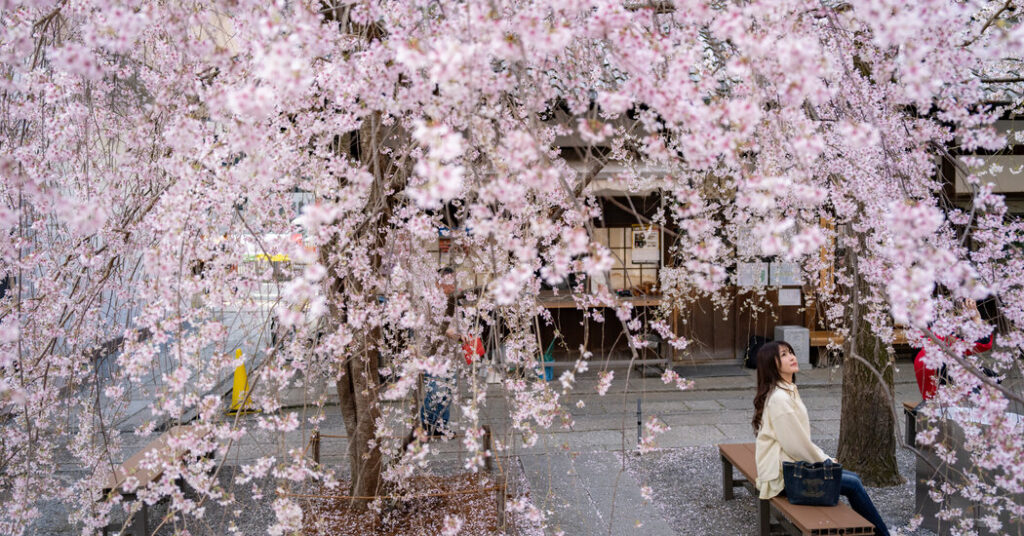
For more than 1,200 years, Japanese noblemen, monks and bureaucrats have carefully recorded one of the most eagerly awaited days of the year — when cherry blossoms bloom in the ancient capital, Kyoto.
In recent years, a climate scientist, Yasuyuki Aono, has been the keeper of this trove of dates, one of the world’s most remarkable and longest-running climate records. Cherry trees, or sakura, are particularly sensitive to changing temperatures, and as the planet has warmed, they have bloomed earlier and earlier.
Then last summer, Prof. Aono, who had meticulously updated the record year after year, died after a battle with cancer. That prompted supporters of his work to start looking for a worthy successor.
“We need help from a botanist or someone local to Kyoto, Japan!” Tuna Acisu, a data scientist at Our World in Data, posted on X this month. The key qualifications, she wrote, were scientific expertise and being “local to Arashiyama,” a district on the western outskirts of Kyoto famous for its cherry trees.
Initially, they didn’t have much luck. No other researchers at Osaka Metropolitan University, where Prof. Aono worked, would be taking over his record-keeping, Hiroko Nishino, a university spokeswoman, wrote in an email.
But now, just as Kyoto sees the last of the year’s cherry blossoms, Prof. Aono’s successor has been found, Ms. Acisu said. On Friday, a Tokyo-based environmental biophysicist, Genki Katata, said he had agreed to be the new custodian of the records.
“Making sure the Kyoto data lives on is a very important job,” Dr. Katata, a senior fellow at the Canon Institute for Global Studies, said in an interview from Tokyo. “I want to carry this forward for as long as I can.”
Cherry blossoms are beloved worldwide. Crowds flock to see them in Washington, D.C., and Vancouver, both recipients of trees gifted from Japan, as well as in Wuhan, China, and Jinhae, South Korea. But perhaps nowhere are they as deeply enshrined in history and culture as in Japan.
Cherry blossom viewing, or hanami, has been a part of daily and aristocratic life in Japan for more than a millennium, celebrated in haiku, depicted in paintings and meticulously recorded in court diaries and chronicles. Today, hanami season is a boisterous affair, marked with bento picnics under the trees and drunken parties that stretch into the night.
The historical records Prof. Aono compiled weren’t originally intended for science. But the dates, locations, and other details contained in the scripts have proven to be a rich source of data from an age that precedes the birth of thermometers.
In one diary entry dated April 14, 1644, Tokitsune Hiramatsu, a court noble and scholar, referred to a cherry blossom viewing party on the grounds of the Seiryoden palace on the grounds of the Kyoto Imperial Palace, the residence of Japan’s emperor for centuries. “We enjoyed watching cherry blossoms, and took sake provided by the emperor,” he wrote.
Over the centuries, various chroniclers would note the progression of blossoms — whether they were just starting to flower, were in peak bloom or were beginning to scatter their petals, adding a level of specificity that has allowed for relatively consistent data through the generations.
Prof. Aono focused on a sturdy native variety called Yamazakura, highly sensitive to spring temperatures and long Japan’s standard cherry tree, before the more delicate Somei-Yoshino hybrid gained popularity.
Prof. Aono pored over those records, teaching himself ancient Japanese script. The effort took more than 15 years. “I was never good at literature in school, and at first I had no idea even where to look,” he said in an acceptance speech for an academic award he received in 2017. “Incredulous colleagues would ask, ‘Are you still studying cherry trees?’”
Slowly, the snippets of everyday life became records of the changing climate. Cherry blossoms need a period of winter cold to break dormancy, followed by warmer days to trigger blooming.
His data showed that, for roughly 1,000 years, peak bloom dates tended to fall around mid-April, with fluctuations in response to natural climate variations. But starting around 1820 to 1830, cherry trees began to bloom earlier, as Kyoto urbanized and humans burned more fossil fuels, releasing planet-warming gases into the atmosphere.
That trend has accelerated sharply in recent years. In 2021, the peak bloom in Kyoto happened on March 26, its earliest arrival in 1,200 years. That represents a shift of nearly three weeks compared to the historic average.
Using computer modeling, Prof. Aono estimated a general temperature rise of 3.4 degrees Celsius, or about 6 degrees Fahrenheit, on average in the Kyoto area over the past 170 years. He also examined the effect of Kyoto’s urbanization on local temperatures, because buildings and roads trap heat, which drives up local temperatures in a phenomenon researchers call the heat island effect.
His research still clearly indicated the effects of global warming. Climate change was making extremely early blooming events, like the record-early 2021 season, many times more likely, researchers at the British meteorological service found in a 2022 study coauthored by Prof. Aono.
Dr. Katata, his soon-to-be successor, said he aimed to further disentangle the distinct effects of global warming, urbanization, and natural variability on cherry trees. “That’s important to separate out to accurately see the impacts of climate change,” he said.
He said he hadn’t expected to be taking on a 1,200-year legacy. He had assumed that other researchers closer to the late scholar would have been prepared to take up his work, he said. But in recent years, Dr. Katata’s own research has been increasingly focused on reconstructing long-term historic climates, had started to converge with Prof. Aono’s.
The two scholars had been discussing working on a joint paper when Prof. Aono died in August, Dr. Katata said. “I had sent two final emails that I didn’t receive replies to,” he said. “I knew something was wrong.”
Patrick Gonzalez, a climate scientist and forest ecologist at the University of California, Berkeley, called the cherry trees research “rigorous.” The data represented “a unique ecological time series,” Dr. Gonzalez said. In Washington, research had also shown cherry flowers blooming one week earlier, on average, he noted.
A shift in blossoms can have wider consequences. When flowers bloom too early, they may miss pollinators like bees and insects, for example, or be killed by a sudden late-spring frost.
Earlier blossom times can also harm fruit harvests in some species, or even lengthen pollen seasons, worsening allergies and affecting human health, said Lewis H. Ziska, a plant physiologist at the Mailman School of Public Health at Columbia University.
“The rise in carbon dioxide and change in temperature are affecting every aspect of human existence,” he said.
In some parts of Japan, seasons may be getting too warm for certain kinds of cherry blossoms to thrive. In a study this year, researchers at the Kyushu Research Center in Japan used weather models to investigate how warmer winters were failing to provide the necessary chilling for cherry trees. That was already starting to cause abnormal flowering on Kyushu, Japan’s southernmost island, they found.
The millennium of data will be vital in navigating the coming changes, said Richard B. Primack, a plant ecologist and conservation biologist at Boston University and a co-author of the Kyushu study.
Still, some things don’t change, he noted. Just as ancient letters and diaries had provided valuable records in the past, today there is an abundance of photos of the blossoms uploaded onto social media, complete with time stamps and location tags, he said — a modern-day chronicle of cherry blossoms. This year, the cherries again reached full bloom significantly earlier, in early April, though later than the 2021 record.
“That data is all out there,” he said. “Scientists will have to just put it all together.”
Hiroko Tabuchi covers pollution and the environment for The Times. She has been a journalist for more than 20 years in Tokyo and New York.
The post Japan’s Cherry Blossom Database, 1,200 Years Old, Has a New Keeper appeared first on New York Times.