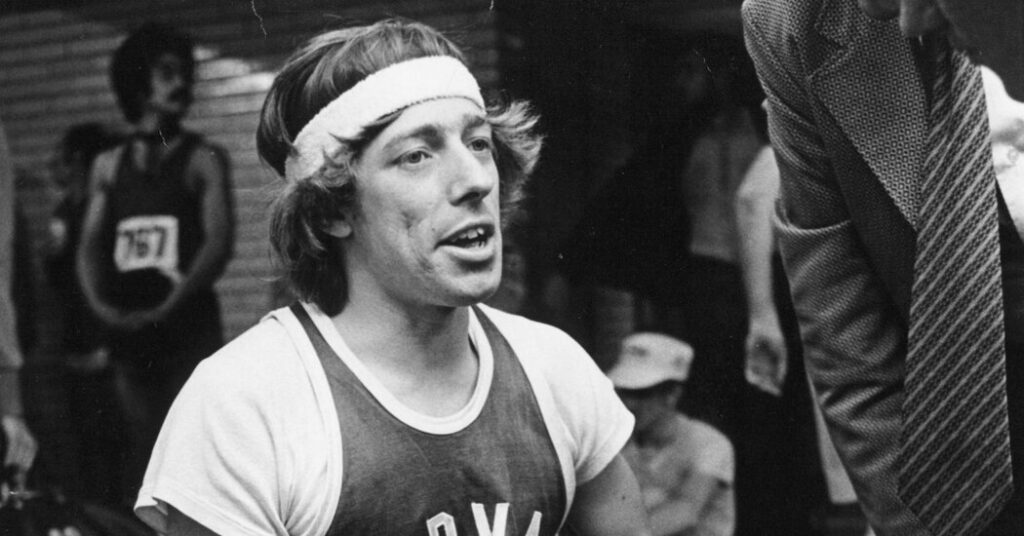
Bob Hall, who survived polio as an infant to become the first recognized wheelchair champion of the Boston Marathon in 1975, and who helped pave the way for tens of thousands of wheelchair athletes to participate in road races around the world, died on Sunday in Cambridge, Mass. He was 74.
His death, in hospice care in a hospital, was from complications of pneumonia, his wife, Jane Raymond-Hall, said. He had lived in nearby Watertown, Mass., for more than 30 years.
In late 1974, Hall wrote to Will Cloney, then the race director of the Boston Marathon, seeking entry into it, the world’s oldest annually held marathon, with a distance of 26.2 miles. He wanted to compete in a wheelchair alongside able-bodied runners.
Hall had contracted polio in his right leg when he was 10 months old and had undergone corrective surgeries that permanently fused his right ankle. He played Little League Baseball when he was 12 and could walk with braces and crutches but could not run. He lettered one year in wrestling at Boston State College (which later merged into the University of Massachusetts, Boston) and began participating in wheelchair basketball in his late teens.
His competitive drive led him to track and field. In June 1974, Hall set a national record in the wheelchair mile race. Two months later, he won the first formal national wheelchair marathon, held in Toledo, Ohio, in 2 hours 54 minutes 5 seconds.
He then wrote to Cloney about entering the 1975 Boston Marathon. Cloney responded by saying that Hall could not be an official entrant because it might encourage others to seek to join the race by “bike, minibike, scooter, skateboard or some other contrivance,” according to an official history of the Boston Athletic Association, which organizes the marathon.
Cloney offered an alternative: Hall would be considered an official finisher if he completed the course in under 3½ hours.
In 1970, Eugene Roberts, a Vietnam veteran who had stepped on a land mine and lost his legs, began the Boston Marathon in a wheelchair an hour before the official start and reached the finish line seven hours later. It was an effort of startling perseverance but an unofficial one; Hall’s attempt, if completed under a time constraint, would be authorized.
His training sessions covered up to 22 miles, including one exhausting section of the course known as Heartbreak Hill. Using a modified standard wheelchair on the day of the race, April 21, 1975, Hall started on the side of the able-bodied field and finished in 2 hours 58 minutes, telling The Boston Globe afterward that his hands were sore from braking and weaving between runners.
Yet, he had made history. According to Boston race officials, it was the first major marathon race to include a wheelchair athlete. In 1977, when the Boston field grew to seven wheelchair competitors, Hall won in 2:40:10.
“I’m not a radical,” he told The Globe in 1976. “I’m only doing something I want to do for a personal goal.”
His outlook would evolve — with inclusivity and rights for the disabled becoming driving missions.
Today, professional wheelchair divisions are regularly included in the world’s top marathons. Nearly 2,000 wheelchair athletes have participated in the Boston event, with 51 scheduled to compete in this year’s race, on Monday. The men’s and women’s wheelchair winners will each receive $50,000 in prize money, with $50,000 bonuses available for setting course records.
“He was the first to do it publicly, and the first to do it in a major road race,” Dave McGillivray, who has been the Boston Marathon race director since 2001, said of Hall in an interview. “That’s putting a lot on the line. If he didn’t make it, maybe this whole sport would never have happened.”
Robert Joseph Hall was born on Oct. 31, 1951, in Cambridge and grew up in nearby Belmont, Mass. His father, Edmund, was a purchasing agent for a bank. His mother, Anna (Higbee) Hall, ran the household. After receiving a bachelor’s degree in physical education in 1974, Hall found it difficult to get a job teaching gym because of his disability.
Despite his welcome by the Boston Marathon, he faced resistance when he tried to officially enter the New York City Marathon. Fred Lebow, a co-founder of the New York race, wrote to Hall in 1977, saying that his participation could be unsafe for him and the event’s 5,000 runners, especially on the five bridges along the marathon’s five-borough course, when wheelchair racers gain speed rolling downhill.
Hall called the safety question “frivolous” and sued the race’s organizing body, now called New York Road Runners. The New York State Human Rights Commission granted him permission to compete in 1978 and ’79. .
Even then, though, he did not always feel welcome. Given the tense situation with race officials, he carried a wrench during the 1978 race in case he had to protect himself, Ms. Raymond-Hall said. And in New York’s 1986 race, as Hall told The New York Times, a police motorcycle pulled in front of him and slowed him to a crawl as he was beginning to pass the lead female runners at the eight-mile mark.
Wheelchair athletes were not fully embraced at the New York City Marathon until a separate division was created in 2000.
“Bob changed the sport,” Tatyana McFadden, a five-time winner of the women’s wheelchair division at both the Boston and New York City marathons, said. “When you fight for one marathon, it opens the door for others.”
In 1978, Hall started Hall’s Wheels, a business in Somerville, Mass., that designed and built custom racing chairs.
Technological advances resulted in three-wheel racing chairs that weighed between 13 and 16 pounds — far lighter than the 27-pound chair he used to race in Boston in 1975. A chair he designed in 1986 is included in the permanent collection at the Museum of Modern Art in New York.
As he broadened into advocacy for greater acceptance of disabled athletes across various sports, Hall created chairs for them to use in basketball and tennis and a mono-ski for Alpine skiing.
“I didn’t start out to be a pioneer,” he told The Associated Press in 1999. He was originally motivated by self-interest, he said, but it had expanded into something “much bigger than that.”
In addition to his wife of 38 years, a two-time wheelchair competitor in the Boston Marathon, he is survived by three sisters, Jeanne Galambos, Rosemary Rikeman and Susanne Griffin; and a brother, John Hall.
In 1980, to raise money for cancer research, McGillivray, the Boston race director, ran alongside Hall as Hall wheeled more than 1,500 miles from Winter Haven, Fla., to the permanent finish line of the Boston Marathon.
Through the years, Hall and Ms. Raymond-Hall, who works for the Massachusetts Department of Children and Families, also pressed for wheelchair divisions to be included in smaller Boston-area races. He served as coordinator of the wheelchair division at the Boston Marathon and was a grand marshal of the 2025 race.
The Bob Hall Legacy Fund, in cooperation with a Massachusetts company called REquipment, raised more than $150,000 ahead of this year’s Boston Marathon to help provide wheelchairs and other adaptive equipment to those lacking access to those necessities for everyday use.
“He felt very strongly about disabled people being in charge of their destiny,” his wife said.
Jeré Longman is a Times reporter on the Obituaries desk who writes the occasional sports-related story.
The post Bob Hall, First Wheelchair Champion of the Boston Marathon, Dies at 74 appeared first on New York Times.