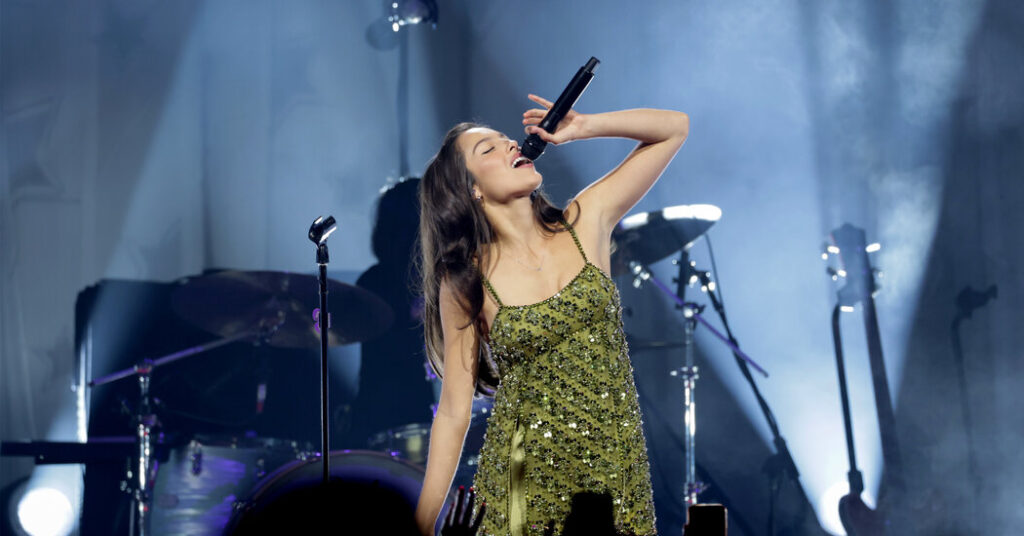
As an expert chronicler of youthful heartbreak, Olivia Rodrigo’s reputation precedes her. She broke out in 2021 with the pop-operatic sensation “Drivers License,” went scorched earth later that spring with the spiky rocker “Good 4 U” and returned to her sustained musical project of taking exes to task in 2023 with the sharp-fanged kiss-off “Vampire.”
Earlier this month, when the 23-year-old Rodrigo announced the first single off her upcoming third album, “You Seem Pretty Sad for a Girl So in Love,” she seemed to promise familiar emotional carnage in its very title: “Drop Dead.” But now that the song is here, it’s clear that was a fakeout. “Drop Dead” is the most visceral evocation of dreamy romance that Rodrigo has released yet, and its title is not a barb so much as a confession of crush-struck melodrama: “The most alive I’ve ever been,” Rodrigo sings at the climax of the heart-racing chorus, “but kiss me and I might drop dead.”
In a crowded pack of young female pop stars vying to be Gen Z’s answer to Britney Spears or Taylor Swift, Rodrigo has set herself apart by claiming a spiritual kinship with the alternative rock of the 1980s and ’90s. Her 2023 album, “Guts,” channeled Veruca Salt and Bikini Kill, and she invited the Breeders to open some dates on its accompanying tour.
On “Drop Dead,” Rodrigo makes her retro-rock bona fides clear from the jump, referencing a 1987 hit by the Cure in the opening verse: “You know all the words to ‘Just Like Heaven,’” she murmurs, “and I know why he wrote them now that you’re standing right here.”
Even as she tries to present herself as the cool-girl-next-door, though, the line contains a winking reference to her own superstardom: Rodrigo actually does know why Robert Smith wrote “Just Like Heaven,” because the two performed the song together during her headlining set at Glastonbury last year. (In a recent British Vogue profile of Rodrigo, Smith, 66, wrote in a statement that he owned both of her albums, and that while he knew her songs were “not really ‘aimed at my demographic’ (!), they are all so good that it is hard not to fall in love with them.”)
In the charming video for “Drop Dead,” directed by the photographer Petra Collins, Rodrigo treats the ornately cavernous Palace of Versailles like it was her bedroom, rushing through its gilded halls with wired headphones on, lip-syncing along to her own song in a private reverie. The setting and the defiantly girlish aesthetic pay homage to “Marie Antoinette”-era Sofia Coppola, but the song’s starry-eyed synths and syllable-stuffed verses also subtly recall “A-Lister,” a minor viral hit released last year by Coppola’s daughter Romy Mars when she was 18. (Given the fact that Sabrina Carpenter released a video inspired by “The Bling Ring” earlier this month, I’m declaring the Gen-Z-pop-star Sofiassance officially upon us.)
Rodrigo has established herself as such a distinctive talent that even the smallest concessions she makes to sounding like anybody else can feel especially sobering. It’s notable that she wrote “Drop Dead” with contributions from contemporary pop’s most booked-and-busy songwriter, Amy Allen, who in just the past year has had a hand in hits by Olivia Dean, Tate McRae and Carpenter. (Allen also had a credit on one song on “Guts,” the album track “Pretty Isn’t Pretty.”)
And even after the controversy that ensued from Swift belatedly receiving writing credits on Rodrigo’s 2021 hit “Deja Vu,” an unmistakable echo of her chirpy cadences can be heard throughout “Drop Dead.” But Rodrigo is ultimately able to transcend these more earthly concerns with her sheer commitment to the heavenly feeling that the song conjures — the woozy hope and antic flights of fancy that are born out of fresh infatuation.
“I realized all my favorite romantic love songs were beautiful because they had a tinge of fear or yearning in them,” Rodrigo told British Vogue, explaining her inspiration for the new album. Perhaps the trick she picked up from “Just Like Heaven” was figuring out how to pack the emotional wallop of a breakup anthem into a love song.
Lindsay Zoladz is a pop music critic for The Times and writes the music newsletter The Amplifier.
The post Olivia Rodrigo’s ‘Drop Dead’ Is a Heavenly Fakeout appeared first on New York Times.