WASHINGTON — Democrats who once saw retaking the U.S. Senate as a longshot in 2026 have newfound hope thanks to an unpopular president and a California donor machine that has snapped into action.
Californians provided the most out-of-state cash to Democrats in nearly every hotly contested race, and in several cases gave more than in-state donors, according to a Times analysis of campaign finance filings covering the first three months of 2026.
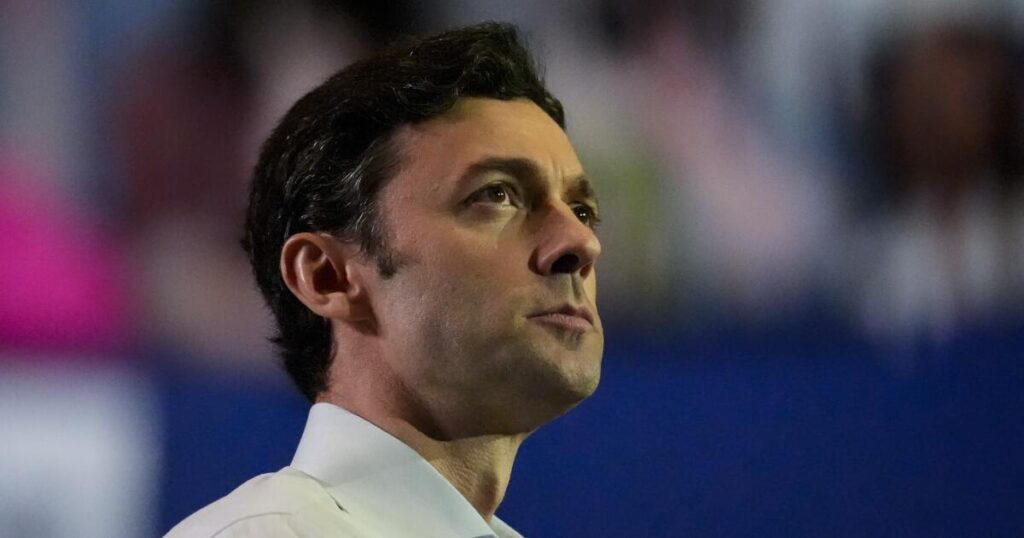
Georgia Sen. Jon Ossoff, who took in more than $14 million overall, received nearly as much from California backers as from supporters in his home state among donors who contributed at least $200 and whose identities were disclosed.
James Talarico, a Democratic Senate candidate in Texas, has raised a staggering $27 million so far this year, with California donors contributing just under $1.2 million to back his campaign — second only to Texas supporters among those donors whose names were disclosed.
Donors who give less than $200 are not required to be identified in campaign finance reports and made up a significant share of the donors to both Ossoff and Talarico’s campaigns.
Republicans currently have control of the Senate with 53 of the chamber’s 100 seats. This year 35 seats are at play, including special elections in Florida and Ohio.
GOP still winning a key cash race
While more of the seats up for grabs are currently in Republican hands, polling showing the potential for tight races in a handful of them has given Democrats hope that they might be able to shrink or reverse their deficit in November.
Top Democratic candidates have out-raised their Republican rivals in the most competitive Senate races, but Republicans are currently winning the cash race among big-money committees that can accept checks far larger than the $7,000 cap on donations to candidate committees.
Those Democratic candidates have continued a grand tradition of relying on donors in the country’s most populous state to bankroll their campaigns.
“California has been a rich goldmine for many a candidate and continues to be that,” said Michael Beckel, director of money in politics reform at Issue One, a bipartisan advocacy group.
Democratic Senate candidates in a few races raised more from California donors than from donors in their home states, according to campaign finance reports filed Wednesday.
Alaska Democratic Rep. Mary Peltola, who is challenging incumbent Republican Sen. Dan Sullivan, brought in nearly $900,000 from California donors who had contributed at least $200. Alaska donors contributed just over $520,000 to Peltola in the same time period.
Two of the three leading Democratic hopefuls in Michigan’s open Senate race, Rep. Haley Stevens and physician Abdul El-Sayed, reported taking in more from California donors than from donors in Michigan. California was the second biggest bank of support for the other top Democratic contender, state Sen. Mallory McMorrow.
And in Nebraska, Independent Dan Osborn, who is challenging incumbent Republican Pete Ricketts, took in $80,000 more from disclosed California donors than from Nebraskans.
Dozens of California donors gave to at least five Senate candidates across the country, according to The Times’ analysis of the filing data.
Burbank playwright and screenwriter Winnie Holzman has donated to Democratic candidates in nine key races and said she has been inspired to give to them — and other candidates and political groups — because of concerns about the policies of President Trump’s administration and what she sees as its violation of the law.
“This isn’t just about who is in the Senate,” said Holzman, who wrote the script for the play “Wicked” and co-wrote its movie adaptations. “But if enough Democrats were in the Senate right now, there would be a lot more ability to push back on this.”
The impressive fundraising hauls by Democrats come with a significant caveat.
The two most prominent political committees that support Republican Senate candidates — the party-affiliated National Republican Senatorial Committee and the Senate Leadership Fund super PAC, have both outraised rival Democratic groups by a significant margin this cycle.
For the NRSC, an $11.5-million fundraising advantage since the start of 2025 has translated to a modest $2-million advantage in cash in the bank through the end of February compared with the Democratic Senatorial Campaign Committee.
But the Senate Leadership Fund, which can accept unlimited amounts of cash from donors, had $91.6 million more to spend at the end of March than the Democratic rival Senate Majority PAC.
And the pro-Trump super PAC MAGA Inc. had a stunning $312 million in the bank at the end of February.
Money raised by a candidate campaign committees does, however, bring some advantages over money raised by other committees. Most significantly, candidates are able to buy advertising at cheaper rates than other political committees.
That is an important distinction in a year when advertising spending in Senate races is expected to top $2.8 billion.
The Senate map
While political analysts expect that Democrats will likely perform well in congressional races — with early signs pointing to a strong possibility that the party regains control of the House — winning control of the Senate would be a much taller order.
“The Senate is going to be won or lost in red states,” said Kyle Kondik, managing editor of Sabato’s Crystal Ball at the University of Virginia’s Center for Politics.
Even in the best-case scenario for Democrats, to retake control of the chamber they would likely need to win in at least two states such as Iowa, Alaska, Ohio or Texas, all of which went to Trump in the 2024 presidential election by double-digit margins.
With the vast sums likely to be raised — and spent — by both sides, Kondik said that fundraising can reach a point of diminishing returns.
“You’d rather have more than less, obviously, but the actual effect is pretty debatable,” he said.
And history shows that fundraising prowess doesn’t necessarily translate to electoral success in November.
Take the example of Texas Democrat Beto O’Rourke.
In his 2018 challenge of incumbent Republican Ted Cruz, O’Rourke brought in more than $80 million, more than double Cruz’s fundraising haul of $35 million.
But it wasn’t enough to put the former congressman from El Paso over the top.
O’Rourke lost the race by 2.5 percentage points.
The post Californians are pouring money into Democrats’ Senate races in other states appeared first on Los Angeles Times.