This article is part of our Museums special section about how institutions are commemorating the past as they move into the future.
To the untrained eye, the gleaming black skyscraper at the corner of Whitehall and Pearl Street is unremarkable.
To Russell Shorto, a historian who has written two books on Manhattan’s Dutch roots, it’s a landmark.
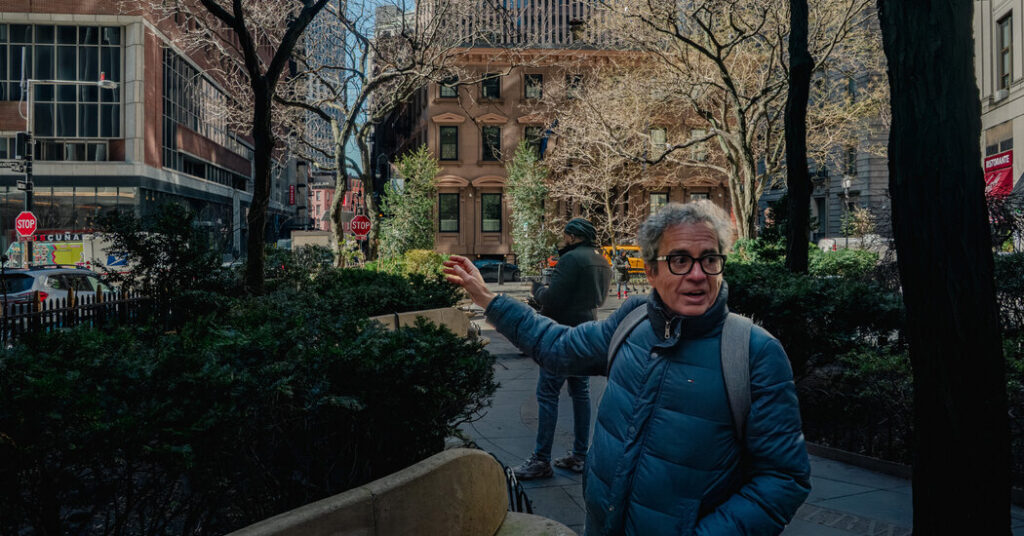
Peter Stuyvesant “built his house on this corner,” Shorto said on a recent walk through Lower Manhattan. He noted that, given the location, Stuyvesant — the peg-legged leader of New Netherland, the Dutch colony centered on New Amsterdam — could monitor ships coming and going, “so he had an idea of what was going on.”
And a lot was going on.
Continuing down the block, Shorto explained that 400 years ago, the Dutch settlers arriving here built the first houses in the settlement of New Amsterdam along this street, Pearl — so named because back then, it ran along the water, and oysters could be found offshore.
“Broad Street, here, this was the canal,” said Shorto, crossing a curved street now lined with a row of Citi Bikes. “This canal goes right up through the center of New Amsterdam, and we’re at the edge of New Amsterdam looking out on the water.”
Walk with Shorto long enough, and each corner takes its 17th-century form. A gray brick outline on a plaza becomes the City Tavern, where the Dutch colonists gathered to drink and exchange news. A helicopter pad on the East River becomes Coenties Slip, where ships arrived and departed, bearing beaver pelts and tobacco and settlers and enslaved people. Wall Street becomes a long wooden defensive perimeter the Dutch built to keep the English out: the wall that gave the street its name.
One particularly pivotal spot? Wall and Broad, with the New York Stock Exchange on one corner, Federal Hall on another.
Gesturing at all of it, Shorto said, “think about all of these things — what a spark New Amsterdam was and how much flowed from it. The center of American capitalism in the 1600s, which in the 1700s becomes Wall Street. The center of American democracy.” He waved toward Federal Hall. “This was where George Washington was inaugurated.”
“This was the epicenter of all that, and there’s still something of that vibe here, you know?”
In that moment, New Amsterdam feels very real. So real you can picture it, and see the Dutch inheritances in New York — and America — of today.
In May, the New York Historical aims to bring that vivid sense of New Amsterdam to life in an exhibition, “Old Masters, New Amsterdam” (through Aug. 30). Curated by Shorto, who is the director of the New Amsterdam Project at the museum, and Arthur K. Wheelock Jr., a former curator at the National Gallery of Art, the exhibition uses 17th-century Dutch paintings, along with maps and documents, to give a sense of life in New Amsterdam — and to draw connections between past and present, the Netherlands and America.
Though none of the old master paintings in the show were made in New Amsterdam, or depict specific locations there, the works are being used to convey what Dutch people at the time valued, and how they behaved.
In short, Wheelock explained, the idea in displaying these works was to convey what New Amsterdam might have been like in the 17th century, by showing what the people who populated it were like.
“We can’t walk the streets with them in the way we’d like to, but we want to feel like we are,” he added.
The show was long in the making. For years, Louise Mirrer, president and chief executive of the New York Historical, and her staff had been contemplating ways to mark two big occasions this year: the 400th anniversary of New Amsterdam’s founding and the 250th birthday of the United States.
She and Shorto knew about the Leiden Collection, a trove of Dutch old master paintings and drawings owned by the American billionaire Thomas Kaplan and his wife, Daphne Recanati Kaplan. Mirrer said that, when she and Shorto had an idea for a show highlighting the ties between the Old World and the New, they approached Kaplan to ask whether they could use some paintings from the collection.
In a video interview, Kaplan recalled the conversation. “With me, it was, you want to promote history and the 400th anniversary, et cetera et cetera? You had me at hello.”
Mirrer remembered Kaplan’s enthusiasm. “He was like, ‘Russell, here’s the cookie jar. Just put your hand inside, and take whatever you want.’”
That cookie jar contained some 220 works by Rembrandt, Jan Lievens, Gerrit Dou and their contemporaries, all focused on what Wheelock, who serves as senior adviser to the Leiden Collection, calls “the human element.”
Kaplan explained that, in collecting, he has taken a keen interest “not just in high life, but also in regular people doing regular things.”
“We have paintings by Gabriel Metsu of women who had clearly been war widows and men changing diapers, and herring sellers and fishmongers, and just these very, very prosaic scenes.”
Wheelock and Shorto pored over the collection. To find paintings that would evoke New Amsterdam, they looked for pieces featuring all kinds of people — soldiers, sailors, doctors, traders, the rich and the poor.
Some pieces they selected were tronies, paintings that depict a person who would not have paid to have their portrait done.
“It’s a guy that Rembrandt would have seen on the street, for example,” Wheelock said, adding that these tronies “are often very roughly painted and expressive, and they give you a feeling of the people — you can almost hear them talk.”
The pair chose 45 paintings from the Leiden Collection, adding works from various museums, archives and private collections — as well items from the New York Historical’s own collection — to create the universe of the show.
A big, boisterous scene will welcome museum goers to that universe, in Jan Steen’s “Peasants Merrymaking Outside an Inn” (ca. 1676).
In that scene, “people are drinking and playing the fiddle and all these different little vignettes are going on,” Shorto said, adding, it “really kind of gives you this sense of New Amsterdam.”
Before continuing through the art, visitors will encounter objects tied to the real people who lived in New Amsterdam — documents bearing their handwriting, portraits showing their faces — in a prologue.
These will include the proposed coat of arms for New Amsterdam (complete with two large beavers), portraits of Stuyvesant and Cornelius Steenwyck (another prominent city leader) and the Flushing Remonstrance, a document that, the wall text notes, “is considered by many to be the first statement of religious freedom in America.”
The idea, Shorto explained, is for visitors to “get steeped” in the history, then “carry that into the main show.”
The main show will unfold across six sections: “At Home,” “At Work,” “At Play,” “Food and Drink,” “The Individual Self” and “The Wider World.”
In many paintings, the activities look strikingly familiar. In one domestic scene, a young man lights a candle; in another, a woman plays with a dog. In the work section, “A Bookkeeper at His Desk” (ca. 1627) — surrounded by books, a faraway expression on his weary face — is relatable to any exhausted corporate cubicle dweller. In “At Play,” merrymakers skate on an expanse of ice.
“Winter came,” Wheelock said. “We know that. Snowcrete.” New Amsterdammers 400 years ago: They’re just like us.
“The Wider World” section opens the show’s aperture to consider New Amsterdammers’ connections with the world beyond a handful of streets at the tip of Manhattan — examining why the colonists left the Netherlands, how they traveled across the ocean and how they were connected to the world at large.
“The Departure of the Pilgrim Fathers from Delfshaven” (1620) reminds visitors of one primary emigration driver: religious persecution. The Dutch policy of religious tolerance worked in the favor of many who came to New Amsterdam, from French-speaking Protestants to Jews fleeing Dutch Brazil.
In the paintings here, details speak volumes. A man’s pipe nods to the Virginia tobacco fields; a young woman’s parrot points to trade with the Caribbean.
That trade was built on one of the darkest aspects of the Dutch colonies: trade in enslaved people. New Amsterdam’s history involved slavery, and the subjugation of Indigenous people, as a contextual section makes clear, by showcasing Wenceslaus Hollar’s etchings of Black people and Native people alongside etchings of white women in furs: the products of that subjugation and exploitation.
Beneath it all runs a common undercurrent: trade. One sign notes that the paintings themselves could not have been created without it. The pigments used by the Dutch old masters to make their paints included materials from Mexico, Afghanistan and even the ocean. And the canvases, if they were not being painted on, could be made into sails.
As the years rolled on, people kept sailing across the ocean and, in 1776, the United States declared its independence, starting the Revolutionary War.
The exhibition’s last section brings the story up to the 250th anniversary. As in the prologue, it grounds visitors in the history, with items showing the handwriting, and faces, of people in the nascent United States. And finally, there is a map of New York in 1776, marked with Dutch place names still with us today: Brooklyne (from the Dutch Breuckelen), Haerlem (once Haarlem) and Staten Island (formerly Staaten Eylandt).
It is fitting, perhaps, to end with a beginning because, as Mirrer pointed out, “in many ways, this is an origin story.”
She noted that, to understand who we are as Americans, “we need to understand that we come from diverse people, and we come from people who set foot in this city, and in this nation, for the first time and found here an opportunity to make something of themselves that they couldn’t succeed in doing in Europe, or they simply wanted a new chance for themselves.
“And that’s what it means to be an American, really.”
The post Recalling When Lower Manhattan Was New Amsterdam appeared first on New York Times.