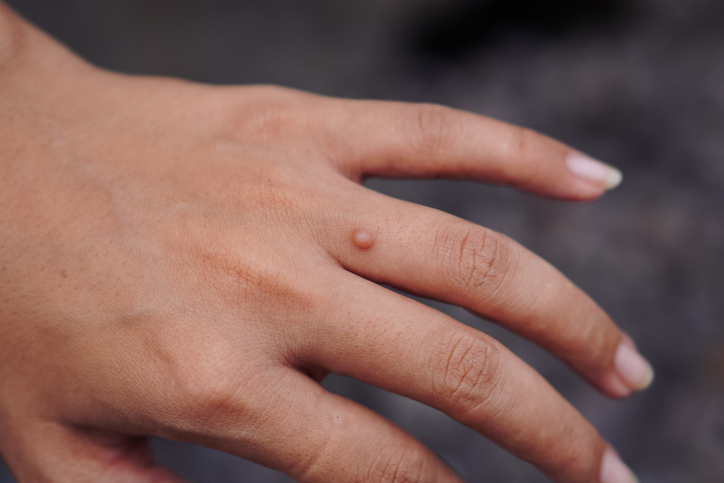
Many of us have had an irritating bump — or a cluster of them — on our hands, feet or even face.
It may have been a wart.
These common skin growths are caused by various strains of a particular virus that most people are exposed to at some point in their lives, experts said.
If you get a wart, even though ones on those body areas are usually harmless and tend to go away eventually on their own, you may prefer to get rid of it sooner. That’s why we spoke to three dermatologists about different types of warts, how you get them and, most importantly, how you can treat them at home.
What are warts?
Warts are caused by a virus known as the human papillomavirus, or HPV, and often appear as flat or raised bumps or clusters of bumps on the hands, feet or genitals but can occur elsewhere. Different types of warts are caused by different strains of HPV, said Adam Friedman, a professor and chair of dermatology at George Washington School of Medicine and Health Sciences. There are more than 240 strains of HPV and they can have a varied impact on your body depending on the type and location of the infection (not all of them cause warts).
Here are some of the most prevalent types of warts, according to experts:
- Common warts, also known as verruca vulgaris, are rough, raised bumps — sometimes with black dots in the center — that can form singularly or in clusters resembling cauliflower and usually pop up on the hands and fingers.
- Flat warts are smaller and smoother and tend to form in clusters — sometimes dozens to even 100 or more — often on the face and hands, Friedman said.
- Plantar warts usually appear as thicker growths on the bottoms of the feet and may be pushed inward by pressure from standing or walking, making them painful.
- Genital warts appear as rough, raised, skin-colored or whitish-gray growths or sometimes as flat growths and often cluster together in a cauliflower-like shape. “They’re different from the types that cause warts on hands and feet, so you can’t get genital warts from someone’s hand wart,” Friedman said. (The strains of HPV that cause genital warts are typically not the same ones that may cause cervical cancer and other cancers.)
Most of the common types of warts are spread from one part of the body to another through friction, scratching or shaving, said Shari Lipner, a professor of clinical dermatology at Weill Cornell Medicine. But warts can also be spread from person to person. This can happen through direct skin contact or through contact with contaminated items or surfaces such as shared shoes or towels, locker room floors or exercise equipment in public gyms, especially when there are breaks in the skin, Lipner added.
Marisa Garshick, a dermatologist in New York, said you can avoid getting warts “by minimizing exposure and maintaining the skin barrier.” This includes wearing shoes or flip-flops in higher risk areas such as gyms or pools, avoiding sharing razors and other personal care tools and not picking at the warts.
How can I remove warts at home?
Most common warts resolve on their own within a couple years, but there are various methods to remove them faster, both medical-grade treatments in a dermatology office and over-the-counter ones at home, experts said.
While at-home remedies may be appropriate for small warts on the hands and feet, never try to treat a large number of warts or warts on sensitive areas of the body such as the face or genitals as there is an increased risk of skin irritation, burns and scarring, Garshick said.
People of color have a higher chance of pigment changes and scarring, Lipner said.
If you want to try to treat a wart at home, dermatologists recommend certain steps, depending on the type of treatment you choose:
- Over-the-counter salicylic acid in gel, liquid or pad form: Salicylic acid, often considered a first-line treatment, dissolves the intercellular glue that holds skin cells together, causing the infected cells to shed — along with the wart. Here’s how to use it: Soak the wart in warm water for about five minutes to soften it, then gently sand it with a disposable emery board or pumice stone, taking care not to touch another part of your body. Apply the salicylic acid according to the package instructions and cover with a bandage. Reapply the salicylic acid daily until the wart is gone or if the skin becomes irritated.
- Over-the-counter freezing spray: Cryotherapy, or freezing spray, can be used both in a dermatology office or at home. Over-the-counter freezing spray uses a mixture of dimethyl ether and propane to get cold but doesn’t reach the same low temperatures as liquid nitrogen used in doctor’s offices so it tends to be less effective, Friedman said. Here’s how to use it: Closely follow the package instructions, which usually direct you to hold the applicator directly on the wart for 10 to 40 seconds, depending on the product and wart size. The skin will blister, scab over and heal within one to two weeks, eliminating or reducing the wart. Repeat as needed, but do not apply to the same spot more than once every two weeks and stop using the product if you develop significant blistering, irritation or pain, Friedman said.
- Duct tape: Duct tape has gained widespread attention on social media as one of the most popular at-home remedies, partly because a 2002 study found that 85 percent of people using it had warts resolve in two months compared with 60 percent using liquid nitrogen. Results are mixed, though, with other clinical trials, particularly of clear duct tape, demonstrating no advantage over placebo. (Silver duct tape adheres better, Friedman said.) One theory about why duct tape may work, Lipner said, is that the tape creates a moist environment that may soften the wart and also stimulate an immune response. Here’s how to use it: Use a small piece of silver (instead of clear) duct tape, cover the wart and leave it in place for six days. Remove the tape, soak the skin in water for 10 to 20 minutes, gently sand the wart using a disposable emery board or pumice stone and leave uncovered overnight. Then reapply fresh tape for another six days. (You can apply salicylic acid to the wart before covering it with tape to increase the effectiveness, according to the American Academy of Dermatology.) Repeat the cycle for up to two months until the wart is gone.
If at-home treatments don’t work for you, consult a board-certified dermatologist who may recommend in-office treatments such as medical-grade cryotherapy; electrosurgery and curettage, which uses an electrical current to remove the growth; or certain injections or prescription medications, experts said.
Also, consult a doctor if you have genital warts or more stubborn warts such as plantar warts; warts that are painful or show signs of infection such as bleeding or oozing; warts under or around the nail; or if you have diabetes, are being treated for cancer or have an immune deficiency such as HIV, experts said.
Most importantly, experts said, consult a dermatologist when you’re not certain that a growth is a wart. “Some skin cancers can look like warts, and you want a professional diagnosis before you start treating aggressively,” Friedman said.
Are you wondering whether to believe a hyped-up health tip, viral wellness trend or long-standing scientific claim? Email [email protected] and we may answer your question in a future column.
The post What you need to know about warts — and how to treat them at home appeared first on Washington Post.