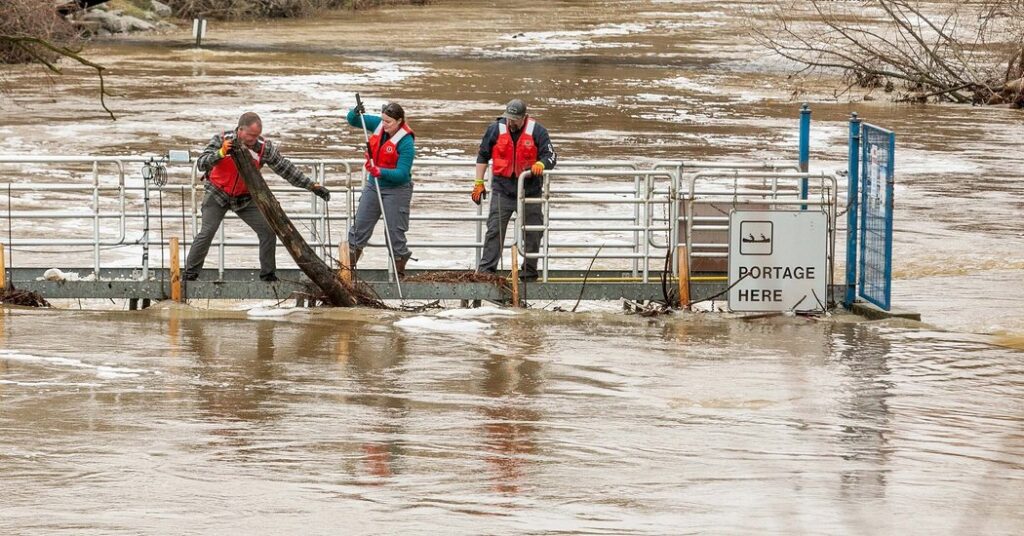
As workers raced to shore up a dam in Cheboygan, Mich., after weeks of persistent rain and recent snowmelt, Gov. Gretchen Whitmer said the predicament is not unique to the small town or to her state.
“We’re grappling with a new moment,” Ms. Whitmer said at a news conference in Cheboygan on Thursday. “And 100-year-old infrastructure is not up to the moment — no matter where you live in the country.”
Failure of the dam, which was built in 1922 and sits near the end of a 38-mile network of rivers and lakes in Northern Michigan, is unlikely to cause any loss of life, and only three buildings appear to be imperiled, state officials said at the news conference. But the situation is emblematic of the issues that confront not only Michigan, with its 2,500 dams, but states all around the country that must pay to maintain and repair bridges, roads and rails.
Water has crept within six inches of the top of the Cheboygan Dam, which had sprung leaks in recent days that workers had hurried to patch.
Officials said Thursday that they were hustling to reactivate an adjoining power plant that has been out of commission since 2023 to speed the flow of water through the dam. The plant is privately owned, while the dam is owned by the state.
Mark and Sheila Crowley, who live on the shore of Lake Huron, pulled off the street in downtown Cheboygan, stepped out of their vehicle and peered down at the river — a wide brown ribbon rushing past, carrying white foam.
Mark, 71, a retired electrician, said they weren’t worried. Sheila, 70, a retired lawyer, disagreed.
“We are concerned,” she said, recalling dam failures in Central Michigan in 2020 that led to mass evacuations and swamped portions of the city of Midland. “We never stopped to look at the river before, you know what I mean?”
Michiganders, hit by ice storms a year ago, weathered a strong snowstorm in mid-March that piled up more than two feet of snow in three days across the northern tip of Lower Michigan. This week, though, the snow began melting amid heavy rains. The runoff was overwhelming rivers and streams.
“There’s just so much water. It really doesn’t have any place to go,” said John Boris, a meteorologist at the National Weather Service office in Gaylord, Mich., which covers the region surrounding the Cheboygan Dam.
Forecasters were expecting a break until another storm arrived on Saturday. But the troubles extended far from Cheboygan. In all, 33 counties are covered by an emergency order issued by Ms. Whitmer.
Officials in Newaygo County, along the western edge of the state, issued an evacuation order downstream of the Croton Dam after the Muskegon River rose more than three feet this week.
Further north, in Oceana County, water had reached within six inches of the top of Hesperia Dam, according to county officials. Officials in Antrim County, just northeast of Traverse City, declared the Bellaire Dam stable, but said water had risen within a foot of the top and that emergency workers were using boats and drones to locate debris that might damage the structure.
“It’s a slow-moving disaster that’s unfolding,” said John Damoose, the state senator who represents the district.
Amy Graff is a Times reporter covering weather, wildfires and earthquakes.
The post Michigan’s Dam Crisis Shows Decay of U.S. Infrastructure, Whitmer Says appeared first on New York Times.