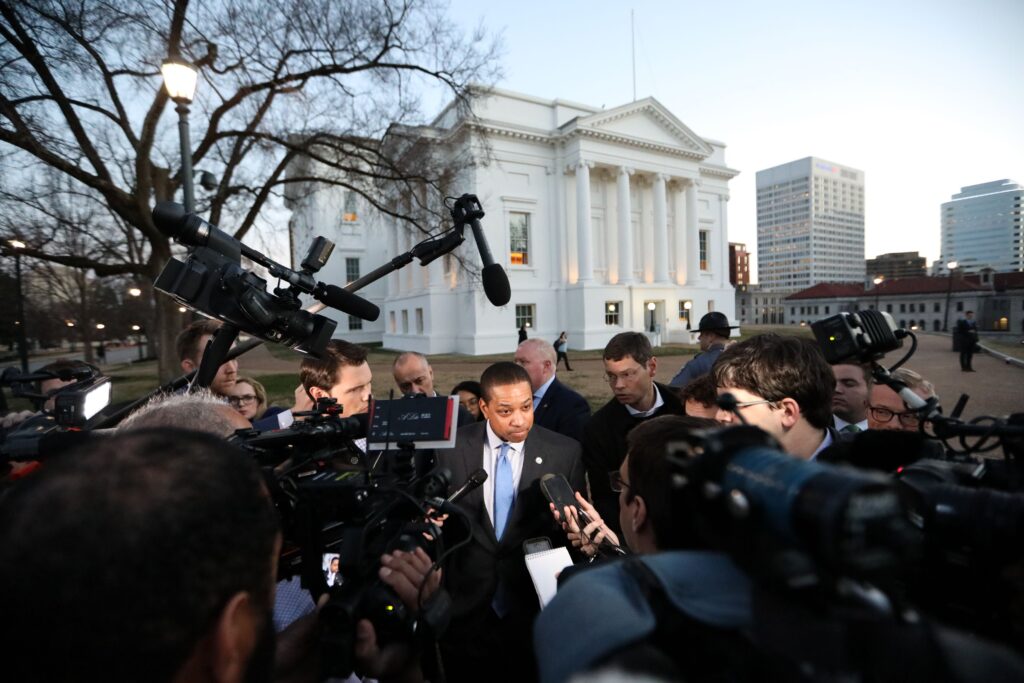
Justin Fairfax, the former Virginia lieutenant governor who was found dead with his wife in an apparent murder-suicide Thursday, was once an emerging star in Virginia politics, becoming the second African American elected to a statewide office before allegations of sexual assault derailed his political career.
Fairfax, an Ivy League-educated lawyer descended from enslaved people, looked poised to become governor when Gov. Ralph Northam (D) faced demands to resign in 2019 after admitting to once wearing blackface.
Northam refused to step down, and days later, two women accused Fairfax of sexual assault. Fairfax denied the allegations, but his political career never recovered. He finished poorly in his run for the 2021 Democratic gubernatorial primary.
After leaving office in 2022, Fairfax tried to clear his name and rebuild his legal career by representing the families of shooting victims.
Fairfax shot and killed his wife, Cerina, before fatally shooting himself, Fairfax County Police Chief Kevin Davis said Thursday after officers discovered the couple dead in their Annandale home.
Here’s what to know about Fairfax’s rise and fall.
Entering politics
Fairfax grew up in a predominantly Black neighborhood in Northeast Washington and attended Duke University and Columbia Law School. After graduating, he clerked for a federal judge in the Eastern District of Virginia and joined a white-collar law firm in D.C. before becoming a federal prosecutor in Virginia in 2010.
Fairfax resigned after two years to run for attorney general. Despite being a 34-year-old outsider to Virginia politics, Fairfax managed to finish three percentage points behind Sen. Mark R. Herring in the Democratic primary in 2013.
After the loss, Fairfax stayed active in Democratic politics ahead of his second campaign for statewide office.
Becoming lieutenant governor
Fairfax ran for lieutenant governor in 2017 and easily defeated two first-time candidates in the Democratic primary. In the general election, he ran as part of a Democratic ticket with Northam and Herring.
Virginia had not elected an African American to statewide office since 1989, when L. Douglas Wilder became the nation’s first elected Black governor. Fairfax described Wilder as an idol and sought his advice. As the state in 2017 grappled with the fallout from violence by white supremacists in Charlottesville and debate over statues honoring Confederates, Fairfax said he personally supported the removal of the statues, though he emphasized the decisions should be made locally. He also spoke forcefully about racial disparities in wealth and criminal justice enforcement.
Fairfax defeated Republican state Sen. Jill Vogel by five percentage points in the general election. At his inauguration, Fairfax carried in his coat pocket a copy of the manumission document that freed his great-great-great-grandfather from slavery.
As lieutenant governor, Fairfax cast the tiebreaking vote to expand Medicaid to 400,000 low-income adults, fulfilling a key campaign promise. He declined to preside over the state Senate during annual tributes to Confederate Gens. Thomas J. “Stonewall” Jackson and Robert E. Lee.
Sexual assault allegations
About a year into Fairfax’s tenure, he began preparations to become governor if Northam were to resign amid scandal.
Northam apologized for a photo in his medical school yearbook page of a person in blackface and another in a Ku Klux Klan robe. (Northam initially admitted to being the person in blackface but later backtracked and admitted to wearing blackface on another occasion).
Fairfax called the image “abhorrent” but did not join nearly every other prominent Democrat in calling for Northam’s resignation. The two met privately and Fairfax had begun preparing in case he were to ascend to the governorship, he told The Washington Post, but Northam ultimately rejected public pressure to step down.
Days later, Fairfax was embroiled in his own scandal. Two women separately accused the lieutenant governor of sexually assaulting them — one during college, the other during the 2004 Democratic National Convention. Fairfax denied the allegations. Democrats quickly called for him to resign, complicating efforts to oust Northam from office given that Fairfax was next in line. An attempt to impeach him fizzled out.
Months later, Fairfax left the law firm he worked at while serving as lieutenant governor.
An attempt to clear his name
Fairfax never shed the fallout from the allegations against him and continued to fight them publicly, tweeting at the lawyers of his accusers from his personal account and unsuccessfully urging a college friend to come forward and clear his name. In 2019, he filed a defamation lawsuit against CBS for its reporting on the allegations, which was later thrown out.
On the final day of the legislative session in 2019, Fairfax compared himself to victims of lynching while giving a speech in his own defense, drawing rebukes from a lawyer for one of his accusers and Virginia Republicans.
Fairfax surprised some political observers with how he and his allies continued to bring attention to the allegations in his attempts to repair his reputation.
Fairfax ran for governor in 2021 but finished a distant fourth in the Democratic primary with about 3.6 percent of the vote. He drew criticism for comparing himself to George Floyd and lynching victim Emmett Till during a primary debate.
That loss ended Fairfax’s political career, and he did not run for office again. He largely stayed out of the public eye, with the exception of several cases in which he represented relatives of shooting victims.
Recent months
Fairfax lived in Annandale with his wife and two teenage children. The couple had an “ongoing domestic dispute” surrounding a divorce, Davis, the police chief, said at the Thursday news conference.
In January, police investigated a report from Fairfax that his wife assaulted him but determined no assault had occurred, Davis said. The police chief also said that Fairfax was recently served paperwork on a court proceeding and that the couple were separated but living together.
The post Justin Fairfax’s rapid rise in Virginia politics flamed out after scandal appeared first on Washington Post.