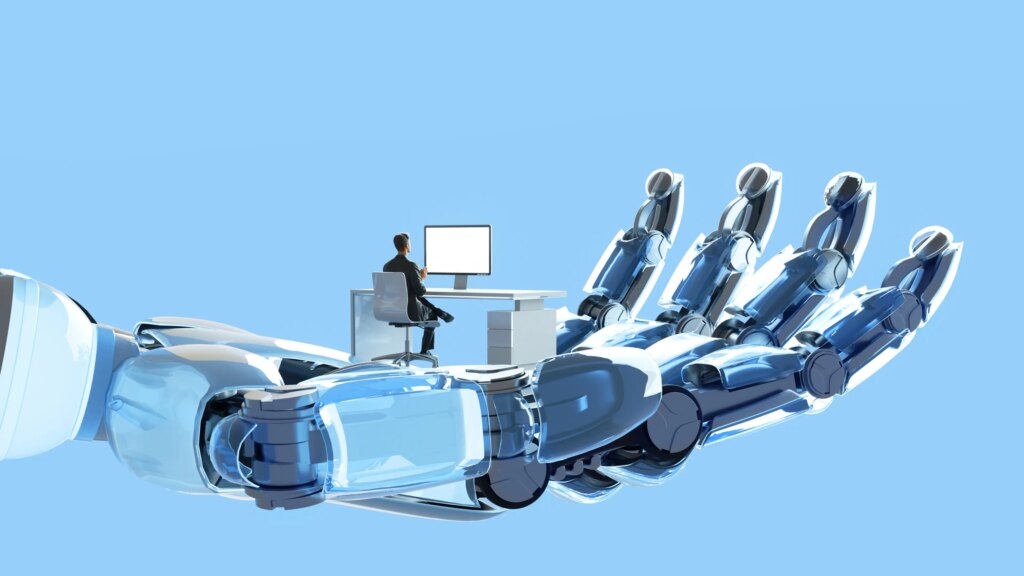
As AI becomes a daily work tool, the real risk may not be losing our intelligence—but losing confidence in our own thinking. New research suggests the difference comes down to how actively we engage with the technology.
In a study of nearly 2,000 working adults, researchers found that people who relied heavily on AI—especially those who accepted its answers without much modification—were more likely to say tools like ChatGPT, Claude, and Gemini were “doing the thinking” for them. Those same participants also reported lower confidence in their own reasoning and a weaker sense of ownership over their ideas.
But that pattern wasn’t inevitable. Participants who pushed back—editing, questioning, or rejecting AI-generated suggestions—reported the opposite: greater confidence and a stronger sense that the final output was truly theirs.
The findings suggest AI isn’t inherently undermining our abilities. Instead, it may be subtly reshaping how we experience our own thinking. “Generative AI can lead to cognitive decline or cognitive evolution—it depends on your interaction style,” says study author Sarah Baldeo, a PhD candidate in AI and neuroscience at Middlesex University in England and author of 100 Ways to Future-Proof Your Brain in The Age of AI. “When we look at brain activity contingent on how people choose to use the tool, we can see increases or decreases. It really doesn’t have to do with the tool itself.”
That distinction—between engaging with AI thoughtfully or deferring to it—may be what ultimately determines whether the technology helps or hinders us at work.
How AI use shapes confidence
The study, published April 16 in Technology, Mind, and Behavior, followed 1,923 adults in the U.S. and Canada as they used AI tools to complete a series of simulated workplace tasks—ranging from drafting a salary negotiation plan to interpreting ambiguous data. Rather than comparing AI users to non-users, the research focused on how people actually interact with the technology.
What stood out most was the range of behaviors. Some participants accepted the first response they got, moving on as soon as the AI produced something usable. Others slowed down—editing, pushing back, and reworking the answer until it reflected their own thinking. Those choices, the study found, were closely linked to how confident people felt in their reasoning.
Read More: The Internet’s New Favorite Insult: ‘Did AI Write That?’
The pattern shifted depending on the task. People were most likely to outsource their thinking entirely during planning and sequencing tasks—the kind of open-ended, multi-step work that defines a lot of professional life. But when tasks turned personal or introspective, something changed. Asked to reflect on their own experiences or evaluate their own character, participants were far more likely to push back on what the AI produced. When the subject was themselves, they trusted themselves.
Senior workers were more likely to override AI outputs and reported higher confidence than their entry-level counterparts—suggesting that expertise may be protective. The more you know, the easier it is to push back.
“If the AI solves a problem for you, you don’t think and you don’t learn,” says Ethan Mollick, an associate professor at the Wharton School of the University of Pennsylvania who studies AI and work, and author of Co-Intelligence and the forthcoming Co-Existence. But the reverse is also true. “If you make AI act like a tutor and push people, you get improved outcomes.”
The real variable isn’t AI—it’s your choices
There’s a tempting story about AI and the brain: The tool is eroding it, one outsourced task at a time. But experts are pushing back on that black-and-white framing. Decisions about how much to rely on AI, Mollick notes, are often unconscious ones. “Humans are naturally designed to be lazy and take as little effort as possible to do things,” he says—which makes passive AI use the path of least resistance. “We’re deciding what skills to cede to the AI.”
And that, Mollick says, has always been true of new tools. “We all give up skills all the time on purpose because we don’t need to do them anymore,” he says. Ask yourself, for instance: When’s the last time you did long division by hand? For many, the answer is not since high-school math class, thanks to the fact that there’s now almost always a calculator in your hand or pocket. “Part of this is about deciding what things you want to maintain,” Mollick says. “If you want to maintain a skill, you’re going to have to consciously decide to do that.”
Baldeo sees this as partly a self-confidence loop: People who already feel uncertain about their abilities are more likely to defer to AI—and deferring, in turn, deepens that uncertainty. “Human beings who have a higher sense of self-confidence will have a greater likelihood of using AI in a cognitively healthy way,” she says. The inverse is also true. “If you’re already experiencing an unstable sense of self, using AI is actually not well-advised for you.”
How to use AI without losing your edge
For workers trying to strike that balance, the takeaway isn’t to avoid AI—it’s to use it more deliberately.
The key, Mollick says, is being intentional about which tasks you actually want to do yourself—and resisting the reflex to hand everything off just because you can. Sometimes it’s worth the extra effort. “It might be worth being less efficient for practice,” he says, comparing it to exercise: “There are a lot easier ways to move weights up and down than with your own hands, but we do it because we want to maintain muscle.”
Baldeo offers a similar approach. She encourages users to build what she calls “cognitive scaffolding”—a baseline understanding of a task before outsourcing it—and to actively engage with AI by questioning and refining its responses.
It’s also essential to learn how to argue with AI. Rather than accepting the first response it produces, Baldeo recommends going back and forth with the tool at least two or three times—pushing back, asking for more specificity, or simply telling it you disagree. “You can speak to it as if you were speaking to a human,” she says. If an AI returns a project plan you’re not satisfied with, for instance, you might respond: “I don’t think you’re taking into account X—please be more specific.” That back-and-forth, she says, keeps your own thinking in the loop rather than on the sidelines.
Read More: Stop Letting AI Run Your Social Life
She also suggests a specific prompt to counteract AI’s tendency toward flattery. Preface queries with this language, she advises: “Respond based on third-party verifiable information. Do not attempt to flatter me or build an emotional bond.” Put that into any major AI tool, she says, and you’ll get a more honest, useful response that actually challenges your thinking rather than just agreeing with it.
It also helps to take a closer look at what AI produces. Early outputs can seem impressively polished, Mollick notes—but that first impression can be misleading. “It’s easy to get taken in by how good things look when they’re not necessarily that good in reality,” he says.
What matters most, Mollick adds, is staying intentional: “AI doesn’t have agency over what we’re doing right now. It’s not taking over our lives,” he says. “We’re deciding when we want to let the AI do something, and when we don’t. Being conscious about that decision will turn out to matter.”
The post Letting AI Do Your Work Erodes Your Confidence, According to a New Study appeared first on TIME.