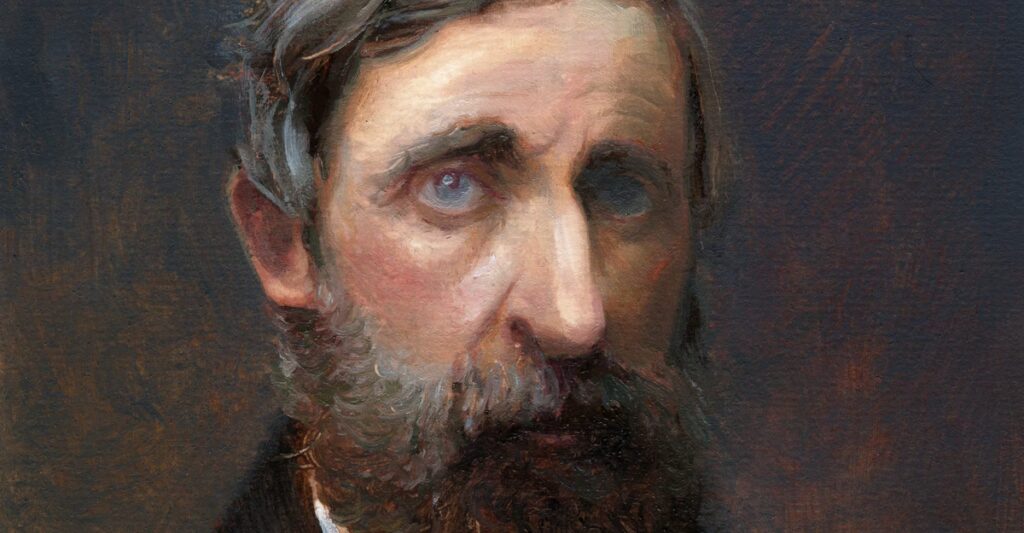
One afternoon in the summer of 1846, Henry David Thoreau left his hut near Walden Pond and walked into town to pick up a shoe he was having mended. He was stopped by the local tax collector, who nudged him for the umpteenth time about paying his poll tax—the dollar and a half that every man over the age of 20 had to pay annually, or else lose the right to vote. The tax collector, who wanted to clear his books, even offered to cover the bill, which hadn’t been paid for four years. But Thoreau refused, and he was taken to jail. The one night he spent in a second-floor cell overlooking his hometown of Concord, Massachusetts, was not particularly dramatic. But it was clarifying. As an opponent of slavery, he understood that paying the tax would mean legitimizing a government “which is the slave’s government also,” he later wrote. He couldn’t do that, and so he didn’t.
Thoreau has served different prophetic purposes at various moments in American history, depending on what we have needed him for. There is Thoreau the environmentalist, a proselytizer for the need to preserve nature because nature is what preserves us. There is Thoreau the libertarian individualist, suspicious of the state, hostile to bureaucracy, and committed to the sovereignty of the self. There is Thoreau the life coach who tells us to “simplify, simplify.” And a new three-part PBS documentary, co-produced by Ken Burns, offers us Thoreau the eccentric outsider—fittingly, Jeff Goldblum provides his voice. Images of Walden Pond, frozen over or surrounded by the vibrant fall foliage, flash by every few minutes, and we hear stories of Thoreau communing with ants and fish. The film keeps coming back to the insight that he was tuned in to bigger things, wider patterns, to the way the eternal makes its presence felt in the particular.
At a time of great political, societal, and technological upheaval, I’ve been thinking about yet another Thoreau, a messier and more dangerous one: Thoreau the dissident, the man who goes to jail rather than pay his taxes. This Thoreau belongs in a category with people who resisted dictatorships, theocracies, colonialism, and unjust systems throughout history and around the world. This Thoreau was not just a link in the Underground Railroad; he was also the first intellectual to publicly defend John Brown after his attempted slave revolt in 1859, calling him an “angel of light” while most others saw him as a terrorist. This Thoreau in recent years has also inspired some surprisingly personal vitriol; he’s been labeled a misanthrope, a moral purist, an obnoxious jerk. But dissidents are often perceived this way. I would say instead that he was, in the best sense, presumptuous—he held himself to a higher standard, in his abhorrence of slavery and also in his solitary contemplation of the changing leaves.
Although Thoreau was quickly bailed out from jail, his night in confinement led him to write his most famous essay, originally titled “Resistance to Civil Government”—and now known as “Civil Disobedience.” It has been read over the past century and a half by the likes of Gandhi and Martin Luther King Jr. as a guide for how to avoid complicity with injustice and instead “let your life be a counter-friction to stop the machine.” But it is also a psychological reveal, an expression of Thoreau’s presumptuousness: He is someone who no longer accepts the rules of his own society and has decided to live as if he were the citizen of a different, better one.
Thoreau announces that his individual conscience is more real to him than anything else. “The only obligation which I have a right to assume is to do at any time what I think right,” he asserts. This mindset could be the road to anarchy, but Thoreau was not an anarchist—he was ruled by principles. He had a straightforward standard for what it meant to act “rightly”: He refused to obstruct the freedom of anyone else. “If I devote myself to other pursuits and contemplations, I must first see, at least, that I do not pursue them sitting upon another man’s shoulders,” he writes. When asked to pay a tax that might support slavery—or a war of conquest against Mexico—he did not face a difficult choice. To violate this rule would reduce him to less than a man, to merely “straw or a lump of dirt.”
Think of the absurd self-assuredness that it takes to always live and act in this way while the rest of us are still entangled here on Earth, still busy paying our taxes. It’s no wonder that his dissidence could be interpreted as arrogance. And yet, how necessary such people are. Human history with no dissidents would be a depressing catalog of servitude and stasis.
Thoreau would not have used the word dissident, but it fits, especially when we consider how expert he was at what the Soviet poet Joseph Brodsky once called “the science of ignoring reality.” This was certainly true of his most famous experiment: living off the land for two years, two months, and two days in a wooden hut near Walden Pond. He was attempting to create the authentic and ethical life that he felt was impossible elsewhere. “If I am not quite right here, I am less wrong than before,” he writes, sitting at his green desk in his one-room cabin during his early days there.
In her biography of Thoreau, Laura Dassow Walls describes his Walden era as “an iconic work of performance art,” which stopped me at first because I had always pictured him as a hermit. But it turns out that Thoreau’s life in the woods—farming his beans, eschewing possessions, living in harmony and conflict with the seasons—could all be witnessed easily from a main road that ran to Boston. He was inhabiting a different reality not just for himself but for anyone who happened to pass by. At a moment when nature was something to be either exploited or conquered, he was showcasing a reverence for it that was not of his time.
The Soviet and Eastern European dissidents of the 20th century practiced a similar magic trick, which could be distilled into two words: as if. They lived in unfree societies under an authoritarian Communist system, but they acted and thought—and showed others how to act and think—as if they were free. They presumed their own freedom. When the historian Timothy Garton Ash visited Poland in the early 1980s, he used this formulation often. He was witnessing the emergence of the Solidarity movement, the first independent labor union in the Soviet bloc, which would end up including a third of the adults in the country, 9 million people. Solidarity effectively created a new republic within the shell of Communist Poland. As Ash met dissident poets and shipyard workers, he marveled at the way they disregarded the dangers and were guided instead, he wrote, by “one fundamental principle: behave here and now as if you lived in a free country.”
This mode of action doesn’t always take the form of civil disobedience. In fact, starting in the mid-1960s, the dissident movement in the Soviet Union practiced “radical civil obedience,” as the historian Benjamin Nathans recently put it. Whereas Thoreau fantasized about a country without immoral laws or practices, the presumption of the Soviet dissidents was that the existing, on-the-books laws, many of them enshrined by Joseph Stalin—including the rights to assemble and to receive an open trial—should actually be followed in practice and not just in theory.
Of course, the United States in the 19th century was also violating its own founding principles, beginning with the statement that “all men are created equal.” For Thoreau, so sure in his convictions about slavery, brief imprisonment had a counterintuitive effect: He came to pity the state. All it could do was lock up his body, which changed his thoughts not a bit. In his writing, he moves from feeling oppressed by the system to regarding it as something absurd. He had, in effect, already left the world that imprisons him.
[Read: Life without principle]
Thoreau thought this was a form of power that people tended to neglect. He was confounded by those opposed to slavery who went around with petitions to dissolve the Union. “Why do they not dissolve it themselves—the union between themselves and the State—and refuse to pay their quota into its treasury?” he asks. For Thoreau, the system was held up by individuals, and individuals had the wherewithal to undo it. If everyone who thought slavery was wrong refused to pay their taxes and went to jail, then slavery would end. A minority, he writes, “is powerless while it conforms to the majority,” but “it is irresistible when it clogs by its whole weight.” Or as one Soviet dissident, Alexander Esenin-Volpin, put it when describing why his fellow citizens should insist on their rights, “If one person did it, he would become a martyr; if two people did it, they would be labeled an enemy organization; if thousands of people did it, they would be a hostile movement; but if everyone did it, the state would have to become less oppressive.”
Thoreau saves his harshest words for those who share his beliefs but “sit down with their hands in their pockets, and say they know not what to do, and do nothing.” Because actually making a decision to live in an imagined country is a transformative experience: “Action from principle, the perception and the performance of right, changes things and relations,” he writes; “it is essentially revolutionary.”
By dwelling on the way Thoreau was attuned to higher principles, the new PBS documentary explains his steadfastness. According to the various talking heads, the author lived in a dimension where not only was there no divide between humans and nature, but even inorganic matter—dirt and rock—spoke to him. From this cosmic perspective, people owning other people would seem nonsensical.
This kind of single-mindedness can also easily lead to self-righteousness. In 2015, the journalist Kathryn Schulz wrote a blistering Thoreau takedown, titled “Pond Scum.” She read Walden closely and found in it not a glorious mystic but a priggish man who had little fellow human feeling. He was, she writes, “in the fullest sense of the word, self-obsessed.” For her, even Thoreau’s radical position on slavery was more about his own commitment to “rugged individualism” than any kind of real moral core. I think this gets it backward: Like most dissidents, he was able to maintain such a moral core precisely because he was a rugged individualist; he didn’t let society dictate his perception of right and wrong.
And yet I understand why his presumptuousness could be off-putting. When it came to holding back his taxes, even some of Thoreau’s closest friends, including Ralph Waldo Emerson (who owned the land on which Thoreau built his hut), took issue with all of the purity. “But you, nothing will content,” Emerson writes in his journal, imagining his response to Thoreau. “No government short of a monarchy consisting of one king & one subject, will appease you.” His friend’s “true quarrel,” Emerson suggests, “is with the state of Man.” Emerson gets so worked up at Thoreau’s implication that taxpayers are hypocrites that by the end of his private screed, he is accusing his friend of being the real hypocrite. If Thoreau was going to refuse to pay the poll tax, why stop there? The purchase of taxed goods, like sugar or books, also helped fill government coffers. “These you do not stick at buying.” The friction revealed their differing worldviews. Emerson believed in self-transformation on a more spiritual plane, while Thoreau insisted on expressing one’s opinion through literal, bodily action.
What keeps Thoreau the dissident relevant is that, although uncompromising, he was not a nihilist. He didn’t want to live outside of government. He even writes about looking for “an excuse for conforming to the laws of the land.” But these laws needed to recognize the individual as a “higher and independent power,” from which all of the state’s “power and authority are derived.” And for him, the only way to get there was to conduct yourself as if this was already a fact. When a tax collector asked what he was supposed to do, Thoreau told him to quit: “When the subject has refused allegiance, and the officer has resigned his office, then the revolution is accomplished.” I don’t know if it’s quite so simple, but a dissident has to think like this, has to believe that through their own behavior they have the capacity to unmake and remake the world.
His championing of John Brown is pure dissident Thoreau. The moment created, as the scholar Lois Brown says in the documentary, a “seismic shift” in Thoreau’s life. He perceived that the issue of slavery was not going to be solved through persuasion, or even through politics at all. Blood would have to spill. He saw the Civil War coming, and he knew it would demand that many more people summon the courage of Brown, whose life ended at the gallows. Other abolitionists may have drawn this conclusion by then, but Thoreau was willing to say it out loud. By backing Brown, he was declaring that there were some ideas worth dying for.
This talent for seeing things that others can’t yet see is what the Marxist philosopher Ernst Bloch called “anticipatory consciousness.” Bloch’s central concept is the “not-yet,” the notion that there is an infinite variety of possible futures. Some people have the ability to catch glimpses of these futures, even in the most seemingly unchangeable present. Their “anticipatory consciousness” is a little like looking at a block of limestone and perceiving a man and woman embracing, even before you have a chisel—or know what to do with one.
When Thoreau writes at the very end of “Civil Disobedience” about imagining a state that is “just to all men” and is built on respect for the individual, he knows he’s engaging in this kind of thinking, and that’s what makes it so potent: “A State which bore this kind of fruit, and suffered it to drop off as fast as it ripened, would prepare the way for a still more perfect and glorious State, which also I have imagined, but not yet anywhere seen.” Not yet.
This essay was adapted from Gal Beckerman’s book, How to Be a Dissident, which will be published next Tuesday.
The post Be as Self-Righteous as Thoreau appeared first on The Atlantic.