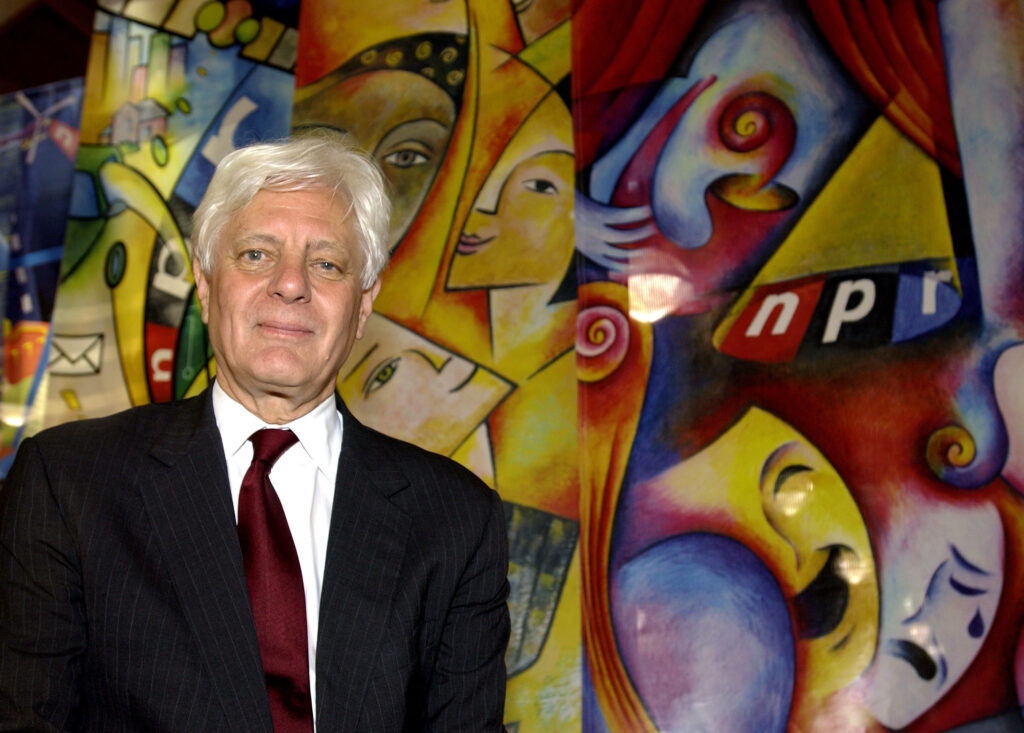
Kevin Klose, a longtime Washington Post journalist who reported from behind the Iron Curtain and later turned to public broadcasting, helping lead NPR into a new era of financial independence while serving for about a decade as the organization’s president and CEO, died Wednesday at a memory care center in D.C. He was 85.
The cause was complications from Alzheimer’s disease, said his wife, Deborah Ashford.
Beginning in 1967, Mr. Klose spent a quarter-century as a reporter and editor at The Post, including a stint covering Soviet leader Leonid Brezhnev as the paper’s bureau chief in Moscow. He was “a gentleman journalist of the old school, literate and worldly,” said University of Maryland journalism professor Mark Feldstein, and later drew on his newsroom experience while establishing himself as a top radio executive.
As president of Radio Free Europe/Radio Liberty in the 1990s, Mr. Klose oversaw the state-funded broadcaster’s relocation from Berlin to Prague — a post-Cold War move rife with symbolism for the organization, which had long broadcast news into communist and authoritarian societies.
Later, as president of NPR from 1998 to 2008, he played a central role in securing the largest donation in public broadcasting history. The 2003 gift, a bequest of more than $200 million from Joan B. Kroc, the widow of McDonald’s executive Ray Kroc, went into NPR’s endowment, transforming the organization’s fortunes while helping to accelerate its growth and insulate the broadcaster from the whims of Washington politicians.
The endowment has proved critical in recent years, softening the impact of President Donald Trump’s campaign to strip public media of federal funds. In May 2025, Trump signed an executive order instructing federal agencies to stop funding NPR and PBS because of a perceived left-wing bias in their news coverage. Congress later voted to rescind more than $1 billion in funding for the now-shuttered Corporation for Public Broadcasting, which steered federal money to public media outlets including NPR.
“The reason Trump couldn’t get NPR the way he wanted to was Mrs. Kroc’s money,” said Robert G. Kaiser, a former managing editor at The Post who preceded Mr. Klose in Moscow.
Antoine van Agtmael, who chaired the NPR Foundation while Mr. Klose was president of the broadcaster, called the Kroc bequest “the single most important event in the history of NPR, besides starting ‘All Things Considered’ and ‘Morning Edition,’” two of its flagship news programs.
“Without it,” he added, “we would have been toast.”
When Mr. Klose joined NPR, his record as a fundraiser was virtually nonexistent. But he proved to be a natural in courting Joan Kroc, who first sat down with Mr. Klose about a year before her death in 2003.
John Herrmann, another former NPR Foundation chair, recalled that after receiving an initial call from Kroc’s representatives, Mr. Klose met her multiple times, though he never expected a gift anywhere close to the seismic sum she ended up donating. When word arrived that NPR had been remembered in Kroc’s will, Mr. Klose gathered a small group of executives, who each guessed what the bequest might be. Estimates topped out around $50,000.
“Nobody sitting around that table had millions of dollars in their bet,” Herrmann said.
Margaret Low, an NPR vice president at the time, said Mr. Klose had won Kroc over through his repeated visits. To make the case for the organization, he had tasked Low with assembling an audiotape capturing NPR’s essence — without telling her what it was really for. The tape opened with journalist Robert Siegel reporting from the streets of New York on 9/11, and closed with a burst of on-air laughter from comedian Phyllis Diller.
“It expressed, in a quite beautiful way, the depth and range of what NPR does — from covering the most pressing issues of the moment to pure, unadulterated joy and delight and humanity,” Low recalled.
Part of the bequest was used to launch a fellowship program, named in Kroc’s honor, and to hire a cohort of beat reporters who deepened NPR’s newsgathering for years to come. “The list of people who have come to NPR thanks to the Kroc fellowships is breathtaking,” Low said. “It really fueled the future of NPR.”
By the time Mr. Klose stepped down as the organization’s CEO in 2006 (he stayed on as president for two more years), NPR’s annual budget had more than doubled, to $167 million. Its listenership had doubled as well, to some 26 million a week.
The third of six children, Kevin Klose was born in Toronto on Sept. 1, 1940. His father, Willard “Woody” Klose, was an American advertising executive, and his mother, the former Virginia Taylor, wrote for women’s magazines including McCall’s and Ladies’ Home Journal. Together, his parents collaborated in writing and producing radio shows, including a nationally broadcast call-in show, “Red Hook 31,” they hosted at their farmhouse in Red Hook, New York.
Mr. Klose’s career in journalism seemed almost preordained. His maternal grandfather, Frank W. Taylor, was the managing editor of the St. Louis Star-Times, and had made headlines in 1935 by nabbing a rare interview with Benito Mussolini at the Italian dictator’s residence in Rome.
But as Mr. Klose told it, he turned toward journalism by chance, after one of his college roommates at Harvard asked if he might be able to help his father with a favor: conducting an interview and typing up a manuscript for a book.
“I raised my hand, changing my life,” Mr. Klose recalled in a 2022 essay for his Harvard class reunion.
The interview was with Sala Pawlowicz, a Holocaust survivor from Poland who published an account of her wartime experience in the 1962 memoir “I Will Survive.” Mr. Klose, who graduated with an English degree that same year, was credited as her co-writer.
“I spent many hours interviewing Sala, reviewing my notes, spending many additional hours exploring in vivid memory every detail of the hideous dangers that threatened her and her family through the Holocaust years,” he recalled.
The experience informed his writing career, he added, “and opened my eyes to human suffering and the inspiring capacity of some to endure unimaginable atrocities and yet retain their humanity.”
After serving in the Navy, Mr. Klose launched his reporting career at the Poughkeepsie Journal in New York, covering city hall and county government.
At The Post, he edited local coverage out of Virginia, Maryland and Washington before becoming Moscow correspondent in 1977. Mr. Klose went on to interview Soviet dissidents, including Nobel Peace Prize winner Andrei Sakharov, during a four-year stint marked by suspicion, eavesdropping and occasional harassment.
“One is never secure from the prying, interfering presence of the state; and a conscientious correspondent can never forget that Soviet sources must always be protected,” he wrote in 1986, looking back on his years in Russia. “The safest, most comfortable place for routine conversations is often during walks through Moscow’s parks. Routine calls to Soviet friends are made from pay phones several blocks outside the compound. The names of Moscovite friends are never mentioned at home — by any family member or to any guest.”
Returning stateside, Mr. Klose published a book, “Russia and the Russians,” about his time overseas. He was later The Post’s Midwest bureau chief and deputy national editor, and worked as an assistant editor in the Outlook section before leaving in 1992 to join Radio Free Europe/Radio Liberty.
After leaving NPR, Mr. Klose had a second stint at the helm of RFE/RL, leading the broadcaster from 2013 to 2014. He also served for several years as the dean of the University of Maryland’s Philip Merrill College of Journalism, where he said he aimed to help students prepare for a media career at a time when technology was transforming the industry, but when journalism’s fundamental tenets remained unchanged.
“There’s still going to be, and always will be, a need for edited, fact-checked, archived, verifiable journalism,” he told The Post in 2009.
His first marriage, to Eliza Kellogg, ended in divorce. In 2013, he married his longtime partner Deborah Ashford, now a senior counsel emeritus at the law firm Hogan Lovells.
In addition to his wife, survivors include three children from his first marriage, Nina, Brennan and Chandler Klose; four stepdaughters, Jesseca, Sarah, Lilli and Rebecca Salky; two brothers and two sisters; 13 grandchildren; and four great-grandchildren.
Reflecting on his career in his 2022 Harvard essay, Mr. Klose returned to what he considered the profound stakes of his work. “Our democracy is at risk and fact-based journalism has never been more important,” he wrote. “Each of us must do all we can to preserve both good journalism and our sacred democracy.”
The post Kevin Klose, who reported behind the Iron Curtain and led NPR, dies at 85 appeared first on Washington Post.