The murder is the first shock in “The Adding Machine,” Elmer L. Rice’s enduringly weird, stubbornly resonant play from 1923. Its central figure — which is absolutely not to say hero — is the timid bookkeeper Mr. Zero, who fantasizes about a finer existence.
After 25 tedious years in the same job, he imagines himself being promoted at last. He daydreams, too, of building a life with his work mate Daisy Devore, if only Mrs. Zero would set him free by dropping dead.
But when his cigar-chomping employer abruptly fires him to make way for an adding machine, Mr. Zero’s reveries vaporize along with his self-worth. In his rage, he becomes a man of action.
“I killed the boss this afternoon,” he tells Mrs. Zero that evening, and the police take him away.
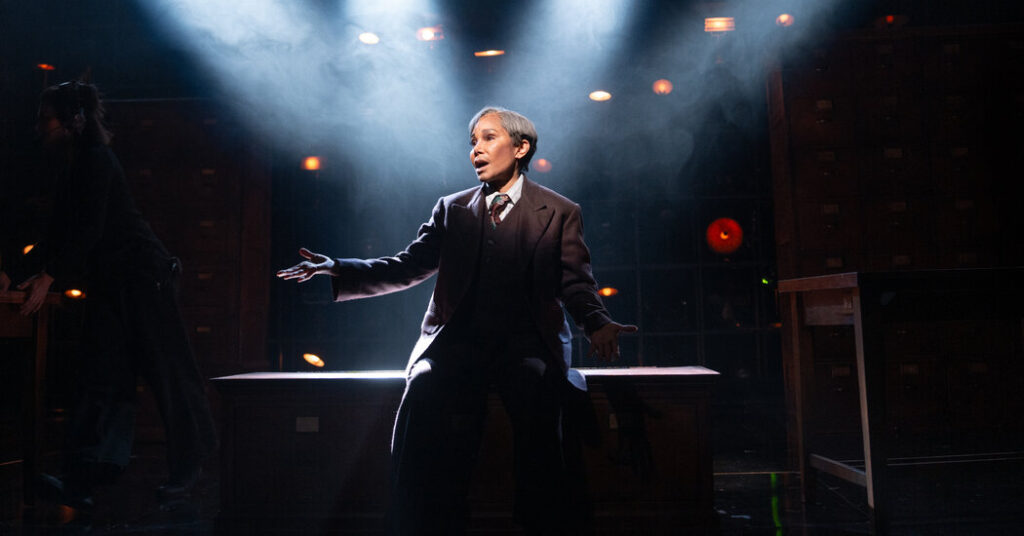
The happy news about Scott Elliott’s handsome yet under-realized revival of “The Adding Machine,” for the New Group, is what a delight Daphne Rubin-Vega is to watch as Mr. Zero. With his three-piece suit (by Catherine Zuber) and his tough-guy New York accent, he is both physically and figuratively a little man. He feels keenly all the injustices done to him but has a swaggering, self-absolving tendency not to feel terribly deeply on anyone else’s behalf.
He has a lot of company in that. Rice’s expressionist drama is known for being a tale of man vs. machine in an age of merciless efficiency, but inhumanity in a broader sense is its true core subject.
As the play follows Mr. Zero into the courtroom, the prison, the execution chamber (another moment of shock) and the afterlife (ditto), he is as adept as anyone at regarding others as mere ciphers — especially if, by virtue of gender or race, he considers them beneath him. It all feels a bit like a modern morality play: an experimental descendant of “Everyman” and “Doctor Faustus,” four or five centuries removed.
On a set by Derek McLane that makes luxurious use of the capacious stage at the Theater at St. Clement’s, the New Group’s new home in the Hell’s Kitchen neighborhood of Manhattan, this is an audacious and shaky swing at a classic. The cast is enticing, with Jennifer Tilly as Mrs. Zero, Sarita Choudhury as Daisy and a very game Michael Cyril Creighton as the narrator and all the other characters. But the production means to be funnier and more forceful. Wanting to brighten up the bleakness, it never finds its tone.
Thomas Bradshaw (“The Seagull/Woodstock, NY”) has revised Rice’s text, shading it with luridness and overexplication. His script also seems less simpatico with the female characters than Rice’s is.
The opening scene finds Mrs. Zero sitting up in bed beside Mr. Zero, who tries futilely to ignore the stream of chatter she’s spewing in her baby-girl voice. Bradshaw’s edit of the monologue tosses out her reflections on the unending drudgery of housekeeping (“There’s no five-thirty for me. … I don’t get no vacations neither”) but adds a discussion of her husband’s genitalia.
In a plot strand about a single woman who used to live in the Zeros’ building and attracted Mr. Zero’s voyeuristic gaze, Rice’s script suggests she is a “hello girl” — a telephone switchboard operator. Bradshaw makes her unambiguously a prostitute.
He writes in a program note that his aim is “to provide clarity for a modern audience while working to maintain the original’s style, tone, and time period.” Yet his interventions frequently work against that.
I wish it were otherwise. “The Adding Machine” has enormous potential to reverberate right now, when dehumanization is pervasive, and in so many noxious guises — like the job-replacing adoption of A.I., and the othering of anyone who can be portrayed as the enemy. (Downtown theatergoers might remember Joshua Schmidt and Jason Loewith’s musical adaptation of the play, thrillingly directed by David Cromer in 2008.)
Nonetheless, it is glorious to see Rubin-Vega, forever Broadway’s original Mimi in “Rent,” get to really bite into a role. And certainly this production has its moments — as when Mr. and Mrs. Zero meet for the final time before his execution, and when Mr. Zero and Daisy, reunited in the Elysian fields after death, dance to Radiohead’s “Creep” with tender, comic abandon: he ineptly, she gracefully. But the whole does not cohere.
Mr. Zero longs for do-overs, only to mess up anew when given the chance. Theater is all about do-overs, night after night, revival after revival. That this one doesn’t hit its target is simply human.
The Adding Machine Through May 17 at the Theater at St. Clement’s, Manhattan; thenewgroup.org. Running time: 2 hours 15 minutes.
The post ‘The Adding Machine’ Review: A Man Is Made Redundant appeared first on New York Times.